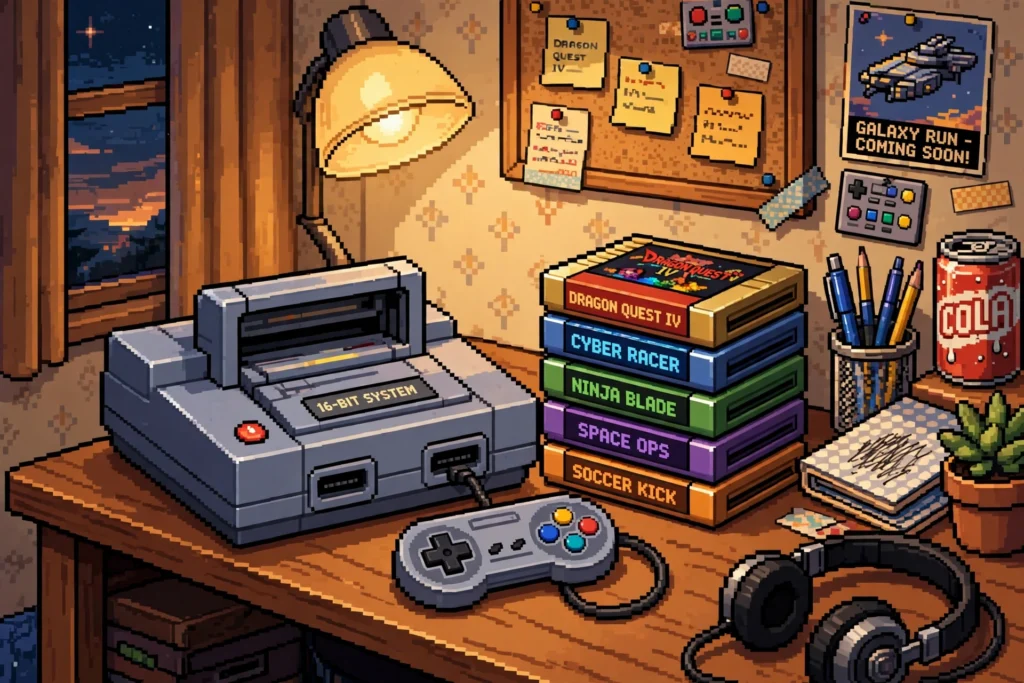
Thirty-eight years after the Mega Drive launched, the console is having the best year of its life — and almost none of it is coming from Sega. The homebrew scene for the Genesis and Mega Drive is releasing more games, better tools, and bolder projects than at any point in the system’s history. New cartridges, new engines, new genres: the little black box that wouldn’t die is thriving.
The tools grew up
Homebrew on the Mega Drive used to mean assembly language and monk-like patience. That era is over. Modern toolchains, C compilers targeting the 68000, and community-built libraries have lowered the barrier dramatically. Second-generation dev tools now handle the gnarly parts — sprite multiplexing, sound driver integration, memory management — leaving creators free to think about game design instead of register allocation.
The result is a Cambrian explosion. Where the scene once produced a handful of tech demos a year, 2026 has already seen full-length platformers, a surprisingly competent racing game, a roguelike, and at least two RPGs with real ambition. The quality bar has moved from “impressive for homebrew” to just plain impressive.
Physical releases, real cartridges
What’s changed the economics is the physical market. Boutique publishers are pressing new Mega Drive cartridges — proper PCBs, proper shells, manuals, boxes — and they sell. Limited runs of a few hundred copies routinely sell out, which means a bedroom developer can now fund months of work with a single release. Some titles have gone back for second and third printings, a sentence that would have been science fiction a decade ago.
The Everdrive and flash-cart crowd benefits too: homebrew ROMs are free to download, and the best of them spread by word of mouth through the same channels as the classics. A kid discovering the Mega Drive in 2026 gets the entire original library plus a shelf of new games that didn’t exist when the console was “alive.”
Why the Mega Drive, specifically?
Every retro platform has a homebrew scene, but the Mega Drive’s is special. The hardware hits a sweet spot: powerful enough for ambitious games, constrained enough that a small team can master it. The 68000 is famously friendly to program. The Yamaha FM chip is a playground. And the system’s identity — fast, brash, a little rebellious — attracts developers who want to make that kind of game.
There’s also the audience. Mega Drive fans are evangelists. They buy cartridges, they stream new releases, they show up to expos with original hardware. A homebrew developer on this platform doesn’t release into the void; they release into a community that treats every new cart like a holiday.
The pipeline keeps filling
What makes this a year rather than a moment is the pipeline. The tools keep improving, the developers keep arriving, and each successful release funds the next one. Demo competitions still unearth new talent. Ports of modern indie concepts keep landing on 30-year-old hardware, each one a little flex that says: look what this thing can still do.
The Mega Drive’s homebrew scene is releasing more games, better tools, and bolder projects than at any point in the system’s history. The little black box that wouldn’t die is thriving.
The Mega Drive was discontinued in 1997. In 2026 it’s getting some of the best games of its life. If that’s not worth celebrating, what is?