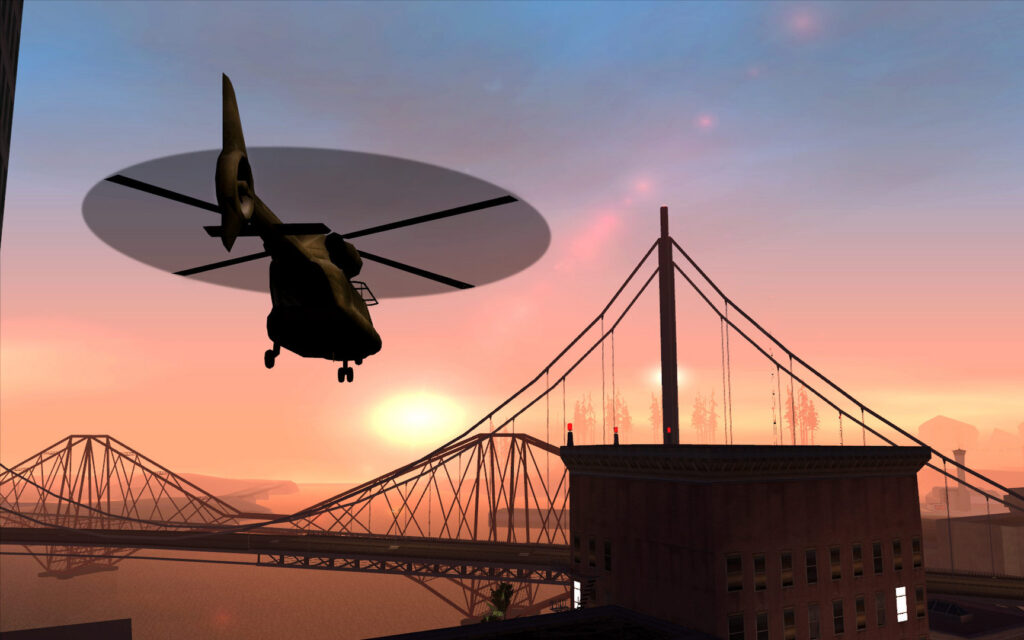
PLAYSTATION 2 · ACTION-ADVENTURE · RETROSPECTIVE REVIEW
Developer: Rockstar North · Publisher: Rockstar Games · Released: October 26, 2004 (PS2) · Genre: Action-Adventure
Twenty-two years on, CJ’s homecoming is still the biggest life the PS2 ever hosted.
Twenty-two years ago today, Rockstar North didn’t just release a sequel — it released a state. Grand Theft Auto: San Andreas landed on the PlayStation 2 on October 26, 2004, and for months it didn’t so much sit in the nation’s disc trays as move in and redecorate. It became the best-selling game on the best-selling console ever made, a genuine cultural event — big enough to make the evening news twice, once for its success and once for the scandal buried in its code.
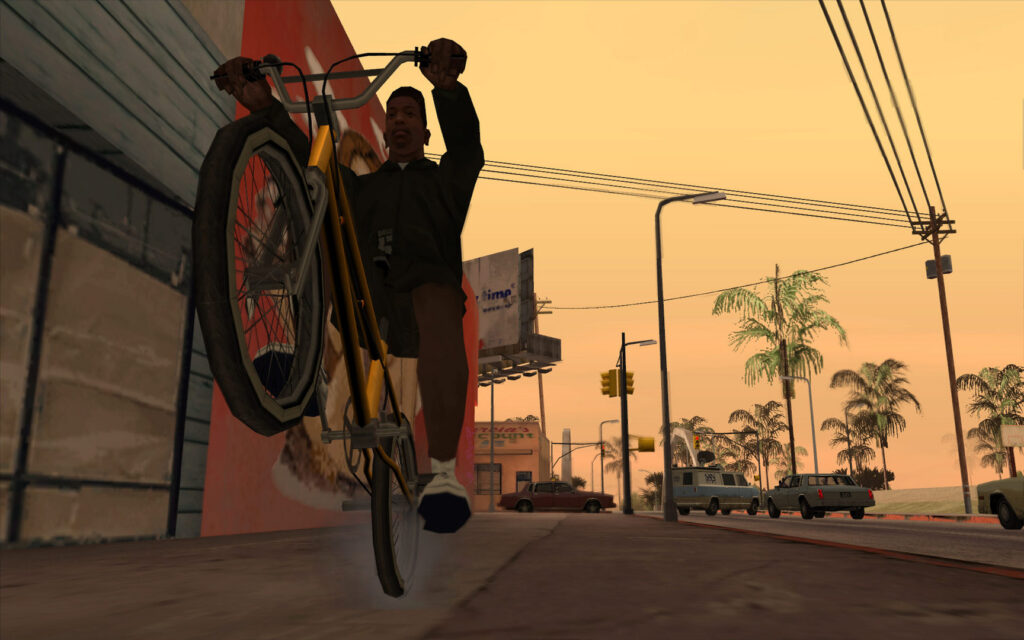
The premise is a homecoming nobody wanted. Carl “CJ” Johnson has spent five years exiled in Liberty City when the call comes: his mother, Beverly, has been killed in a drive-by. He flies home to Los Santos to find Grove Street in ruins — the Families splintered into warring sets, crack flooding the neighbourhood, his brother Sweet blaming him for every bit of it. CJ is barely off the plane before C.R.A.S.H. officers Tenpenny and Pulaski lift him, frame him for a fellow officer’s murder, and dump him in Ballas territory with nothing but a BMX. The game hands you a bicycle and a funeral, and asks you to rebuild a life. Everything in this review unfolds from that one curb in Ganton.
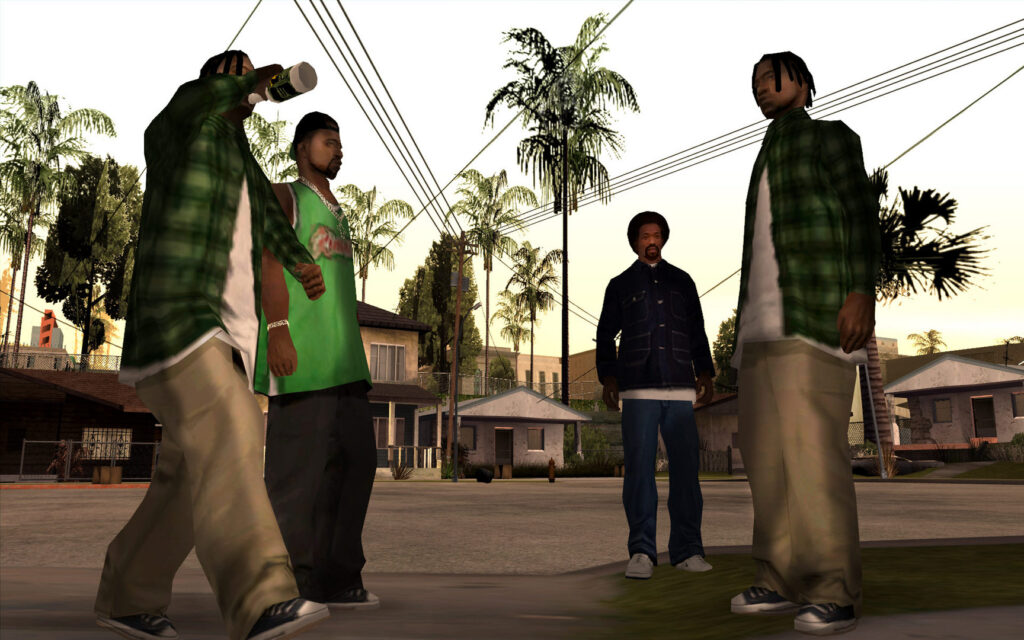
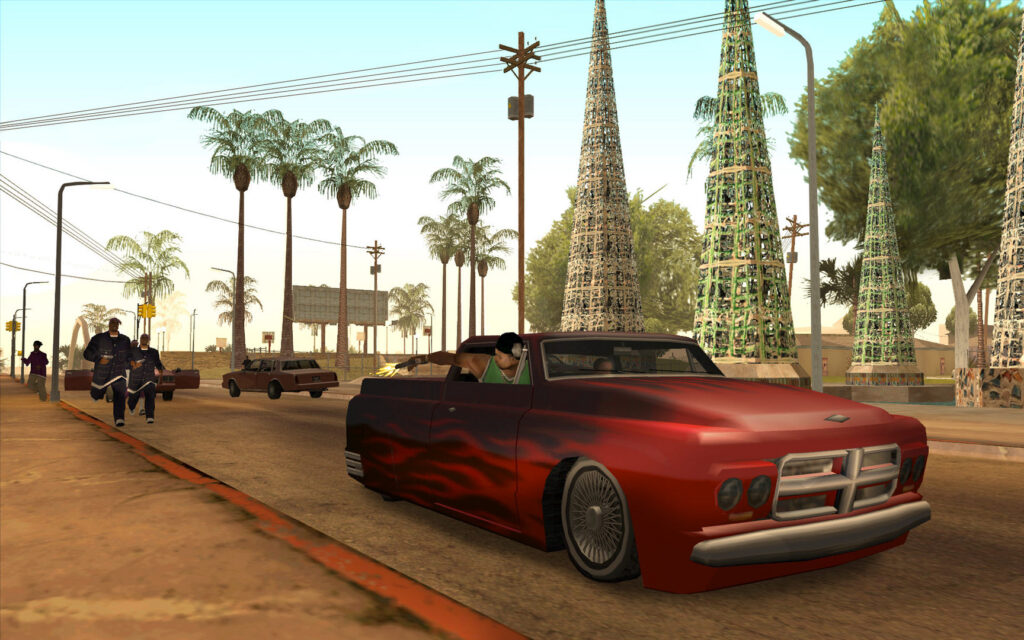
Grove Street, Home
What follows is the most human story Rockstar had ever told — and, two decades of escalating spectacle later, arguably still is. Beneath the gang colours this is a family drama: Sweet’s stubborn, self-destructive pride; Big Smoke’s appetite in every sense of the word; Ryder’s twitchy paranoia; Cesar Vialpando, the rival gangbanger across the tracks who turns out to be the most decent man in the state. The script drinks deeply from the early-’90s Los Angeles cinema of Boyz n the Hood, Menace II Society and Colors, then staffs itself like a dare. Samuel L. Jackson plays Tenpenny as pure charm stretched over menace. Chris Penn is his weaselly partner Pulaski. Real Compton rapper MC Eiht voices Ryder; Faizon Love is Sweet; Clifton Powell’s warm bass rumble makes Big Smoke’s eventual betrayal genuinely sting. And at the centre, rapper Young Maylay gives CJ something no previous GTA lead ever had — a conscience that talks back. CJ protests, jokes, apologises and complains his way through the madness, nowhere more famously than in “Wrong Side of the Tracks,” where Big Smoke’s immortal scolding — all you had to do was follow the train — turned a failed mission into gaming folklore.
The arc is a picaresque that keeps coming home. Exiled to the countryside, CJ rebuilds from nothing: a struggling San Fierro garage business, black-ops errands in the desert for the icily amused Toreno (James Woods, clearly having the time of his life), a Las Venturas casino heist planned like a caper film. Yet the story’s gravity never leaves Grove Street, and the final act — a city tearing itself apart in riots that deliberately echo Los Angeles in 1992 — brings CJ back to settle accounts on the same few streets where he started, older and sadder and still standing up. Games this size are not supposed to have an emotional centre of gravity. This one never loses it.
Three Cities, One State of Mind
Then there is the sheer geography. San Andreas strings three full cities — Los Santos (Los Angeles), San Fierro (San Francisco) and Las Venturas (Las Vegas) — along highways that run through redwood forest, wheat fields, twelve small towns, a desert with its own Area 51-style no-fly zone, and a mountain, Mount Chiliad, tall enough to skydive off. Roughly 36 square kilometres, around five times the footprint of Vice City — streamed invisibly off the disc on a console with 32 megabytes of RAM, with no loading screens between you and anywhere. In 2004 it felt like a magic trick, and nobody else was close.
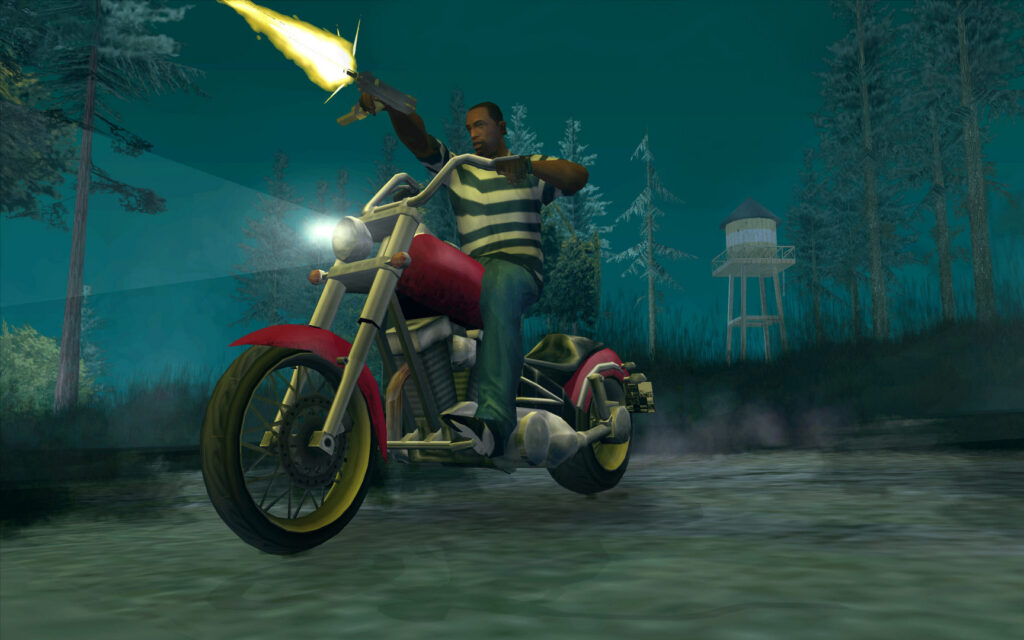
Each city speaks its own dialect. Los Santos is all golden smog and palm silhouettes; San Fierro is fog, hills and tram bells; Las Venturas is neon that never sleeps. But the real revelation was everything in between. San Andreas trusted emptiness: long dawn drives through pine forest with no objective but the horizon, a whole population of players who learned to love the commute. And it kept handing you new ways to cross it — bicycles, lowriders, freight trains, a jetpack liberated from a military base, airliners you could simply walk up and steal. Most miraculous of all, in 2004: CJ could swim. Vice City’s most lethal substance, water, finally defeated.
Fat, Muscle, Respect
Quietly, San Andreas bolted a role-playing game onto GTA’s chassis. CJ’s body is a set of statistics you can see: feed him at Cluckin’ Bell, Burger Shot or the Well Stacked Pizza Co. and he gains fat — sprint less, jump lower, take abuse from NPCs — while the gym burns it into muscle. Stamina, lung capacity, driving, flying and a separate skill for nearly every weapon class all improve simply by being used, the great RPG loop smuggled into a crime saga years before it became industry standard. Appearance is a system too: clothes, haircuts and tattoos feed the Respect and Sex Appeal meters, girlfriends (six of them, each with tastes and tempers) judge you on both, and the game reads CJ’s body back to him through the mouths of strangers.
Over it all sits the turf war — a strategy game hiding in the map screen. Provoke a rival gang, survive three waves, and the block turns Grove green; lose it, and you’ll be dragged out of a casino at 3 a.m. to defend it. It matters, too: you cannot trigger the endgame until you’ve reclaimed enough of the city. Layer on the schools — driving in Doherty, boating, biking, and a flight school whose circling-airstrip licence test still visits veteran players in their dreams — plus tags, snapshots, horseshoes and oysters to collect, and San Andreas stops feeling like a game with side content. It feels like a life with a main quest in it.
San Andreas didn’t just hand you a city. It handed you a body, an appetite and a reputation — and made you maintain all three.
Eleven Stations, One Perfect Dial
The soundtrack remains the deepest licensed jukebox of its generation — eleven stations, and a masterclass in casting. Radio Los Santos carries West Coast hip-hop royalty (2Pac, N.W.A, Dr. Dre, Ice Cube) under real LA DJ Julio G. Playback FM is golden-age East Coast — Public Enemy, Big Daddy Kane, Eric B. & Rakim — hosted by Chuck D himself. K-DST’s classic rock comes presented by Tommy “The Nightmare” Smith, voiced by an uncredited-but-unmistakable Axl Rose. K-Rose spins outlaw country — Willie Nelson, Merle Haggard, Hank Williams — while George Clinton captains Bounce FM’s funk mothership, Radio X brings the alternative noise (Rage Against the Machine, Soundgarden, Jane’s Addiction), and Michael Bivins fronts the new jack swing of CSR 103.9. There is dub, house, metal and the beautiful nonsense of WCTR talk radio besides.
More than tracklists, the stations are place. K-Rose fading in as the city gives way to farmland is a mood no algorithm has ever shuffled into existence, and a generation of players received a real musical education at forty miles an hour in a beat-up Walton — country, funk and golden-age rap absorbed by osmosis, one county line at a time.
Hot Coffee: The Scandal in the Code
It would be dishonest to celebrate this game without the other reason it made the news. In June 2005, Dutch modder Patrick Wildenborg released “Hot Coffee,” a modification for the PC version that unlocked a crude, unfinished sex minigame Rockstar had abandoned mid-development but left, dormant, on the disc. Within weeks the story had escaped the hobbyist press entirely. On July 20, 2005, the ESRB re-rated San Andreas Adults Only — a commercial death sentence. GameStop, Walmart, Target and other major chains pulled it from shelves; Rockstar halted production and rushed out a cleaned edition with the content removed and the M rating restored. Take-Two absorbed tens of millions of dollars in costs and later settled both an FTC complaint and a consumer class action. Politicians, Senator Hillary Clinton most prominently, demanded federal scrutiny, and the ESRB tightened its rules so publishers must now disclose content locked away on the disc.
Told straight, the facts are awkward for everyone: the minigame was cut content no player was ever meant to reach — but it shipped, and the industry has treated dormant code as live ammunition ever since. The saga also proved, perversely, how much the game mattered. Nobody convenes Senate outrage over a title the culture has ignored.
Playing It in 2026
Twenty-two years on you have choices, each with a flavour. The original PS2 disc is the authentic artefact — fog, draw distance and all, best served on a CRT with the evening free. The original PC release, nursed by community essentials like SilentPatch and the widescreen fixes, is the purist’s route on modern hardware. The 2013 mobile port remains surprisingly faithful. And then there is 2021’s Definitive Edition, where honesty is required: it launched in a sorry state, with redrawn character models fans loathed, rain like television static, fog lifted so far you could see the whole state from a jet, and bugs to spare. Rockstar apologised and kept patching, and the “classic lighting” update of November 2024 finally restored the original skies and mood — it is now a respectable convenience version. But a handful of songs never survived the licensing gauntlet, and it will never quite be the disc that changed everything. First-timers will be perfectly happy there; the faithful know where home is.
Some games are time capsules. San Andreas is a hometown. Its template — go anywhere, become someone, maintain the body and the reputation, let the radio narrate your life — is the one open worlds have been chasing ever since, and its 17.33 million PS2 copies made it the best-selling game on the most successful console in history. Twenty-two years on, the streets have aged, the fog has thinned, and the Families still need you. Grove Street recognises you the moment you roll in. It always will.
Score: 10/10. The PS2’s defining game — a state-sized homecoming with a heartbeat, the greatest radio dial in the medium, and systems the industry is still chasing. They don’t make them this big, this warm, or this bold anymore.
📅 This game appears in This Day in Gaming History — October 26 →