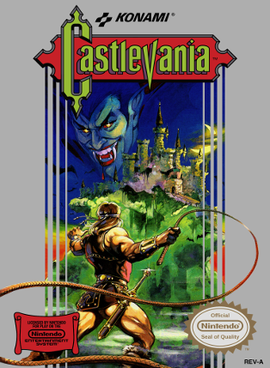
Ask a Castlevania veteran what they remember and you’ll get the liturgy: the music, the whip, Dracula’s second form. Then their voice drops, and they say the word like a diagnosis. The stairs. Not a boss. Not a trap room. Staircases — the plainest piece of architecture in the game — are the thing Castlevania players have feared for forty years, and fear is exactly the right word. A staircase in Castlevania is not how you get somewhere. It’s a boss fight the game disguises as furniture.
How a Staircase Fights You
To understand the terror you have to understand the contract, because Simon Belmont does not climb stairs the way other platform heroes do. Walk him to the foot of a staircase and press up, and Simon doesn’t just go upstairs — he commits. He locks onto the stair’s path and walks it at a stately, unhurried pace, and for the duration of that climb the rules of the game quietly change underneath you.
There is no jumping on stairs. There is no leaping off them, no dropping through them, no bailing out when the climb goes wrong. Your whip still works — Simon can crack it from a step, and you’ll need to — but attacking roots you in place while the animation plays out, on a diagonal walkway with death on both sides. Your sub-weapons still work too, if you’ve kept the hearts for them. Everything else in your moveset, every reflex forty hours of platformers taught you, is gone. The game strips your verbs down to a single one — ascend — and then it starts the clock.
The cruellest clause is the knockback. Get clipped anywhere in Castlevania and Simon is flung backwards; it’s the series’ signature punishment. Get clipped on a staircase, over one of the pits the designers so lovingly placed beneath them, and the fling becomes a fall. One touch doesn’t cost you health. It costs you the entire climb, and frequently your life, and there is no checkpoint waiting at the top to make it fair.
The Perfect Accomplice
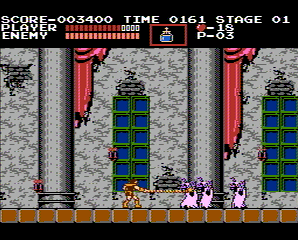
Every great trap needs a trigger, and the staircase’s is the Medusa Head — arguably the best-designed ordinary enemy of the 8-bit era, precisely because it doesn’t care about you. It doesn’t chase, aim, or react. It simply flies across the screen in a fixed sine wave, spawning at regular intervals from whichever edge you’re heading toward, forever. You cannot clear the air and proceed in safety. You can only read the wave, count the rhythm, and step into the gap.
On flat ground, that’s a fair fight. On a staircase, where you can’t sidestep, can’t retreat faster than a funeral procession, and can’t afford a single touch, the Medusa Head’s indifference turns surgical. The two great climbs of the original game are built on this pairing. The long ascent to Death’s chamber — the staircase every player from 1987 onwards can see with their eyes closed — runs Medusa Heads across your path the whole way up, with the Grim Reaper himself waiting at the top as a reward for your composure. And the clock tower climb near the end, gears turning beneath you, throws the same sine waves across a staircase suspended over the castle’s machinery, with Dracula at the summit. The stairs are never the whole obstacle. They’re the part of the obstacle that removes your options while the rest of it attacks.
The Medusa Heads have a support act, too: the flea men, Castlevania’s hopping maniacs, whose erratic arcs are an insult added to the injury of the climb. A Medusa Head can be counted. A flea man bounces like a dropped coin — and the designers, with a cruelty that borders on the personal, station them around the castle’s stairwells, where your one available verb (ascend) meets their one available verb (be somewhere unpredictable). Between the sine wave you can read and the bounce you can’t, the staircase becomes a negotiation between mathematics and panic.
That’s the design insight, and it’s why the fear is so specific. The staircase doesn’t threaten you. It disarms you, publicly, in front of the things that do.
A Field Guide to the Worst Flights
The game teaches you the lesson gently before it examines you on it. The first staircases of the castle entrance are merciful things — short flights over solid floors, where a knockback costs you a heart’s worth of dignity and nothing more. They’re a tutorial written in architecture: this is how stairs work here, this is the pace, there is no other pace. The game wants you fluent before it’s allowed to be cruel.
The examination comes in two sittings. The first is the approach to Death, high in the castle’s upper reaches, where the climb lengthens, the floor falls away, and the Medusa Heads begin their patrol in earnest — with the series’ most punishing boss of the early game waiting at the top to grade you. Failing that climb doesn’t just send you back down; it sends you back down tired, with your health and hearts spent, to try the whole ascent again. The second sitting is the finale’s clock tower, where the staircase winds up through the castle’s gearwork and the sine waves cross at their tightest intervals. By then the game has stopped teaching and started testing everything at once — nerve, rhythm, resource management, memory.
What’s remarkable, playing them now, is how modern the cruelty feels. There’s no randomness to blame, no cheap shot that couldn’t have been read. The wave is fixed. The pace is fixed. The only variable on those stairs is you, and the game knows it, and so — halfway up, hearts pounding, committed — do you.
The Series Learns Mercy
Konami clearly knew what it had built, because the rest of the series reads as a forty-year negotiation with the staircase. Castlevania III (1989) kept the cruel climbs — its clock tower is a set-piece in its own right — but handed you Grant Danasty, a pirate who could climb walls and ceilings outright, as if the designers were smuggling a skeleton key into their own prison. Having partners to swap between didn’t soften the stairs so much as route around them.
Super Castlevania IV (1991) staged the real reform. Simon could now whip in eight directions, answering Medusa Heads above and below the diagonal, and — quietly revolutionary — he could leap through the air and land on a staircase mid-jump, instead of petitioning for entry at the bottom. The commitment remained, but it had escape hatches, and the fear thinned accordingly. By Symphony of the Night (1997) the negotiation was over: Alucard simply walks up stairs like a man in his own house, in any direction, at any speed, and the staircase completes its journey from boss fight to wallpaper.
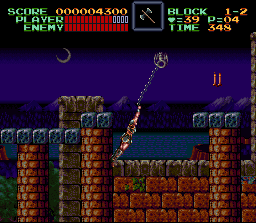
Nobody calls Symphony’s stairs terrifying. That’s not a criticism of Symphony, which is a masterpiece of a different kind; it’s the proof of the thesis. The terror was never in the steps. It was in the commitment — in a game asking you to surrender your options and keep climbing anyway, at walking pace, into a sine wave.
Every Ladder Since
Once you see the principle, you see it everywhere, because Castlevania’s staircases wrote a design language the medium still speaks: take away the player’s verbs, stretch the moment out, and let anticipation do the damage that enemies can’t. The interminable ladder climb in Metal Gear Solid 3 — two minutes of Snake ascending in silence while the theme song blooms — is a Castlevania staircase with the violence replaced by dread. The bridge runs of Shadow of the Colossus, the long defenceless walks modern horror games build their best scares around, the forced slow-walk through a corridor you know is loaded: all of them are the same trick, the controlled removal of agency as a tension device. Konami’s designers arrived at it in 1986 not with a cutscene budget or a physics engine, but with a flight of steps and a flying head.
And the originals remain the purest version of the idea, because they never blink. No checkpoint at the top of the climb. No checkpoint anywhere near the climb. You read the wave, you pick your moment, you commit — and if your nerve or your arithmetic fails you on the second-to-last step, the game hands you back the first one without apology. That cruelty is load-bearing. It’s why reaching the top of those stairs feels like something you did, rather than something you watched.
Castlevania turns forty this year, and its staircases have outlived every attempt to fix them. The scariest thing in a game was never the monster waiting at the top of the stairs. It’s the moment the game looks at your full moveset, takes almost all of it away — and asks you to keep climbing anyway.
Keep reading: Castlevania: Belmont’s Curse review · the NES system archive
2 comments