EVERCADE · HARDWARE
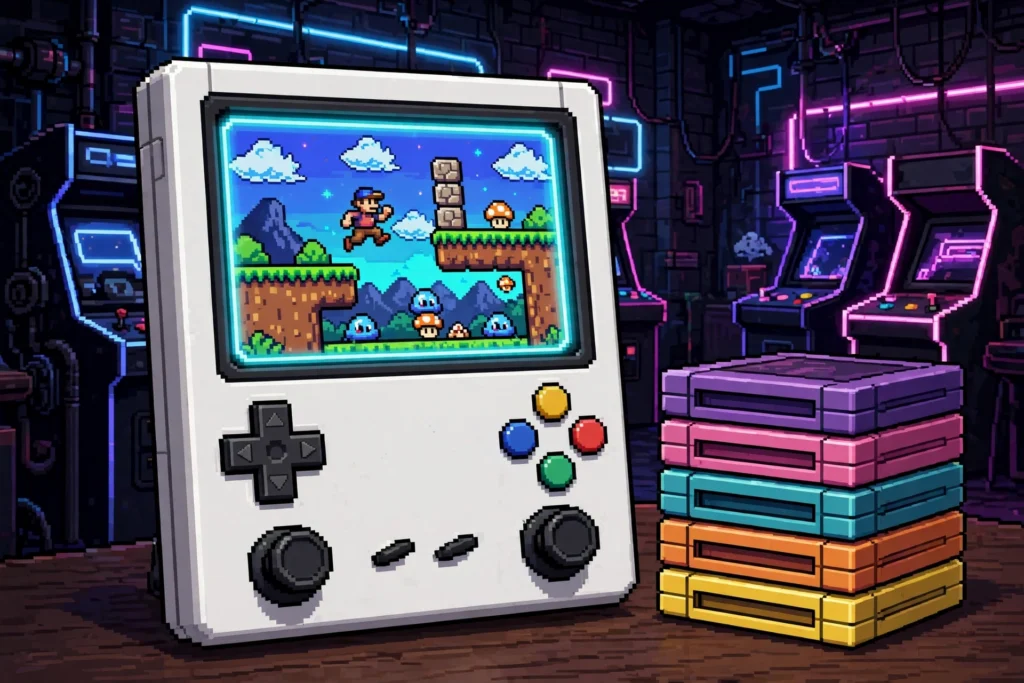
On October 30, Blaze Entertainment ships its biggest bet yet: the Evercade Nexus, a $199 handheld that plays games on physical cartridges in an industry that has spent a decade trying to kill physical media. It’s chunky, it’s expensive, and — if you read the reviews from the press previews this month — it’s weirdly joyful. I’m not ready to call it a smart product. But I think it’s an important one.
What the Nexus actually is
The specs are straightforward: a 5.89-inch IPS screen, dual analog sticks (a first for Evercade portables), and a $199/£169 price tag that puts it squarely in premium-handheld territory. The launch lineup trick is the Banjo-Kazooie Double Pack — Banjo-Kazooie and Banjo-Tooie rebuilt as native Evercade releases with higher-resolution rendering, quality-of-life options, and an unlocked 60fps mode. These aren’t ROM dumps; Blaze and Rare reworked the games for the hardware. That’s the model: licensed, physical, native ports you slot into a cartridge shell and actually own.
The day before the Nexus ships, the DOOM Collection lands: nine pieces of officially licensed DOOM content — DOOM, DOOM II, both Master Levels-era expansions, SIGIL and SIGIL II — as native Evercade ports on a single red-shelled cartridge, with gameplay modifiers like Turbo Monsters and Vampire Mode. DOOM on a cartridge, in 2026, bought once and owned forever. There’s something deeply satisfying about that sentence.
Why this might work
Evercade’s cartridge model looks like a gimmick until you remember what happened to digital storefronts. The Wii Shop died. The PS3 and Vita stores nearly did. Games you “bought” vanish when licensing expires or servers go dark. An Evercade cart is a little gray promise that none of that applies: the game is on the plastic, it works offline, and it works on every Evercade device you own. In 2026, that’s not nostalgia — that’s a feature.
There’s also the collecting dimension, which the retro crowd understands better than any analyst. Cartridges are shelf objects. They have resale value, display value, and the specific dopamine of a click when they seat. Evercade’s monthly free “Game of the Month” downloads — October’s is the NES platformer FleaRun! — funnel indie and homebrew work toward a physical compilation each year. That’s a pipeline from bedroom coder to store shelf, and almost nobody else in gaming offers it.
Why it might not
Two hundred dollars is real money, and then the carts cost $20–40 each. The Nexus is competing with cheap emulation handhelds that play everything for a fraction of the price, and its 3D support — the thing the dual sticks and bigger screen are really for — is still young. The reviews are positive but the word “chunky” keeps appearing, and “premium” is a brave word to apply to retro hardware.
The bigger point
I’ve watched the retro scene split into two philosophies: the emulator crowd (every game, nearly free, in your pocket) and the ownership crowd (fewer games, but yours, on real media). The Nexus is the ownership crowd’s flagship. If it sells — and early preview sentiment plus the sold-out DOOM-edition bundle suggest it might — it proves there’s a durable market for retro games as physical goods, not rented licenses. That matters whether or not you buy one.
In 2026, a cartridge you own outright isn’t nostalgia — it’s a feature.
The Nexus won’t outsell anything from Nintendo. That’s not the game being played. The game is: can licensed retro hardware grow past the niche it built? On October 30, we start finding out.