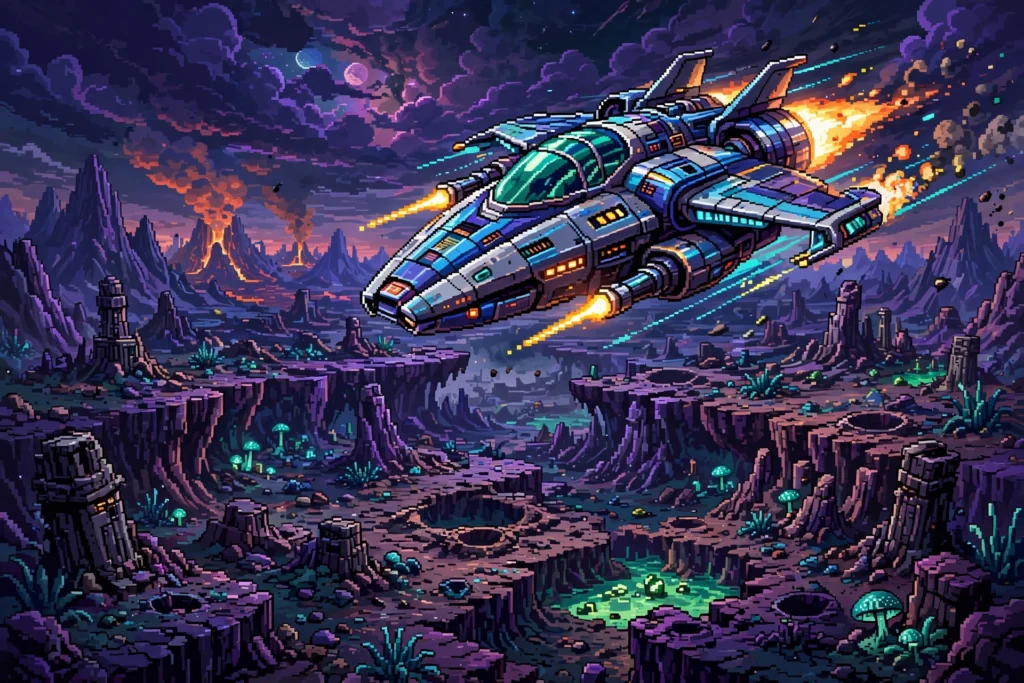
GENESIS · SHMUP · REPLAY REVIEW
The Genesis was the shoot-’em-up console — nobody disputes this — and Thunder Force IV is its crown jewel. Technosoft’s 1992 masterpiece takes everything the hardware can do and spends it all on speed, spectacle, and some of the most gloriously excessive level design the 16-bit era ever produced. Revisiting it now, the question isn’t whether it holds up. It’s whether anything since has matched its sheer velocity.
Speed as a design philosophy
Thunder Force IV moves. The opening stage scrolls horizontally, then the game casually reveals it can scroll vertically too, and from there it’s a blur of free-directional stages, breakneck set pieces, and backgrounds that throw the Genesis’s parallax hardware around like it owes them money. The sense of momentum is the game’s whole identity — you’re not navigating levels so much as surviving them at pace.
The weapon system is the series’ signature: the twin-shot and back-shot, swappable on the fly, plus the shield and the devastating Thunder Sword. Learning when to switch — twin for corridors, back-shot for ambushes — is the core skill, and mastering it feels like learning to drive stick. Clunky until it clicks, then second nature.
The bosses
Let’s talk about the bosses, because Thunder Force IV’s are absurd in the best way. Multi-stage monstrosities that fill the screen, transform mid-fight, and demand you learn their rhythms or die learning. The difficulty is real but honest — every death teaches you something, and the game gives you the tools to apply the lesson immediately.
The soundtrack
Genesis sound gets a bad rap from people who only heard it through bad speakers, but Thunder Force IV is the counterargument in full. The soundtrack is aggressive, melodic, and mixed to cut through the chaos — it drives the action instead of decorating it. This is FM synthesis with intent, and it holds up as pure listening, not just nostalgia.
How it plays today
On original hardware, it’s a showcase. On modern displays via a good scaler or FPGA, it’s arguably better — the fast scrolling that once blurred on CRTs is now razor sharp, and the parallax layering reads beautifully. Emulation handles it well too, though the game deserves a real controller and a low-latency setup; this is not a game to play with input lag.
What shows its age
The difficulty spikes are genuine — a couple of late stages cross from challenging into punishing, and the checkpoint system can feel cruel by modern standards. The story is pure 1992 sci-fi wallpaper. Neither matters much when the action is this good, but newcomers should know what they’re signing up for.
The sense of momentum is the game’s whole identity — you’re not navigating levels so much as surviving them at pace.
Score: 9.0/10. The definitive Genesis shooter and a high-water mark for the entire genre. If you own the hardware, this is essential. If you don’t, it’s worth acquiring the hardware for.