In 1983, Activision’s Dan Kitchen started a Keystone Kapers sequel on a runaway train — then the crash, and other priorities, left it in a drawer for 35 years. This is the story of how that unfinished prototype came back: first as a curiosity shown to the public in 2018, and finally, in November 2024, as Casey’s Gold — Kitchen’s first new Atari 2600 game in over four decades.
When we first covered this story in August 2018, it sounded like a familiar piece of prototype archaeology: a lost game surfaces, its creator announces a remake, everyone nods and moves on. What nobody could have known was that this particular lost game was starting a six-year journey to an actual cartridge — and that the 1983 original would end up being handed to an archivist for posterity in the summer of 2026. Of all the unfinished Atari 2600 games ever pulled out of storage, Keystone Cannonball may have the happiest ending.
A sequel derailed
The story starts in 1983, at Activision, in the brief golden window before the North American video game crash. Dan Kitchen had just finished Crackpots, and he had trains on his mind — as Kitchen told the Atari Compendium, he is a model railroader, and his next project began as a train game. Then his brother Garry’s Keystone Kapers became a hit, and the train acquired passengers: Officer Kelly, the flatfoot hero of Kapers, and his nemesis Harry Hooligan were folded into the design. The result was an unofficial sequel in which Kelly pursued his man across the top of a moving train.
Even in its unfinished state, the prototype showed real craft. Its showpiece was a display kernel that kept eight rotating train wheels on screen — on hardware whose sprite system normally makes two or six objects the practical ceiling, that was a parlour trick worth showing off. AtariProtos’ screen-by-screen analysis lingers on details like these: the train is nicely drawn, the desert scrolls past with its cacti and distant hills, the Activision rainbow sits at the bottom of the screen exactly as it would on a shipping product. This was not a sketch dashed off in an afternoon; it was a production game in the middle of being born.
But the game never got the time it needed. According to Kitchen, he was pulled off the project onto other, higher-priority work, and then the 2600 market collapsed around everyone. That double death — reassignment, then the crash — is how most prototypes of the era died: not cancelled in a meeting, but orphaned. Keystone Cannonball went into storage, eleven screens deep, and stayed there. Kitchen moved on; Activision’s golden age ended; and for thirty-five years the game’s entire public existence was a rumour and a mislabelled cartridge.
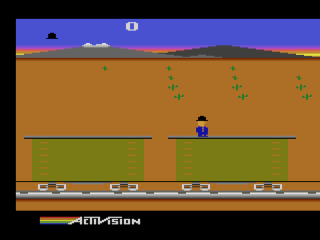
Eleven screens of almost
Thanks to AtariProtos’ documentation of the surviving build, we know exactly how far Kitchen got. The prototype contains eleven screens: eight boxcars, a coal car, a caboose and the engine. Kelly can run from car to car, jumping the gaps between them, but there’s little gameplay beyond the run itself — this is a graphical showcase more than a game. And the unfinished edges are visible if you know where to look. The coal car is missing its coal graphics, so Kelly appears to walk on air as he crosses it. The engine is missing its wheels entirely, sitting on the track like a beached silhouette. It is less a game than a promise of one.
Read those eleven screens as a level map, though, and you can see the game Kitchen intended. A run across the train — boxcar after boxcar, over the coal car, past the caboose, to the engine — is a natural side-scrolling gauntlet, the Keystone Kapers chase rotated ninety degrees and given a destination. The 2024 finished game would keep exactly that structure and build the adventure outward from it: off the train, into the ghost town and the mines, and back again. The prototype wasn’t a false start. It was the first eleven screens of a game that took forty-one years to finish the rest.
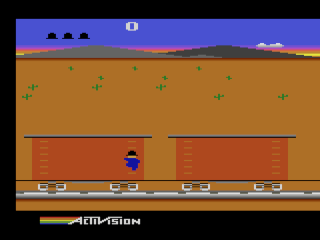
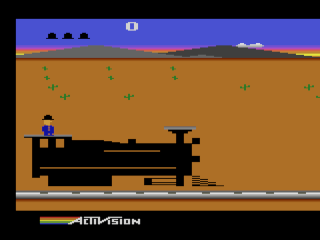
Oh, and about the name: the cartridge label on the surviving prototype is actually spelled “Keystone Canonball.” AtariProtos has a theory about the missing letter — perhaps, they suggest, the programmer had watched Cannonball Run too many times.
2018: out of the drawer
The prototype’s second life began in July 2018, when Kitchen showed the cartridge publicly — footage of the moment found its way to YouTube — and announced something more ambitious than a museum-piece ROM release: he would rewrite the game from scratch. Retro sites including Neon Rocketship picked the story up, and the Atari Compendium preserved Kitchen’s own account of the original project, wheels and all. The rewrite plan, as announced, kept the train and discarded almost everything else. The new version would not star Keystone Kelly at all: the train became a runaway circus train, its cars menaced by exotic animals to avoid, and each level would end with the player hunting down scattered engine parts and reaching the locomotive. A physical release was planned through Tiki Vision Games. In the end, that publisher didn’t ship it — the rewrite’s road to a cartridge turned out to be longer and stranger than anyone announced that summer. Announcements are cheap in prototype land; plenty of revivals are declared and never heard of again. What makes this story different is everything that happened next, slowly, over the following six years.
The idea changes trains
While Kitchen’s rewrite gestated, the train itself changed hands creatively. David Crane — Kitchen’s fellow Activision alumnus and Audacity Games co-founder — took the Cannonball train concept and spun it into Circus Convoy, released in 2021 as Audacity Games’ debut title. The runaway-train idea, dormant since 1983, had produced a finished game at last — just not Kitchen’s one. That was still coming.
There’s something fitting about the concept’s route back to market. The Cannonball train was born inside Activision’s legendary early-eighties bullpen, where programmers traded ideas across office doors; four decades later it was revived inside a company built by two of those same programmers, explicitly to make new games for the old machine. Circus Convoy proved Audacity could ship. It also turned the Cannonball from a piece of trivia into a going concern — and set the stage for its originator to finish his own version.
Casey’s Gold
On November 25, 2024, the rewrite finally went on sale as Casey’s Gold, published by Audacity Games, with boxed copies shipping the week of December 2. The numbers tell the story of how much the game had grown beyond its 1983 sketch: five years in development, and over 128 KB of game content — sixteen times the memory of Kitchen’s earlier 2600 titles. The train is still the heart of it, but the finished game ranges far beyond the boxcars: gold has been scattered through a ghost town and abandoned gold mines, and the player’s job is to recover the bars and return them to the train’s Gold Car. The circus-train framing of the 2018 announcement evolved along the way, but the spine of the design — cross the train, gather what’s scattered, reach the front — survived from prototype to product intact.
For Kitchen, it was his first new Atari 2600 release in over 40 years — the drawer he’d closed in 1983, reopened and finished at last. And Audacity treated the occasion like the event it was: the game launched in Standard, Collector and VIP Collector editions, each copy personally encoded with a unique serial number, the Collector tiers adding low numbers, a digital second copy, and — at the VIP level — a hand-signed, numbered certificate and a box autographed by the designer. A game that began life as an unfinished Activision side project ended up with the kind of launch treatment modern collector culture reserves for its crown jewels. (A second Kitchen revival announced back in 2018, a Titanic game called Bon Voyage, has yet to surface.)

Coda: the original comes home
A remake finishing the story would have been enough. But in July 2026, Kitchen closed the loop on the original artefact too: he gave a copy of the 1983 prototype ROM to collector and archivist Matt Reichert, and on July 15, 2026, AtariProtos published its full review of the unfinished Keystone Cannonball — alongside a review of Kitchen’s other unreleased Activision prototype, The Levee Game. The prototype that spent 35 years in a drawer is now documented screen by screen for anyone to study, while its reincarnation sits in collectors’ hands in a box with a serial number.
That double survival is rarer than it sounds. Plenty of prototypes get preserved but never finished; plenty of remakes get finished while the original stays lost or locked away. Here, unusually, the creator personally shepherded both halves of the story into the light — the 1983 fragment into the archive, the 2024 completion onto the shelf. Preservationists usually have to reconstruct an artist’s intent from whatever survived the dumpster. Dan Kitchen simply kept his work, and then, four decades later, finished it and footnoted it himself.
That’s the arc: an eleven-screen fragment, killed by a market crash and a busy schedule, that refused to stay dead — because its creator kept it, talked about it, rebuilt it, and finally made sure both versions survived. Most lost games get an obituary. Keystone Cannonball got a sequel, a remake and an archive. Not bad for a game whose own label couldn’t spell its name.