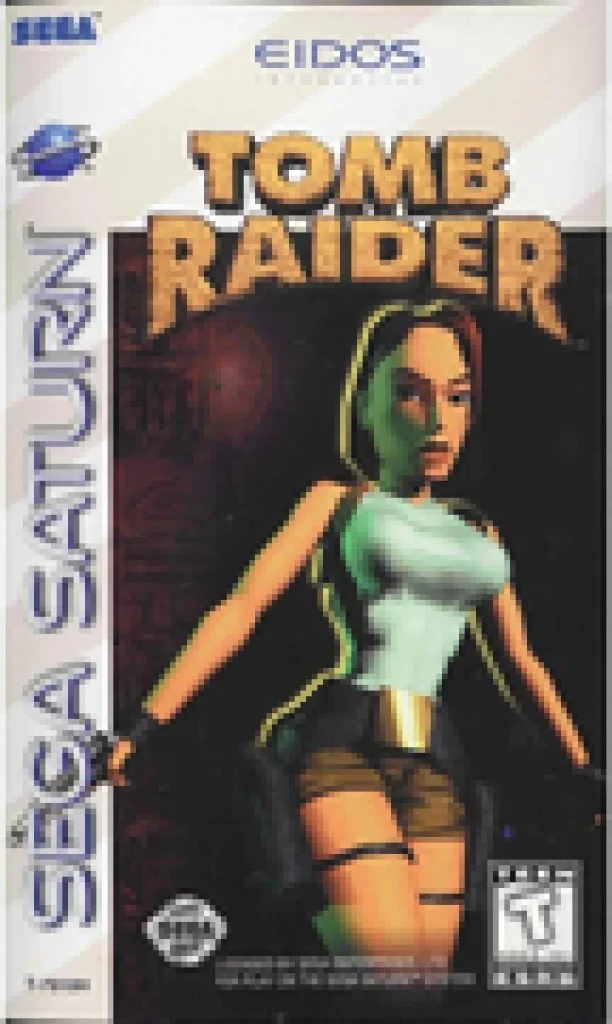
SEGA SATURN · ACTION-ADVENTURE · RETROSPECTIVE REVIEW
Developer: Core Design · Publisher: Eidos Interactive · Released: October 25, 1996 (Saturn first) · Genre: Action-Adventure
The Saturn original: Lara’s first tomb, thirty years on.
Thirty years ago today, Lara Croft made her debut — and she did it on the Sega Saturn. History tends to remember Tomb Raider as a PlayStation phenomenon, but Core Design’s adventure launched first on Sega’s machine on October 25, 1996, a timed head start that handed Saturn owners one of the defining games of the 32-bit era. The Derby studio had built its name on solid 2D platformers; nothing in its back catalogue suggested it was about to redraw the map of 3D gaming. Then Lara backflips into the caves of Peru, twin pistols drawn, and it’s immediately clear this is something new: a world you don’t just run through, but read — every ledge, crack and far-off doorway a quiet promise that if you can see it, you can probably climb it.
Context matters here. 1996 was the year 3D gaming grew up in public — Super Mario 64 had shown the world how a character should move in three dimensions, and Sony’s PlayStation was busy eating the industry. The Saturn, a brilliant 2D machine awkwardly retrofitted for the polygon age, needed a showcase. What it got was something better than a tech demo: a slow, strange, confident adventure that trusted the player completely. Revisiting it three decades on, the surprise isn’t how well it has aged. It’s how modern its instincts were all along.
First on Saturn
The Saturn-first launch was no accident. Eidos struck a timed exclusivity arrangement with Sega for Europe, which put Tomb Raider in Saturn owners’ hands on October 25, 1996, weeks before the PlayStation and PC versions arrived. In the long run the PlayStation is where the series became a phenomenon, and Lara’s face became inseparable from Sony’s grey box. But the first tomb was raided on Saturn hardware — and there’s a pleasing purity to this version because of it. No sequels yet, no spin-offs, no film deals, no fancy dress of expectations. Just a new character, a new kind of game, and a machine that badly needed both.
It also means the Saturn version preserves the game exactly as Core shipped it into the world: the same grid-built levels, the same save crystals rationing your progress, the same fog curling in at the edge of every cavern. Later ports and re-releases sanded edges and moved furniture. This is the original furniture. For a 30th anniversary, that’s precisely the point.
Built on a Grid
What surprises, playing it today, is how deliberate it all is. Tomb Raider is built on a grid, and Lara moves like it — measured steps, standing jumps, that famous shuffle to the very edge before a leap. Critics grumbled about “tank controls” even in 1996, and the complaint hasn’t gone away: Lara turns like a shopping trolley, and the camera has a mind of its own at the worst possible moments. But the stiffness is the design. Every room is a measurement problem. A running jump clears exactly this many blocks; a standing jump clears exactly that many; the hop backwards before a run-up isn’t animation filler, it’s you pacing out the distance like a golfer. This is a game about precision, not speed, and its jumps are puzzles you solve with your whole body.
Once that clicks — usually somewhere in the second level, roughly ninety minutes in — the controls stop feeling archaic and start feeling honest. Modern action games quietly correct your aim, magnetise you to ledges and forgive your angles. Tomb Raider forgives nothing, and the triumph when a five-jump sequence over a fatal drop finally lands is earned in a way frictionless design can’t replicate. You didn’t rent that jump. You own it.
The Sound of Silence
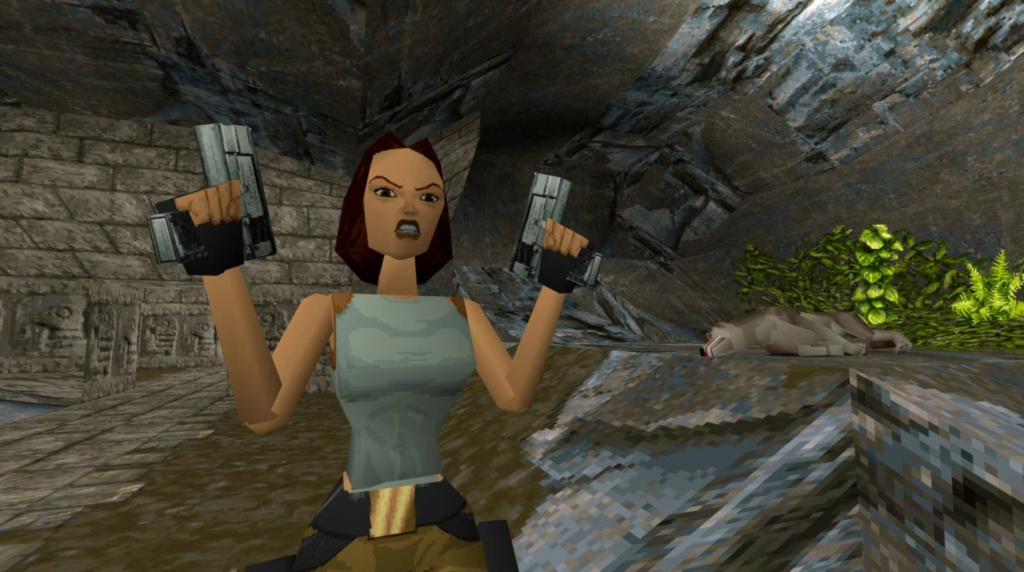
And then there’s the silence. Long stretches of Tomb Raider pass with nothing but footsteps on stone, dripping water, a picked lock, the scrabble of bats — until a wolf’s howl, or a boulder the size of a house, shatters it. Composer Nathan McCree’s score is one of the most restrained of the era: that gorgeous, melancholy main theme appears in short stings at moments of discovery, then withdraws and leaves you alone with the tomb again. Music here is punctuation, not wallpaper.
No blockbuster of the era trusted quiet like this one did, and it’s the single biggest reason the game still generates genuine atmosphere on 1996 hardware. Fear in Tomb Raider isn’t scripted — it’s acoustic. You hear the T-Rex before the ground starts shaking. You hear the trap before the spikes. Thirty years of horror games have borrowed that trick, but few have had the nerve to leave this much empty space around it.
Tomb Raider didn’t just launch a franchise — it taught video games how to be places.
Enter Lara Croft
It’s easy, now, to take Lara Croft for granted — she’s been rebooted, filmed, memed and merchandise-stamped for three decades. In October 1996 she was a genuine risk: designer Toby Gard and the Core team put a woman alone at the centre of a big-budget 3D adventure, in an era when female leads were marketing poison, and made her competent, solitary and entirely uninterested in being rescued. The game’s camera treats her as an athlete first; the attitude did the rest.
Within a year she was on magazine covers far outside the gaming press; within five, on cinema screens. The industry learned the wrong lessons from some of that, as it tends to. But strip the phenomenon back to the game itself and Lara works because the design respects her: the acrobatics are functional, the dual pistols are a reward for exploration as much as a weapon, and her silence through most of the adventure — no quips, no sidekick, no radio chatter — makes her feel like the only person who has ever walked these halls. Which, in story terms, is exactly what she is.
The Long Way Down
Structurally, the game is four descents: Peru’s caves, Greece’s monastery of St. Francis’ Folly, Egypt’s sand-choked Khamoon, and finally Atlantis, where the art style curdles into pulsing, organic body horror that still looks wrong in the best way. The middle two stretches are the peak. St. Francis’ Folly is a single towering vertical chamber you climb, fall from, unlock and re-climb for the better part of an hour — a level design flex that modern games, cut into ten-minute chunks, rarely attempt. Greece also gives us the hand of Midas, where stepping onto a statue’s palm turns Lara to solid gold: an instant-death gag that teaches you the game’s rules by killing you with them.
And yes, the T-Rex. You know about the T-Rex. Everybody knows about the T-Rex — and it remains, even spoiled by thirty years of retelling, the moment the game announces its ambitions. It arrives in near-silence, in a valley that feels too big for the hardware holding it, and turns an exploration game into a survival game in about four seconds. The first time is unforgettable. The tenth time, backflipping away on grid-perfect jumps, you realise the fight is a puzzle like everything else here: terrifying set dressing over beautifully countable mechanics.
Playing It in 2026
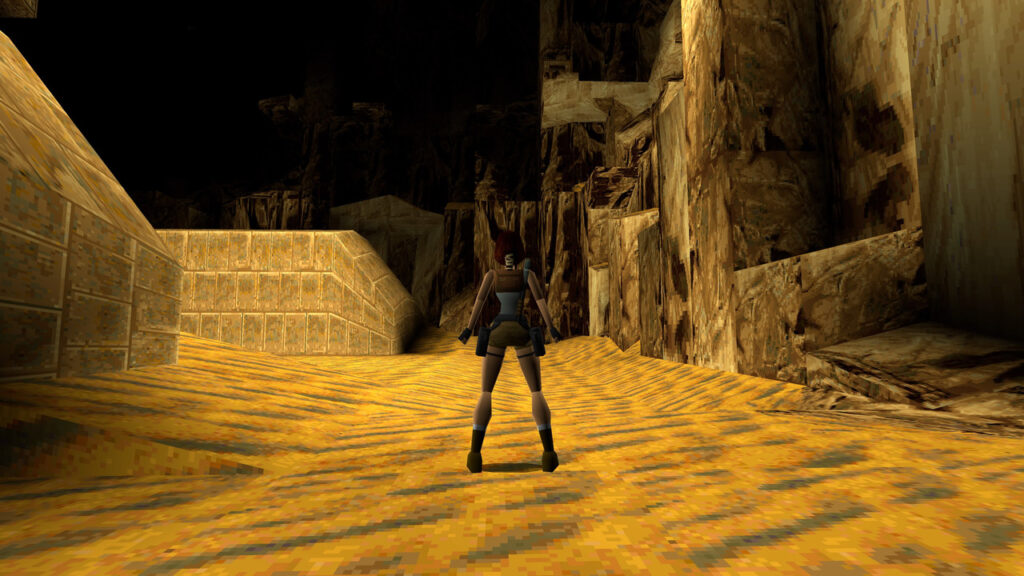
Honesty section. The tank controls will cost you your first hour; the save crystals — the console versions’ only way to record progress — mean a careless death can cost you twenty minutes; and the draw distance means the tombs sometimes materialise out of fog like they’re being remembered rather than rendered. A first-time player in 2026 needs to know they’re meeting the game on its own terms, and its terms are non-negotiable.
They’re also worth meeting. Played on the Saturn today — ideally on a CRT, certainly with the lights low — Tomb Raider’s slowness becomes its superpower. There is no map screen filling with icons, no objective marker, no crafting tree. There is a tomb, a woman, and your own spatial memory. The recent remastered collection is a fine, respectful way in, and its modern control option lowers the drawbridge for newcomers; but the Saturn original remains the purest hit of what Core intended, fog and all. This was a launch-window Saturn game that out-designed machines twice as fashionable. That still counts for a lot.
The Legacy
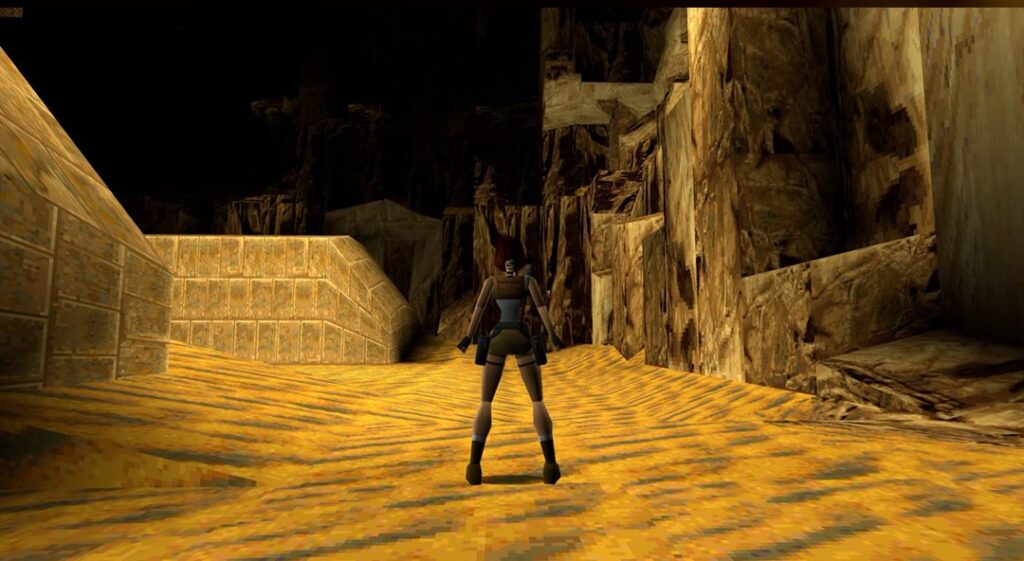
The numbers need no embellishment: more than seven million copies of this first game alone, a series that has run for thirty years, and a template — the cinematic 3D action-adventure, part exploration, part puzzle, part gunfight — that everything from Uncharted to modern Assassin’s Creed still builds upon. Tomb Raider didn’t invent 3D gaming, but it invented a way of being in 3D: alone, high up, listening.
Strip the fame away, though, and the Saturn original remains the purest form of the idea: atmospheric, methodical, utterly confident in its own slow heartbeat. The sequels got louder, the reboots got grittier, but the first tomb is still the quietest — and, on the evidence of this anniversary replay, still the one that gets under your skin. Thirty years on, the tombs are still worth raiding.
Score: 9/10. A landmark that still earns the name — methodical, atmospheric and quietly revolutionary. The Saturn’s essential adventure, thirty years young.
📅 This game appears in This Day in Gaming History — October 25 →