
Old Portsmouth does history properly. The High Street runs between Georgian frontages and naval landmarks, near the harbour. A few doors along stands the George Inn, famous locally as the place where Admiral Lord Nelson passed his final night on dry land before sailing to meet the combined French and Spanish fleets at Trafalgar in 1805. It is, in other words, an unlikely street on which to go looking for video games. Yet tucked away in a basement at number 16, behind a modest doorway you could stroll past without noticing, sat one of the most charming retro venues Britain has produced: Game Over, a café built entirely around old consoles.
When it welcomed its first customers in October 2015, the formula was disarmingly straightforward. Pay for time, pick a machine, settle in. Sofas and bean bags softened the room, snacks and soft drinks came from the counter, and the tables carried the sort of hardware line-up that usually lives behind glass: Mega Drives and Amstrads, Atari 2600s, and the unmistakable upright silhouette of the Vectrex. Shortly after opening, RetroCollect spoke to founder Steve Lowe about how the place came to exist. Retold here, a decade later, his answers sketch a project that was never really meant to be a café at all.
A Museum That Had to Start Life as a Café
Lowe’s real ambition, he explained at the time, was a museum — a properly hands-on one, where visitors would play the exhibits rather than peer at them. He had been working towards it for roughly three and a half years, and had drafted no fewer than nine separate business plans, each shaped around a different building he hoped might house it. Every version ran into the same pair of obstacles: setbacks with the properties themselves, and cash-flow forecasts that refused to add up.
So he changed tack completely. When a suitable basement became available, Lowe abandoned the plan he had been refining, worked out what the venture would cost him even in the bleakest scenario — a long lease with barely a customer through the door — and decided that outcome was one he could live with. At worst, he reasoned, he would be subsidising a very elaborate hobby for the length of the tenancy. The café format was the pragmatic middle step: a smaller, working venue that could earn money in the present while building the funds a full interactive museum would eventually demand. Game Over, in that sense, was a fundraiser with joysticks.
Every Machine in the Room Was His
Nothing on those tables had been bought in specially for the business. Lowe confirmed that each system on offer had come straight from his personal hoard, and when people wondered aloud about letting strangers loose on treasured hardware, his attitude was relaxed: machines locked away in storage help nobody, and putting them back into players’ hands was exactly how they would be returned to life.
That hoard had been accumulating for more than thirty years by the time the café opened. Lowe dated the start of his collecting to around 1984, an era when home computing still felt like a privilege for a schoolkid. His school, he recalled, possessed a single computer for everybody, an object of wonder that was wheeled between classrooms on a trolley. His own route in came through a friend who upgraded and passed an older machine on to him — and, as he told it, having hardware of his own at home was all it took. The collection simply kept growing from that hand-me-down onwards, until it was large enough to fill a café.
An Island Pick, a Coolest Machine, and Three Favourites
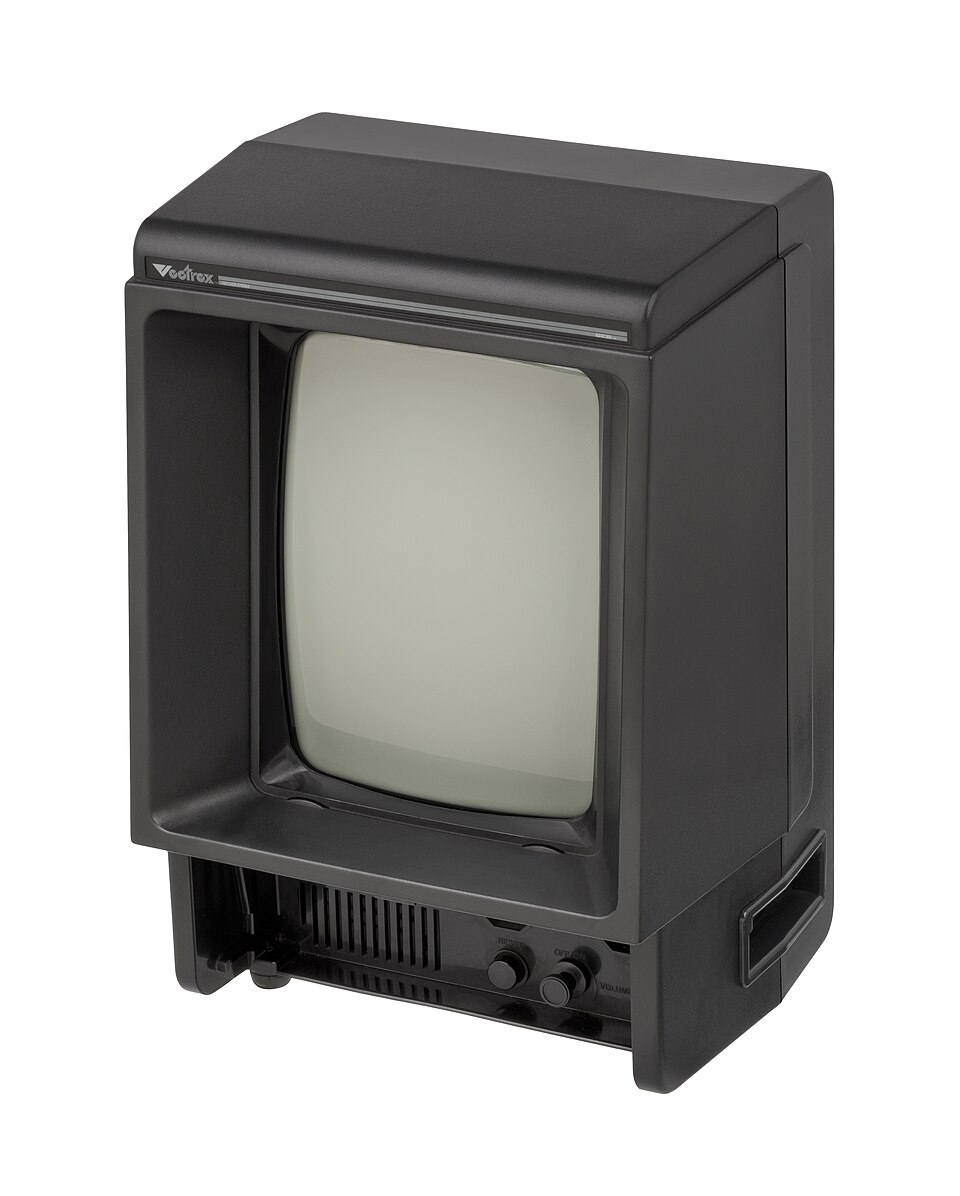
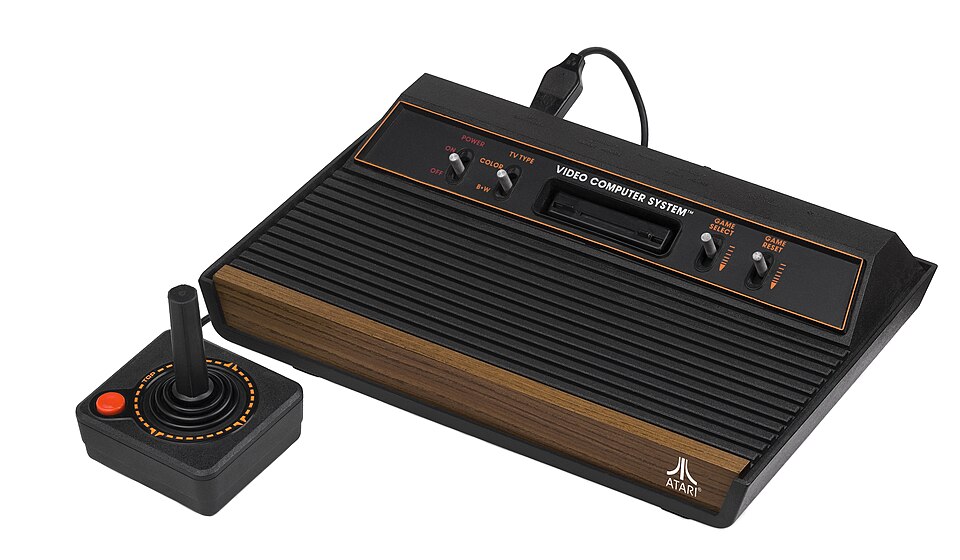
Asked to choose, Lowe split his loyalties in revealing ways. Stranded on a desert island with a single console, he would take the Atari 2600 — not for any one title, but for the sheer breadth of its library and the simple, immediate fun he found across it. Asked instead which machine he considered the coolest thing he owned, he pointed to the Vectrex. Its appeal, as he described it, lay in how it cheated the idea of graphics altogether: rather than building pictures from blocks, it joined points together with clean lines, and the resulting motion felt remarkably fluid.
His three standout games crossed formats and decades without hesitation. From the ZX Spectrum came Ultimate’s Atic Atac, the haunted-house arcade adventure that defined many British childhoods. From the PC came Westwood’s real-time strategy sequel Command & Conquer: Tiberian Sun. And from the PlayStation 2 came OutRun 2006: Coast 2 Coast, Sega’s sun-drenched love letter to its own arcade racer. Spectrum, strategy and Sega — as summaries of a British retro collection go, that trio is hard to beat.
Why Players Came Back to the Arcade
Lowe also had a theory about timing — about why, in the middle of the 2010s, so many people were rediscovering machines older than themselves. His view, as he set it out then, blamed a long stretch of releases chasing ever greater realism. A decade of games striving to look and behave like real life had, he felt, drifted so far from the quick, readable pleasures of the arcade that they had stopped feeling like games at all and turned into simulations. The retro revival, on that reading, was a correction: players hunting for the immediacy the industry had polished away.
He connected that to memory and imagination, too. His generation had grown up coaxing adventures out of chunky coloured blocks, supplying most of the detail in their heads. Younger players, raised on screens that showed them something close to real life, faced no such demands. Even so, Lowe had already noticed knowledge passing sideways through families — teenagers arriving already half-familiar with machines an older sibling had owned, then filling the gaps by looking the hardware up online.
Grandparents, Teenagers and a Square Ball
Only a few weeks into trading, the audience was refusing to fit the stereotype. Lowe reported a split that was close to even between older visitors reliving their youth and younger ones exploring it for the first time. What pleased him most, he said, were the crossovers: strangers from entirely different generations ending up side by side, competing at the same screen.
Nothing encouraged that quite like the simplest machine in the building — the tennis game on the Binatone TV Master. By any modern measure it is almost absurdly crude: monochrome pictures, and a ball rendered as a little square. Yet Lowe singled it out as one of the café’s most heavily used attractions, a firm favourite precisely because anybody could understand it within seconds. Groups could also take over the whole venue in booked blocks, with Lowe and his team on hand to dig out requested games and keep the snacks coming.
Look Up: a Ceiling Cut by Hand
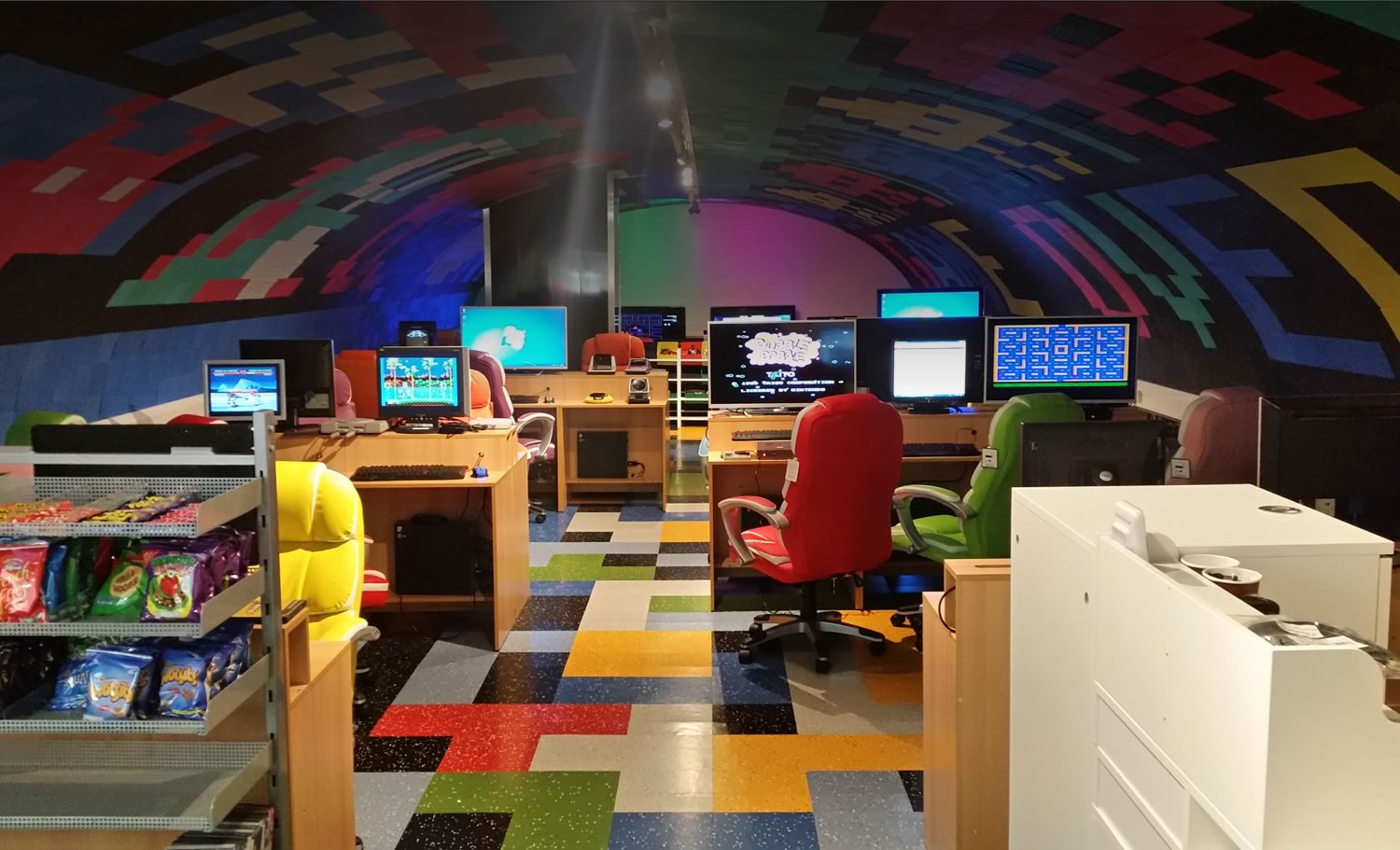
Visitors who remembered to glance upwards found the café’s signature. The arched ceiling — visible in the photograph at the top of this page — is a riot of oversized pixels and familiar shapes from gaming’s early years, sweeping over the play area in bold blocks of colour. It looks like the work of a design studio. According to Lowe, no professionals were involved. He produced the whole thing himself, cutting individual foam tiles by hand and placing them one at a time until the pattern covered the vault, pixel by pixel. As statements of intent go, a ceiling like that tells you everything about the place beneath it: this was a labour of love first and a business second.
Ten Years On: Still Not Game Over
Here is the part nobody could have guaranteed in 2015. Basement cafés built on one man’s collection are not supposed to be long-lived businesses — and yet Game Over survived. At the time of writing, in October 2026, the café is still open and trading from the same address: Basement, 16 High Street, Old Portsmouth, PO1 2LP. Its own website, gameover.cafe, describes it as Portsmouth’s first and only video game café, and sessions are still sold the way they always were, in two-hour blocks — £5 a session, with soft drinks and snacks from 50p. Its current listed opening days are Wednesday, Friday, Saturday and Sunday, from 11:30am to 4:00pm, and its Google listing carries a 4.9-star rating across more than 220 reviews.
Whether the fully interactive museum Lowe was saving towards ever takes shape, we cannot say. But measured against the modest wager he described in 2015 — open the doors, accept the risk, and see what happens — the café has already beaten the odds he set for it. The collection he started with a school friend’s cast-off in about 1984 is still doing the job he always wanted it to do. It is bringing machines back to life, one two-hour session at a time — and in Old Portsmouth, within sight of Nelson’s last landlord, gaming history is still being played, not just remembered.
Keep reading: The Console That Wasn’t: John Lester, CollectorVision and the Coleco Chameleon Mirage