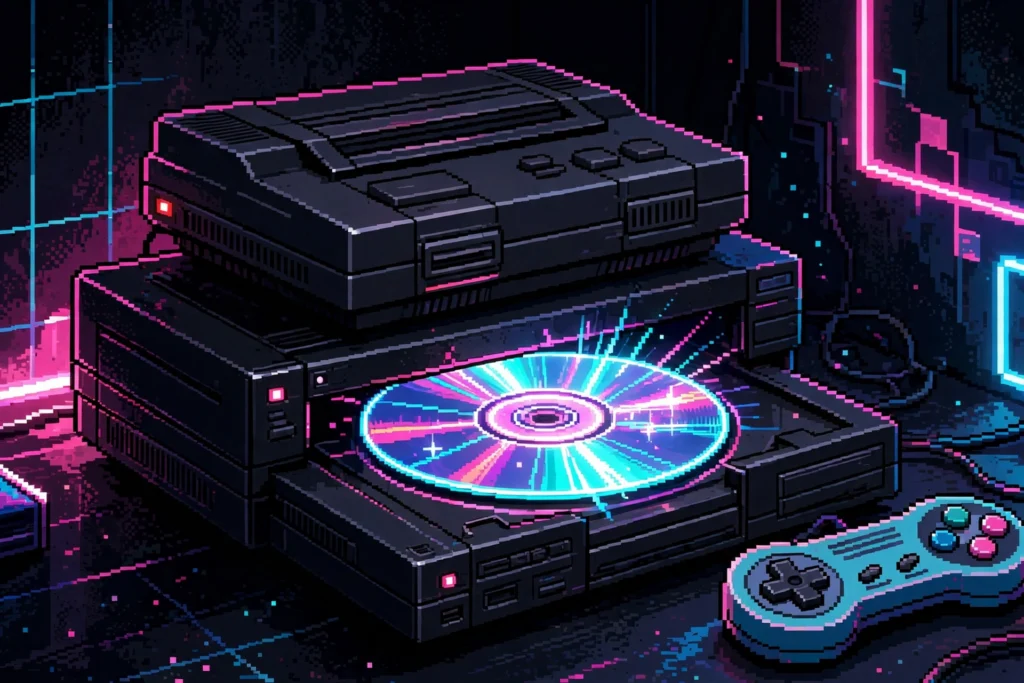
In December 1991, Sega looked at the Genesis — the console currently beating Nintendo bloody in the console wars — and decided it wasn’t done. The Mega-CD launched in Japan that month: a CD-ROM drive that bolted onto the Genesis and promised the actual future. CD-quality music. Full-motion video. Games hundreds of times bigger than a cartridge. It reached North America on October 15, 1992 as the Sega CD, priced at $299 — the cost of a whole second console.
And here’s the thing nobody argues about: the Sega CD did see the future. Within five years, every major console would be disc-based. The Sega CD just couldn’t survive long enough to live in the world it predicted.
What the thing actually was
Strip away the hype and the Sega CD was a genuinely beefy upgrade. It added a second Motorola 68000 processor running at 12.5 MHz — the same CPU as the Genesis, so in effect you had two of them — plus a custom ASIC chip that could scale and rotate sprites, Sega’s answer to the SNES’s Mode 7. A Ricoh PCM sound chip delivered CD audio and eight channels of sampled sound. Memory jumped to 6 megabits of RAM. And the disc itself held around 540 megabytes, next to a Genesis cartridge’s 8 or 16 megabits. The numbers weren’t close.
The catch was the drive: single-speed, 150 kilobytes a second, which meant loading. So much loading. Sega CD owners developed a zen-like patience watching “NOW LOADING” screens that cartridge kids never had to contemplate.
There were two models. The Model 1 was a front-loading tray that sat under the Genesis like a throne, making the combined unit look like a piece of stereo equipment — which, to be fair, it kind of was. The Model 2 was a cheaper top-loading “sidecar” that slid in beside a Model 2 Genesis. Collectors also chase the weird licensed combos: JVC’s X’Eye and the Japanese Wondermega, all-in-one Genesis/Sega CD units that now cost silly money.
Sonic CD: the reason to own one
Every add-on lives or dies on its killer app, and the Sega CD had exactly one undisputed masterpiece: Sonic CD (1993). Built largely by a separate team under Naoto Ohshima while Yuji Naka’s crew made Sonic 3, it introduced time travel — smash a “past” or “future” sign, hit top speed, and the whole level remixed itself across four timelines. Destroy Robotnik’s machines in the past and the future turned lush and clean. It was the most ambitious 2D Sonic ever made, and many fans still call it the best classic Sonic, full stop.
It also shipped with two different soundtracks — the Japanese/European score and a completely different American one featuring “Sonic Boom” — which means Sonic CD arguments can run for hours before anyone even mentions gameplay.
The FMV years (and the Senate hearings)
What the Sega CD is remembered for, fairly or not, is full-motion video. Night Trap, Sewer Shark, Double Switch, Tomcat Alley, Ground Zero Texas — games built from grainy, postage-stamp video clips of B-movie actors, where you mostly watched and occasionally pressed a button. They looked like the future on a store display and played like a remote control with delusions of grandeur.
Then Night Trap — a campy vampire-sorority-sleepover romp that is about as scary as a Scooby-Doo episode — somehow became the centerpiece of the 1993 U.S. Senate hearings on video game violence, alongside Mortal Kombat. Senators played clips of it to horrified gasps. The hearings led directly to the creation of the ESRB rating system in 1994. So the Sega CD’s most historically significant game is one remembered less for what it was than for what it accidentally caused.
Night Trap is a classic example of a game famous for everything except being good. But without it, there’s no ESRB — and without the ESRB, the modern industry looks very different.
The games that were actually great
Buried under the FMV shovelware was a library of genuine classics, many of which never left the system:
- Lunar: The Silver Star and Lunar: Eternal Blue — Working Designs’ beloved JRPG localizations, with lavish packaging, CD orchestrated music, and difficulty “rebalancing” that players still argue about.
- Snatcher — Hideo Kojima’s cyberpunk adventure, a Blade Runner homage that was the game’s only English release for years. Now one of the most expensive discs on the system.
- Shining Force CD, Vay, and Popful Mail — more Working Designs RPG goodness.
- Final Fight CD — the arcade brawler with CD-quality music and the missing content the SNES port cut.
- Ecco: The Tides of Time, Robo Aleste, Keio Flying Squadron, Silpheed, Android Assault, Soul Star — the shooters and action games that showed off the scaling hardware.
- Dark Wizard, Dungeon Explorer, Heart of the Alien — the deep cuts collectors hunt.
It’s a small library — roughly 200 games in North America — but its hit rate at the top end is remarkable for a “failed” system.
Why it failed
The autopsy isn’t complicated. The Sega CD cost $299, and you needed a Genesis to plug it into — so the real buy-in was over $400. That fractured Sega’s own market: developers had to choose between the 30-million-strong Genesis base and the CD’s couple million. The FMV games burned its reputation with the gaming press. And then Sega did what Sega did in the ’90s: it announced the next thing. The 32X arrived in 1994, the Saturn in 1995, and the Sega CD became yesterday’s future overnight. Around 2.24 million units sold worldwide. Discontinued in early 1996.
The cruelest part? Everything it bet on — discs, CD audio, video, bigger games — won. It was just early, expensive, and abandoned.
The Sega CD today
Collecting original Sega CD discs in 2026 is not for the faint of wallet. Complete copies of Snatcher and Keio Flying Squadron run into the hundreds of dollars, and 30-year-old CD-ROM drives are living on borrowed time — failed lasers and worn gears are the norm, not the exception.
So most of the modern scene plays on real hardware via optical drive emulators: Terraonion’s MegaSD (a Genesis cartridge that plays the entire Sega CD library off an SD card) and the MODE have effectively made the library immortal. Emulation is excellent too — Kega Fusion, Genesis Plus GX in RetroArch, and the MiSTer’s FPGA Sega CD core all run the library with cycle accuracy. Night Trap got a 25th-anniversary re-release on modern platforms, and Sonic CD — via the superb 2011 Christian Whitehead remake — is on everything. The add-on died; its best games refused to.
The Sega CD community today: meet, talk, and buy
Forums
- Sega-16 forums — the long-running home of Sega obsessives, with deep hardware and collecting knowledge.
- r/SEGACD — active subreddit for pickups, repair help, and game discussion.
Buying & hardware
- Stone Age Gamer — retro retailer stocking the MegaSD and other modern Sega CD hardware.
- eBay and local retro shops for original discs — check discs for bronzing and rot before paying collector prices.
Explore further
Watch the library in full, get a buyer’s walkthrough, and see the strangest official combo hardware: