At a glance: Slain: Back from Hell · PS Vita (also PS4, Xbox One, PC, Switch) · developed by Wolf Brew Games · published by Digerati · Vita release 22 November 2016 · gothic action platformer · single player
Of all the games we reviewed in 2016, Slain had the best excuse for a resurrection metaphor. You play Bathoryn, a grey-maned warrior hauled out of death’s waiting room and pointed at Lord Vroll, whose summoned horrors have overrun the land in six cursed realms of gothic misery. What Bathoryn’s makers at Wolf Brew Games could not have known, when they designed that premise, is that their game would need the same trick: launched too early, buried by reviewers, then hauled back, rebuilt and relaunched under the only honest title available — Back from Hell. This review covers the Vita version, which arrived last of all in November 2016, and it has to be read as two reviews braided together: of a beautiful, brutal little action game, and of the salvage operation that produced it.
A Poster You Can Play
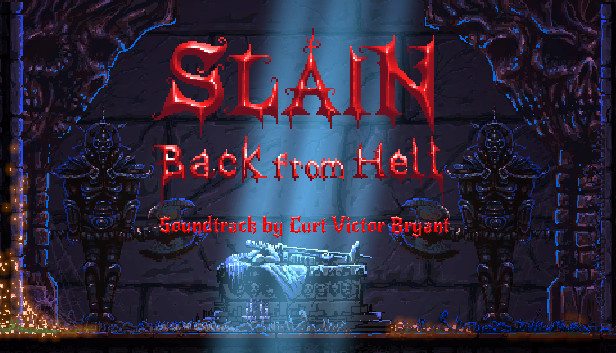
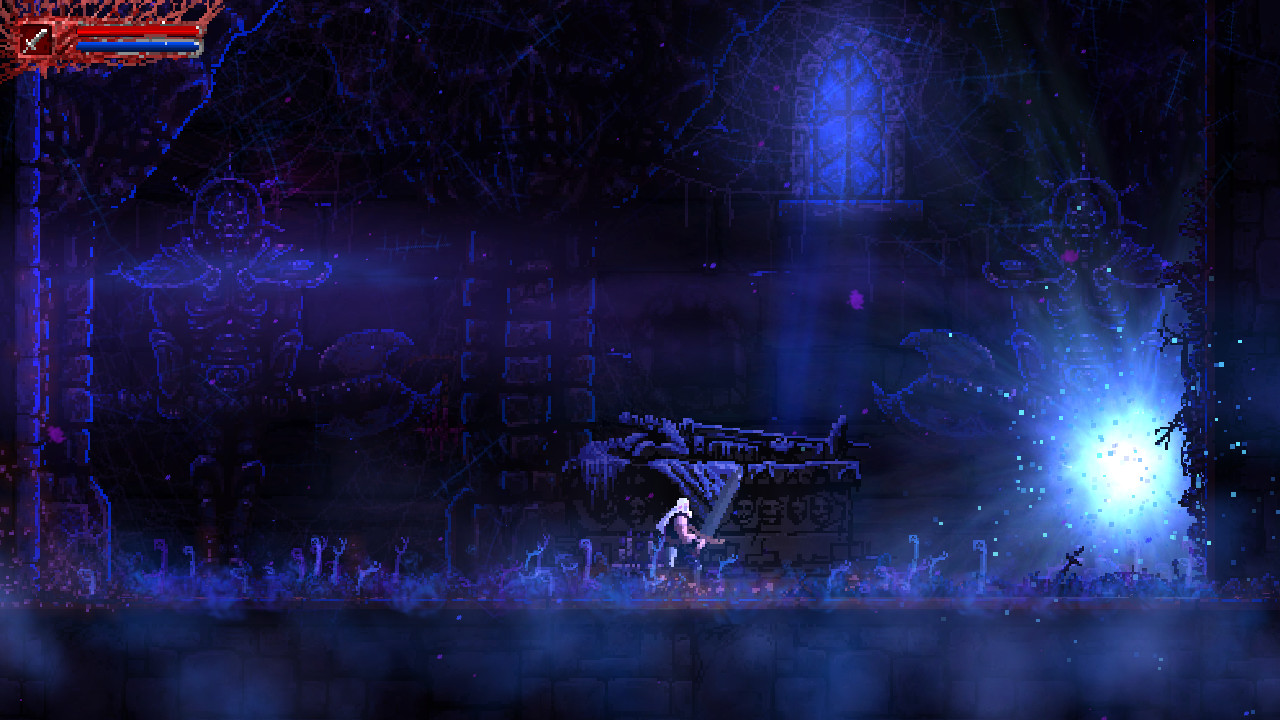
The seduction is the artwork. Artist Andrew Gilmour — by the end, effectively the studio — built a world of rain-lashed ruins, candlelit cathedrals and inventive, gruesome enemies, all rendered in pixel art so detailed it practically drips off the Vita’s screen. Light blooms and bleeds through the murk; Bathoryn’s hair streams behind him as he runs; every stage is oppressive in a new flavour, from flooded crypts to a forest of thorned abominations. Over it all lies Curt Victor Bryant’s soundtrack — yes, the former Celtic Frost bassist — which alternates funereal quiet with full metal crescendos that land exactly when the fighting peaks. Looks and sound are not decoration here; they are the game’s argument, and on those terms Slain is close to flawless. The question that doomed the original release, and dogged even this one, is whether the sword in Bathoryn’s hand feels as good as the world looks.
The Launch From Hell
The facts deserve plain telling, because the industry so rarely tells them. Slain! launched on PC on 24 March 2016 and was savaged — unfinished, unbalanced and buggy. Publisher Digerati later admitted the call had been made to ship it as it stood rather than slip the date yet again, expecting to patch quickly; the problems turned out to run far deeper, the original team disbanded, and the rebuilding fell to a new programmer working through someone else’s code with only Gilmour remaining from the old guard. For five months they effectively remade the game: combat rebuilt, dialogue rewritten, bosses added, bugs hunted in weekly updates. On 1 August 2016 it relaunched, free to existing owners, as Slain: Back from Hell — and the critical verdict swung with it, the Metacritic score climbing some 35 points to a respectable 75. The console versions, Vita included, were built entirely from this second incarnation. When our original review noted that the Vita’s Bathoryn could still hit a progress-halting glitch partway through, it was watching the last aftershocks of that birth — a fault the developers acknowledged publicly and patched, but a blemish a buyer in November 2016 deserved to be warned about.
“The most honest sequel subtitle ever printed: not a special edition, not a director’s cut — an apology that plays like a manifesto.”
On Vita: Beauty, Brutality and Splinters
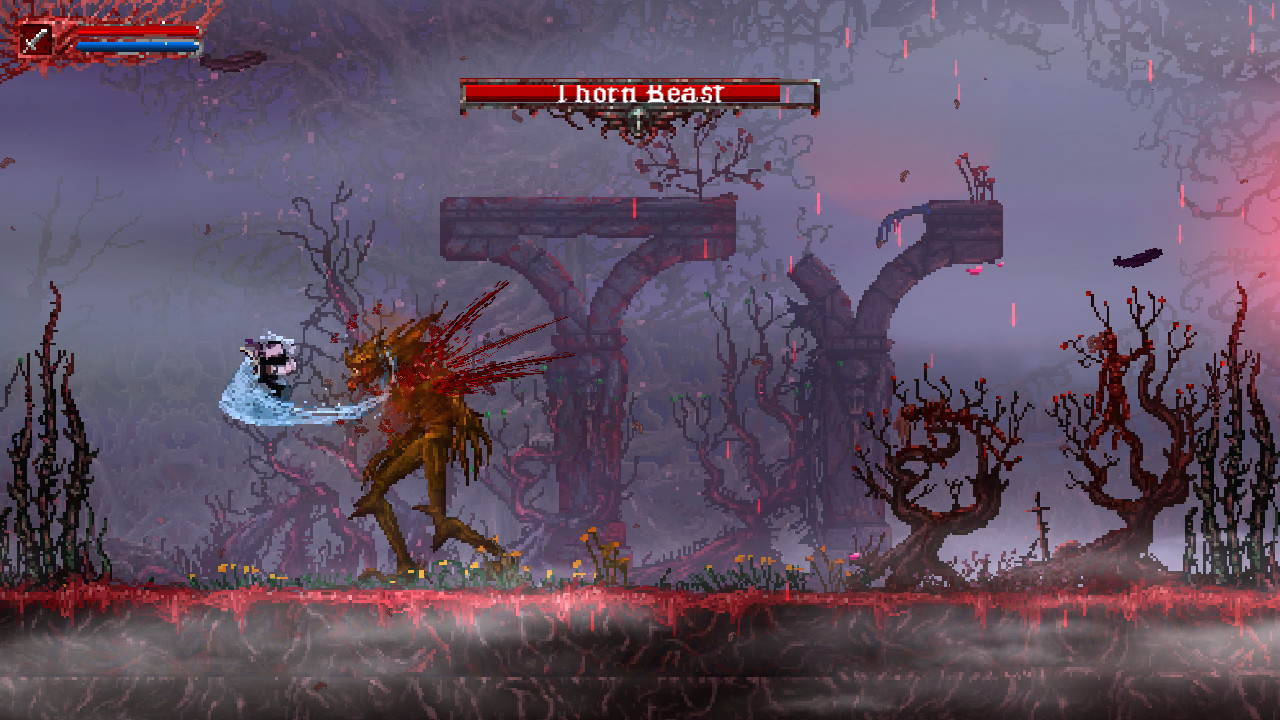
So how does the rebuilt game actually play, in the hand, on the bus? Better than its reputation, rougher than its screenshots. Bathoryn’s kit is compact: a three-hit sword combo, a block that becomes a devastating counter if you catch a blow at the right instant, a mana-fed charged attack and elemental weapons — steel, fire and ice — whose strengths against particular enemies add a welcome layer of thought. When the parry system clicks, combat has a vicious rhythm all its own, and the checkpointing is generous enough to encourage experimentation. The splinters are real, though. Hit feedback can feel woolly, so trades of blows sometimes seem decided by coin toss; winged enemies harass from angles your sword covers badly; instant-death pits, lava and traps are everywhere, and the spacing between checkpoints occasionally lurches from fair to spiteful. Enemy AI is rudimentary — horrors will cheerfully wade into hazards in their hurry to reach you. Difficulty is steep throughout and the learning curve steeper, yet it is a chosen steepness, the Castlevania-and-souls lineage worn openly. Bathoryn dies in heaps, in acid, on spikes, under bosses — and the game’s own mythology, a hero who cannot stay dead, makes every respawn feel less like a reload and more like the plot clearing its throat. On the Vita specifically, the small screen flatters the artwork enormously, performance holds up, and the whole package feels native rather than shrunk.
It also helps that the journey itself is well stocked. The six realms each belong to a deadly overlord, and the road to them runs through flooded villages, wolf-haunted woods and cathedrals where the candles seem to be watching you; screen-filling bosses — the Thorn Beast among them — punctuate the trek at satisfying intervals, most of them pattern puzzles wrapped in pixel-art spectacle. Wolf transformations, granted at dramatic moments, let Bathoryn answer spectacle with spectacle, and the drip-feed of elemental weapons gives each new area a small strategic recalculation: what burned the last realm’s horrors may glance off this one’s. None of this reinvents the action platformer, and some of it — the switch-flipping, the platforming over pits — is genre boilerplate. But boilerplate executed at this visual standard, with this soundtrack, is its own reward.
The Verdict
We score the game in front of us, and the game in front of us — patched, rebuilt and blazing with art — is a good one with flaws, wrapped in a story the medium should be prouder of.
Studios almost never get to relaunch a failure with this much honesty and graft, and Back from Hell’s second act remains the standard against which post-launch redemptions are measured. Vita owners hunting a gothic challenge after Axiom Verge will find one here, thorns and all.
Postscript, for the record: the rebuilt Slain went on to a Switch release in 2017, and Gilmour’s art has only grown in reputation since — the game is now routinely cited in “best pixel art” conversations, a fate nobody predicted for a title that launched to single-digit review scores. The Vita version remains exactly what it was in November 2016: the last and most portable edition of one of gaming’s great salvage jobs.
Verdict: a stunning-looking, hard-hitting action platformer whose combat never quite matches its art — and whose resurrection earns it the benefit of every doubt. 7.5.
Keep reading: The Only Way Is Up: Why Castlevania’s Staircases Still Terrify · Small Castle, Big Ideas: Helen’s Mysterious Castle Is the Four-Hour RPG That Respects Your Time · the PS Vita system archive