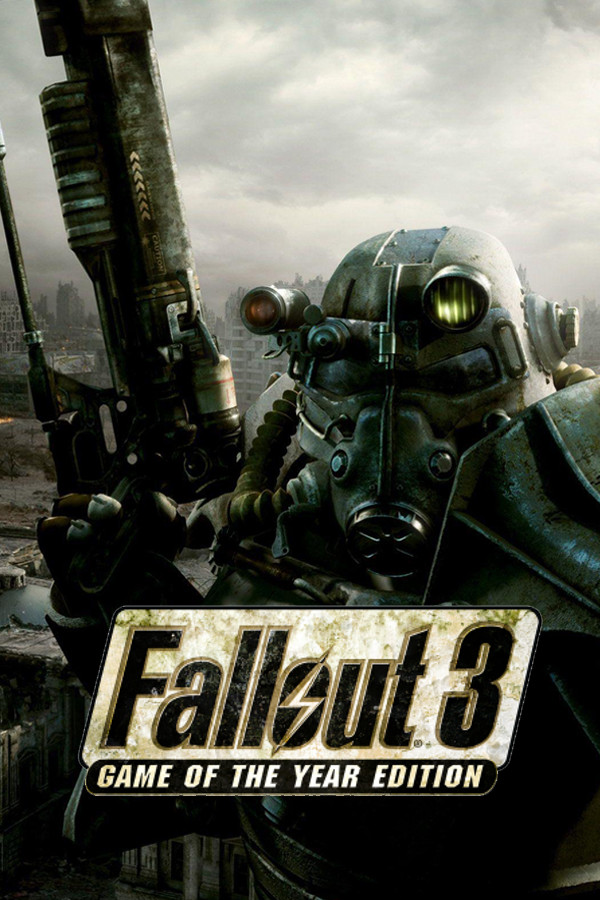
PC · XBOX 360 · PLAYSTATION 3 · ACTION RPG · RETROSPECTIVE REVIEW
Developer: Bethesda Game Studios · Publisher: Bethesda Softworks · Released: October 28, 2008 · Genre: Action RPG
Eighteen years on, Bethesda’s great gamble — Fallout rebuilt from inside a pair of eyes — is still the walk every open-world RPG is trying to finish.
Eighteen years ago today, on October 28, 2008, Bethesda Game Studios released the most argued-over sequel in role-playing history. Fallout had been Interplay’s — isometric, turn-based, gleefully profane — and its true third act, Black Isle’s Van Buren, died cancelled in 2003. Bethesda licensed the series in 2004, bought it outright in 2007 for a reported $5.75 million, and rebuilt it as a first-person epic on the Oblivion engine. The faithful braced for “Oblivion with guns,” a jibe director Todd Howard cheerfully repeated himself. What shipped instead moved more than 4.7 million copies in its first week, scored in the low nineties, and won Best Writing at the Game Developers Choice Awards — and drew the map the next decade of blockbuster RPGs would follow.
“War. War never changes,” Ron Perlman intoned, as he had since 1997. Everything else about Fallout changed. You are the Lone Wanderer of Vault 101, and the year is 2277 — two centuries after the bombs turned Washington, D.C. into the Capital Wasteland. When your father James slips out of the vault, you follow — and a missing-persons case becomes a war over the only treasure left: clean water.
Out of the Vault, Into the Light
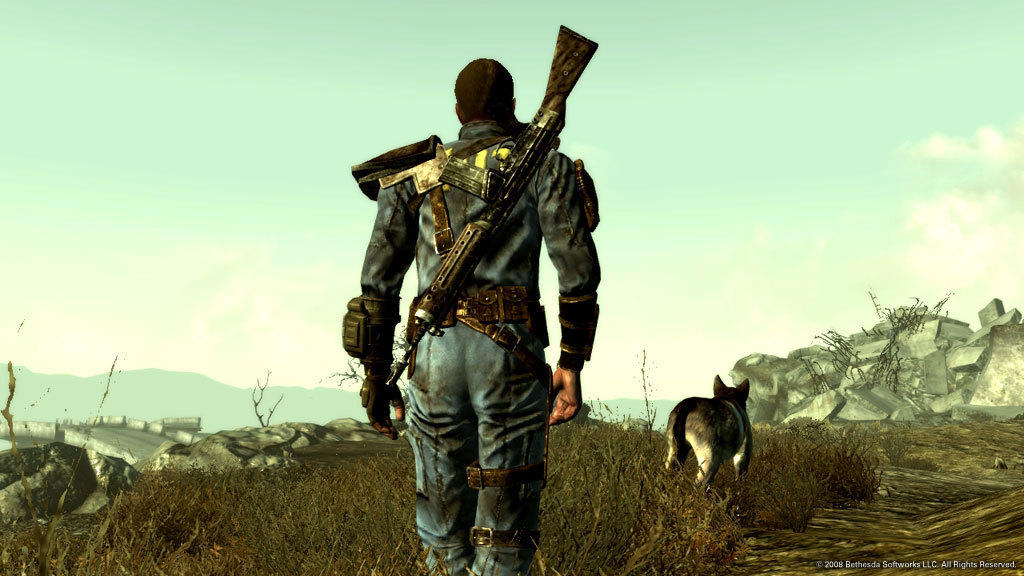
Fallout 3’s first hour is a whole life at fast-forward. You are born — character creation as childbirth, your mother’s heart giving out as Perlman promises the Capital Wasteland is a hard place for a baby. At ten comes a Pip-Boy 3000 and a BB gun; at sixteen, the G.O.A.T. careers exam. At nineteen it all burns: your father gone, the Overseer’s security goons hunting you through the only corridors you’ve ever known, Amata waking you in the dark to say run. And then the door — tonnes of steel grinding aside, light so total the screen whites out — and the game shows you the world for the first time: the husk of Springvale below, the Washington Monument spearing a green-grey sky, nobody shooting at you. Every great open world has an exit wound. This is still the best one ever staged.
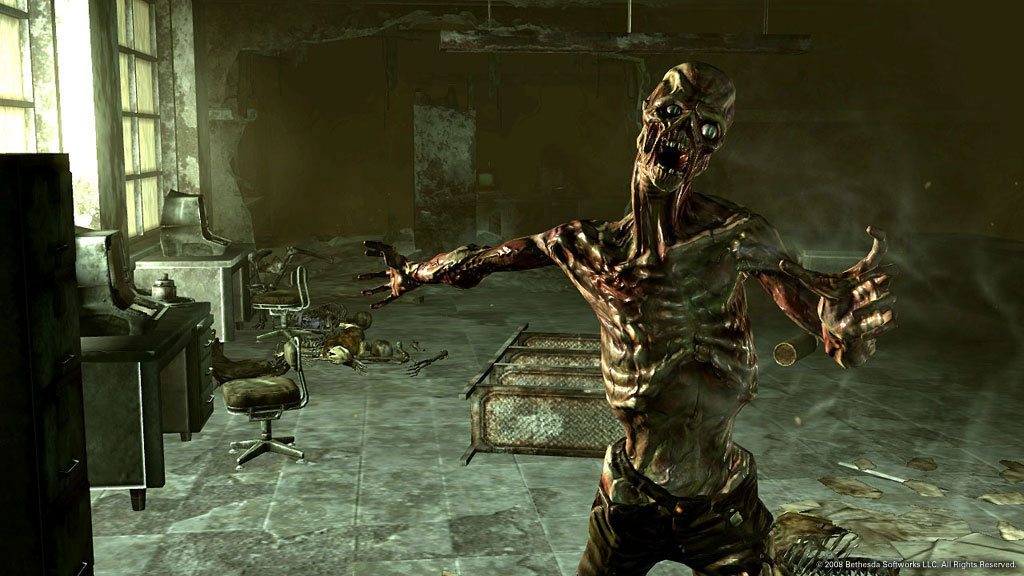
From there the trail runs through the traders of Megaton to Galaxy News Radio’s besieged studio, through ghoul-haunted metro tunnels to Rivet City, a beached aircraft carrier turned fortress-town. Your father was building Project Purity — a vast purifier in the Jefferson Memorial that could cleanse the whole Potomac basin, free. The Enclave, self-appointed heirs of the old government, would rather own it; the Brotherhood of Steel, holding the Pentagon as their Citadel, would rather they didn’t. It is a simple story — a son or daughter walking a father’s road — and that simplicity is the point: the road is the game.
War, by the Numbers
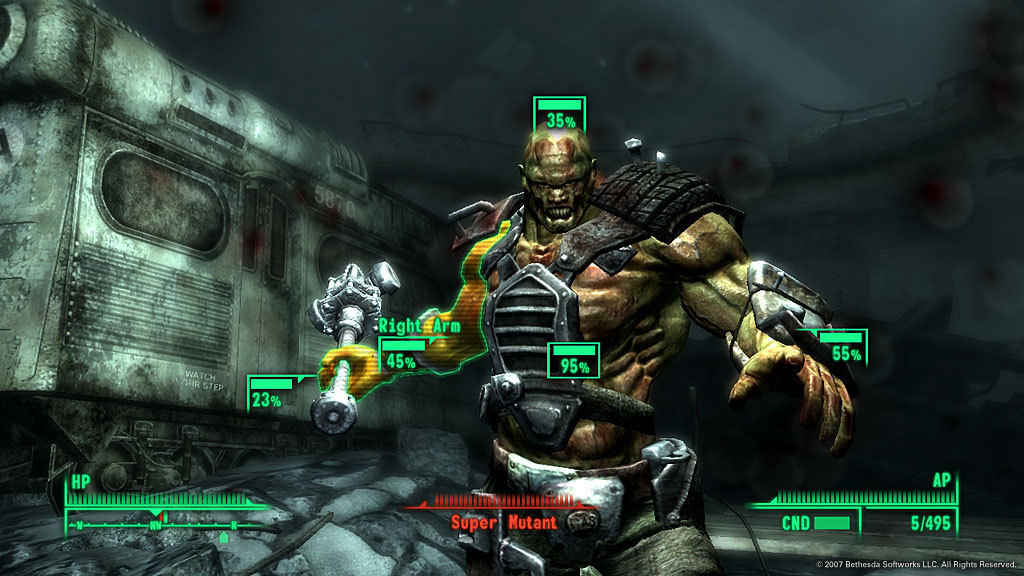
Bethesda’s smartest peace offering to the old guard was V.A.T.S., the Vault-Tec Assisted Targeting System. Freeze the fight, spend Action Points, and the game deals you percentages per limb: 95 to the torso, a gambler’s 45 on the arm holding the rifle, something insulting for the head. Commit, and the camera swoons through the consequences in syrupy slow motion. Shoot the gun out of a raider’s hands. Cripple a deathclaw’s legs to a limp. Take a super mutant’s skull off with the Bloody Mess perk turning arithmetic into vaudeville. The real-time gunplay underneath was always a little spongy — Oblivion’s sword-arm in a rifle costume — but V.A.T.S. made every skirmish a decision instead of a reflex test, and it remains the series’ signature: violence, itemised, at your leisure.
The Bomb in the Middle of Town
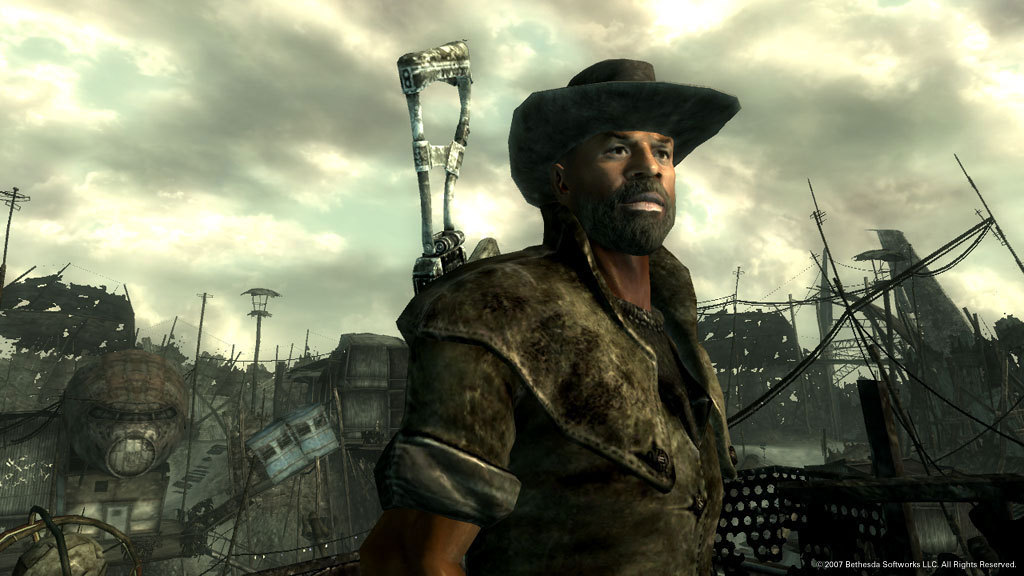
An hour out of the vault you walk into Megaton, a town built in the crater of an undetonated atomic bomb, and a church that worships it. A silk-voiced stranger named Burke offers you caps — and a view from Tenpenny Tower’s balcony — to rig the bomb to blow. Sheriff Lucas Simms offers you a house key and a clear conscience to disarm it. Whichever you choose, Three Dog will tell the whole wasteland on Galaxy News Radio — saint or devil, by name. That is Fallout 3’s moral engine: a karma meter blunt as a Saturday-morning cartoon, policed by Talon Company hit squads and bounty-hunting Regulators, while the choices it meters are far better than it is. The ghouls of Tenpenny Tower can be brokered a peaceful welcome that still ends with bodies in the lobby. Paradise Falls will pay you to enslave named, begging characters — and it feels grubby. In the grove of Oasis, a series veteran — Harold, the man who became a tree — asks you, kindly, to kill him. And in Rivet City hides the Replicated Man, an android who doesn’t know what he is: a seed the franchise would harvest two games later. Consequences rarely run deeper than a radio mention and a differently-cut ending slideshow — but the freedom to be monstrous or saintly, in a world this bleak, was close to intoxicating.
Fallout 3’s main quest is a straight line — but it is drawn through a masterpiece, and the masterpiece is everything that happens when you refuse to follow it.
Written in the Ruins
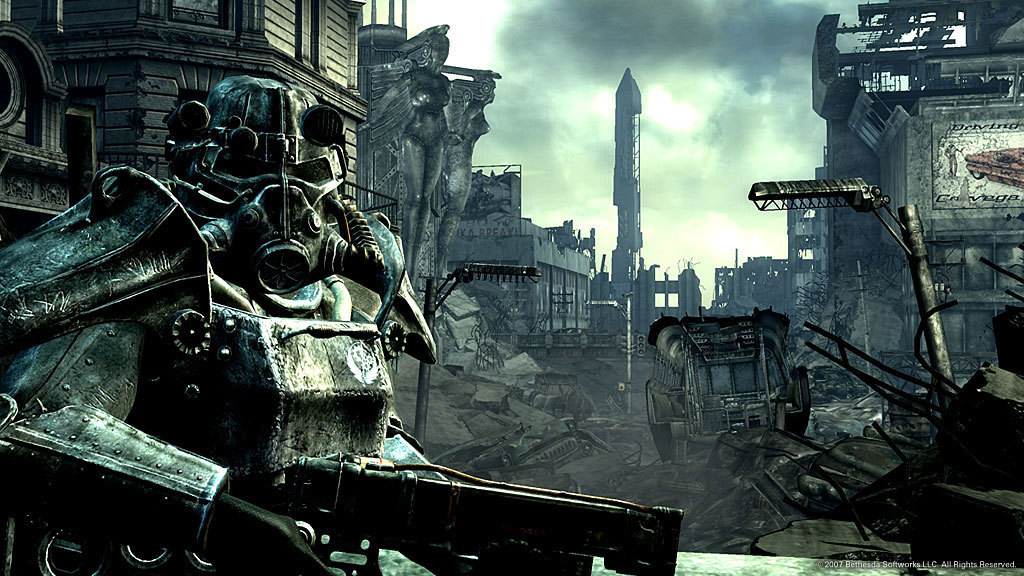
Honesty requires splitting the writing in two. The text along the main road is the weakest in any Bethesda hit: dialogue that can clunk like a Protectron reading a phone book, companions who are mostly luggage with catchphrases — the dog, and Fawkes the gentleman super mutant, honourably excepted — and a father’s grand design amounting, in the end, to martyrdom by water treatment. But leave the road and the game starts whispering brilliance. Its skeletons tell stories no script has to: two sweethearts in a bathtub, a table still set for a dinner two centuries cold, terminal diaries cooling in dead offices, and the Dunwich Building, where the wasteland briefly becomes a Lovecraft story. Moira Brown, Megaton’s indefatigable shopkeeper, writes the warmest, funniest quest chain in the game around your injuries — research, all of it, for her Wasteland Survival Guide. Malcolm McDowell savours every syllable as President John Henry Eden, the Enclave’s honey-voiced radio president, whose true nature is the game’s best-kept secret. And over it all, the radio: Erik Todd Dellums’ Three Dog, howling the news between the Ink Spots, Roy Brown and Cole Porter — “I Don’t Want to Set the World on Fire” crackling out over a world somebody plainly did. Fallout 3’s finest writing was never in its conversations. It was left lying in the ruins for you to read.
The Ending That Broke, and the Steel That Fixed It
And then there is the ending — the original ending, the scandal inside this one. Project Purity’s control room is drowning in radiation, and someone must walk in and not walk out. Beside you may stand Fawkes, who earlier happily waded through lethal radiation to fetch you a G.E.C.K. precisely because radiation cannot hurt him — or Charon, a ghoul, of the species radiation heals. Suggest either and the script ties itself in knots: Fawkes lectures you about destiny, Charon hides behind his contract; even the robot pleads programming. So you die, or Sarah Lyons dies, Perlman slideshows your eulogy, and — in an open-world game whose entire sacrament was the wandering — the credits close the door for good. Players were furious. They were also right.
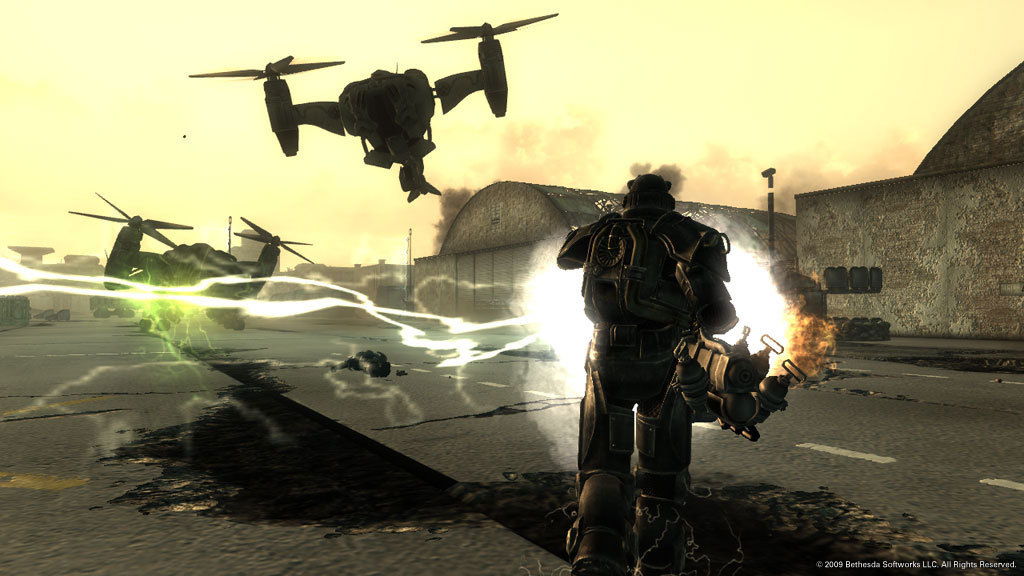
What Bethesda did next is rarer than what they did wrong: they fixed it. Broken Steel, the third of five expansions, arrived in May 2009 and picked up a fortnight later: you wake at the Citadel, the clean water running, the war unfinished — then marched the story to a proper conclusion at Adams Air Force Base under the Tesla Cannon’s blue fire. The level cap climbed from 20 to 30; Feral Ghoul Reavers, Super Mutant Overlords and Albino Radscorpions arrived to justify it; and the wandering could finally outlive the plot. Add Operation: Anchorage‘s Alaskan war simulation, The Pitt‘s genuinely grey slave revolt in a molten Pittsburgh, Point Lookout‘s swamp-gothic Maryland and Mothership Zeta‘s alien-abduction romp, and the Game of the Year edition became the canonical text. The Fallout 3 history remembers is a game whose makers had to be shouted into finishing it. Good — that is what the shouting is for.
Held Together by Duct Tape
None of it ran well, exactly. The Gamebryo engine — Oblivion’s bones, recostumed — delivered waxy faces, moonwalking NPCs and deathclaws launched into low orbit by physics tantrums; the PlayStation 3 version was the litter’s runt, its expansions arriving late and limping. On PC it sat shackled to the dying Games for Windows Live until 2021, when Bethesda’s rescue briefly broke the very mod scene it meant to save. Yet the jank has mellowed into folklore: this was a world held together by duct tape and ambition, and the ambition won. The unofficial patches, the texture overhauls, Tale of Two Wastelands welding this game and New Vegas into a single pilgrimage — the community became a second development team, and eighteen years later it’s still on shift.
Playing It in 2026
The definitive Fallout 3 is neither rare nor expensive, with one platform-shaped caveat. PC players get the Game of the Year edition — all five expansions in the box — on Steam and GOG, the GOG build the friendlier, backed by eighteen years of mods. On Xbox, the 360 version runs through backward compatibility with FPS Boost smoothing it to sixty frames: the most effortless route of all. PlayStation remains the slighted child — no native modern port exists, and the PS3 original streams through PS Plus Premium, warts and all. Fire it up in 2026, though, and the shock is how little translation it needs. Pick a direction, find a story, come home heavier — that loop is still the genre’s loop; Skyrim, The Witcher 3 and a hundred others walked out of this same vault. What has dated is the dialogue. What hasn’t is the walking.
Some sequels honour their inheritance. Fallout 3 committed the braver act of translating it — isometric certainty traded for the view from inside one pair of eyes, standing in the ashes of a capital that ended itself. War never changes, Perlman warned us, in 1997 and again in 2008. But Fallout did — completely — and the medium changed with it. Eighteen years on, the vault door still grinds open for somebody new every week, and the white light still does its work. The wasteland is still worth the walk.
Score: 9/10. A flawed masterpiece and a hinge in RPG history — a main quest outwritten by its own ruins, an ending its makers had to be shouted into fixing, and a Capital Wasteland that taught a generation of games how to be walked in.
📅 This game appears in This Day in Gaming History — October 28 →