
At a glance: Another World (Out of This World) demake · Apple II, lo-res graphics · by Vince “Deater” Weaver, VMW Software Productions · written from scratch in 6502 assembly · begun January 2019 · playable end-to-end by August 2019 and still growing · free disk images and source from the author’s project page
Éric Chahi’s Another World was the most cinematic game of 1991: a lone physicist, a lightning strike, and a hostile alien shore, all told in smooth rotoscoped polygons without a word of dialogue. It was ported almost everywhere, including to Apple’s own 16-bit Apple IIgs, which handled it handsomely at 320 by 200. The 8-bit Apple II, the machine from 1977 with its coarse 40-by-48 lo-res mode, was never going to get a version. Nobody told Vince Weaver. Working as “Deater” under his VMW Software Productions label, Weaver spent 2019 rebuilding Chahi’s film of a game, by hand, in 6502 assembly, for the original Apple II — not because the machine needed it, but because the gap between the two machines was exactly the sort of dare he likes.
A Film Shot in 1,920 Pixels
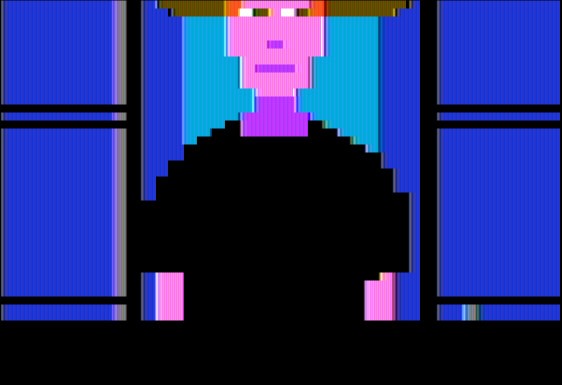
The trigger, by Weaver’s own account, was Paul Nicholas’s Pico-8 tribute to the game. Looking at its chunky little rendition, Weaver caught himself thinking that the colours on show were not far from what the Apple II could manage. That thought has a long history of getting him into trouble: his catalogue of “demakes” — modern or 16-bit games deliberately rebuilt for hardware far too weak to hold them — already included Myst and would go on to include Peasant’s Quest. Another World was the biggest target yet, because the original is not really a game with graphics so much as a short animated film you steer. Every scene is a composed shot. Compress it to a grid of 40 columns and 48 rows in fifteen colours and the question is whether the composition survives. Weaver’s answer was to reproduce the film shot by shot: the laboratory, the storm, the keypad, the plunge into the lake, working outward from the intro he finished first, in January 2019, to the opening caverns beyond it.
Nothing here is a conversion of anybody’s code. The Apple II version is a re-creation, assembled from observation — Weaver played the Apple IIgs edition as his reference and wrote every routine himself, sprite drawing, animation, the lot. In the trade this makes it a demake rather than a port, and the distinction matters: where a port translates, a demake re-stages. The beast that pounces in the first cavern, the slugs dropping from the ceiling, the rope you swing on over the pit — each had to be re-choreographed for a screen where a character is a handful of coloured rectangles, and where the machine underneath has less memory than the email announcing the result.
Squeezed Past the Limit
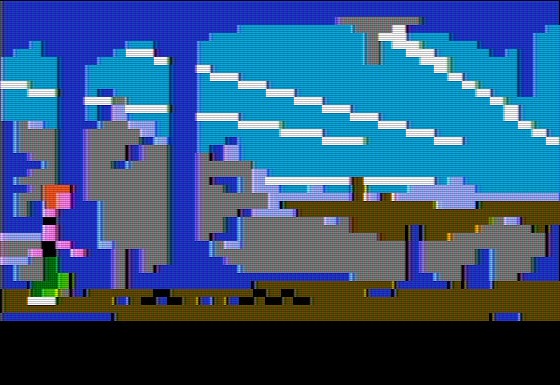
The development diary Weaver kept on the project page is the real treasure here, because it shows the walls closing in. The intro sequence alone, once optimised, still occupied 46 kilobytes — and the room available for it was about 42. The fix was to overlay the data with LZ4 compression, which brought the executable down near 28 kilobytes and bought the project its life. Level by level through the spring and summer of 2019 the diary records the same pattern: a scene that looks simple in the original turns out to hide a dozen small behaviours. The underwater arrival needed the tentacles animating properly. The cage sequence in the second level was, in his words, a lot of trouble for a very short scene, and it consumed four kilobytes of precious RAM on a single audio sample. The gun — which has to fire ordinary shots, raise shields and build up the big blast — plus working doors and an alien friend who follows you, pushed hard against what was left.
By the middle of August the fourth level was mostly complete and the fifth was a placeholder that would not fit on the disk at all. A week later, on 22 August 2019, version 2.7 landed with the entry every reader of the diary had been waiting for: the game was playable straight through, ending in credits set to Mockingboard music that, Weaver wrote, sounded so nice it needed something to play over. Within days, Hackaday carried the story to the wider retro world — the coverage that sent most people, this site’s original teaser included, to Weaver’s page. In September the demake took its place in Total Replay, the curated Apple II games collection, bugs and all; he noted cheerfully that the current revision crashed in a few known spots, including when you beat a level, and that fixes would follow.
“A 1991 polygon film, restaged on a 1977 home computer at forty-eight pixels tall — and the astonishing thing is not that it works, but how much of the film survives.”
Even the Director Approved
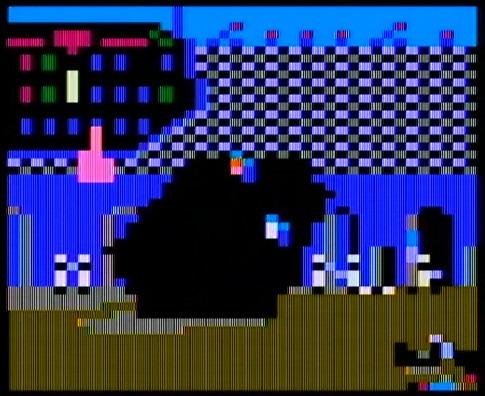
Most demakes end when the joke lands, but Weaver kept returning. By the turn of 2020 there was a proper title screen with a checkpoint menu, written in assembly to replace a BASIC stopgap. Through early 2021 the updates turned technical — faster disk loading, a move to LZSA compression, a rebuilt ending with far more frames — and then, in the spring of that year, the tank and arena sequence gained the animations it had been missing. The loveliest entry in the diary is from February 2021: Éric Chahi had found the project, liked it, and turned out to be a longtime Apple II user himself. The man who made the original on an Amiga had started, like so many of his generation, on the machine now struggling to contain his film at 40 by 48.
Weaver still files the project as partly implemented — placeholder screens stand in for some later checkpoints — and the honest description of the whole endeavour is that it is a playable tribute rather than a finished commercial port. But that undersells what is sitting on his site, free to download as a pair of disk images with the source code alongside: the complete arc of one of the most admired games ever made, running on a computer that predates its original release by fourteen years. The Apple IIgs version showed what Apple’s 16-bit machine could do with Another World. Weaver’s version shows something stranger and better — what the 8-bit machine can be persuaded to remember of it, one hand-drawn frame at a time.