In 1983, Activision’s Potsy the gardener defended his Brooklyn rooftop by dropping flowerpots on climbing bugs. In 2019, Andrew Bunker flipped the whole thing for the ZX Spectrum: now the gardener is a ninja, the rooftop garden is a dojo’s pride and joy — and the things climbing the walls, in waves of twelve, are more ninjas. Ninja Gardening Simulator is a ZX-Dev competition remake of Crackpots, a game the Spectrum never got first time round, and it is exactly as daft and exactly as compulsive as that sounds.
The original: Potsy versus the bugs
Crackpots was designed by Dan Kitchen and published by Activision for the Atari 2600 in 1983 — Kitchen’s first game for the company, released just months before the North American video game crash rearranged the industry. You play Potsy, a rooftop gardener whose Brooklyn building is being invaded from the sewer: bugs of four colours swarm up the wall towards six open windows, and your only weapon is a row of potted petunias. Shuffle left and right along the roof, time your drops, and squash them before they get in.
Its rules are beautifully strict, and they matter here, because Bunker’s remake keeps them almost untouched. Each level is four waves of twelve bugs. The bugs’ colours are their movement patterns — black climbs straight up, blue wiggles, red comes diagonally, green zigzags between windows. Let six or more bugs through the windows and they eat away a layer of the building, dropping you a floor closer to the street and sending you back to replay the level. Lose six layers and the building — and the game — is gone. One screen, one mechanic, escalating panic: a perfect 1983 arcade loop, and one that never received a Spectrum version in the machine’s commercial lifetime. Which is precisely the gap the remake exists to fill.
A remake of a game the Spectrum never had
Ninja Gardening Simulator was created for ZX-Dev MIA Remakes 2019, a strand of the long-running ZX-Dev homebrew competition devoted to games that were “missing in action” on the Spectrum — titles other machines enjoyed that the Speccy, for whatever reason, never did. Bunker built it in AGDX, the community-extended version of Jonathan Cauldwell’s Arcade Game Designer, the toolkit behind a large share of the modern Spectrum scene. It appeared at the start of March 2019, free to download — and this site’s original coverage, all 48 words of it, amounted to a scraped teaser and a “read the rest” link. The game deserved better. So here is the rest.
The premise keeps Crackpots’ rooftop but rewrites its story with a straight face and a wink. After a long day of intense training, you climb to the top of the dojo to tend your clan’s prized rooftop garden — the final duty of the day. Then comes a noise from below. A rival clan has broken into the compound and is already scaling the building. You locked the doors, as any sensible ninja would. But the windows are wide open — it’s a hot day, after all — and your entire arsenal is the garden itself: potted flowers, in quantity.
Waves of twelve
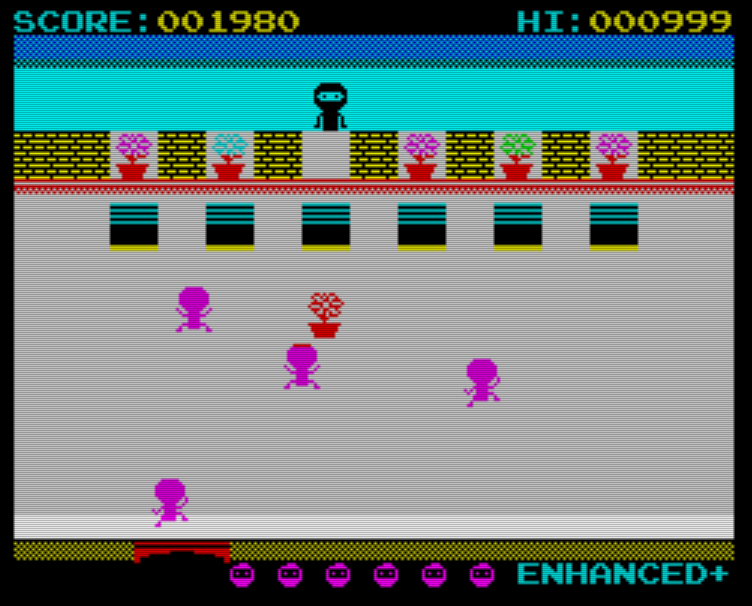
The mechanical fidelity is the lovely thing. The rival ninjas attack in groups of twelve, and each group uses a different climbing style — the exact counterpart of Crackpots’ colour-coded bug patterns, so reading how a wave climbs becomes the game, just as reading bug colours was in 1983. Defeat four groups and the next ones come faster, with more points on offer. If six ninjas manage to get in, they destroy part of the building — the rooftop drops, just as Potsy’s building lost a storey — and you take that group on again at a slower speed, a small mercy the original also granted. When the ninjas have damaged the building six times, the dojo falls and the game ends.
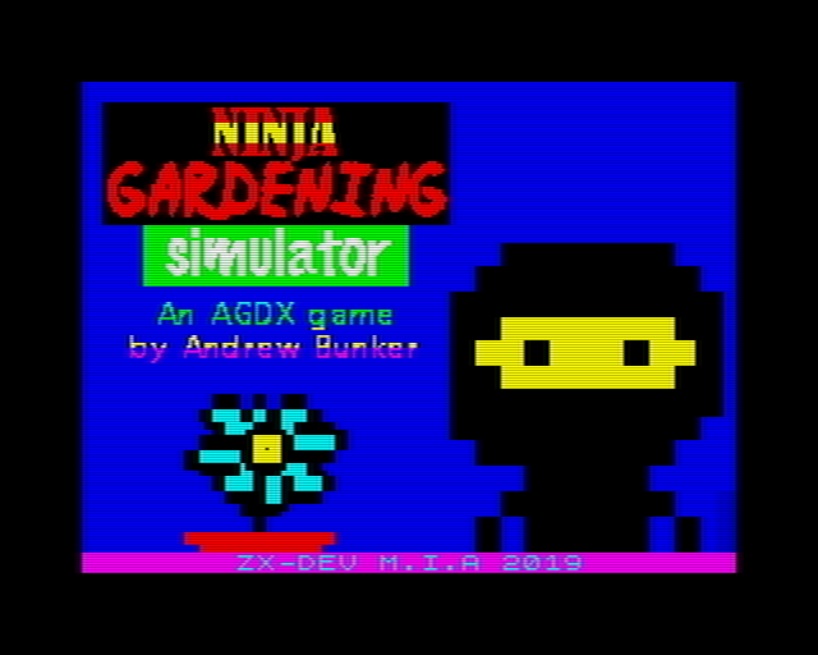
Around that faithful core, Bunker adds the modern homebrew trimmings. The menu offers three game types — Standard, Enhanced+ and Endurance — plus keyboard controls and a high-score table, and the game reached version 1.5, the mark of a competition entry its author kept polishing after the deadline. The presentation is pure Spectrum: a loading screen that states the whole joke in one image (ninja, flowerpot, done), bright attribute-colour climbers against the dojo wall, and the score and hi-score ticking away at the top while your pot supply waits along the ledge.
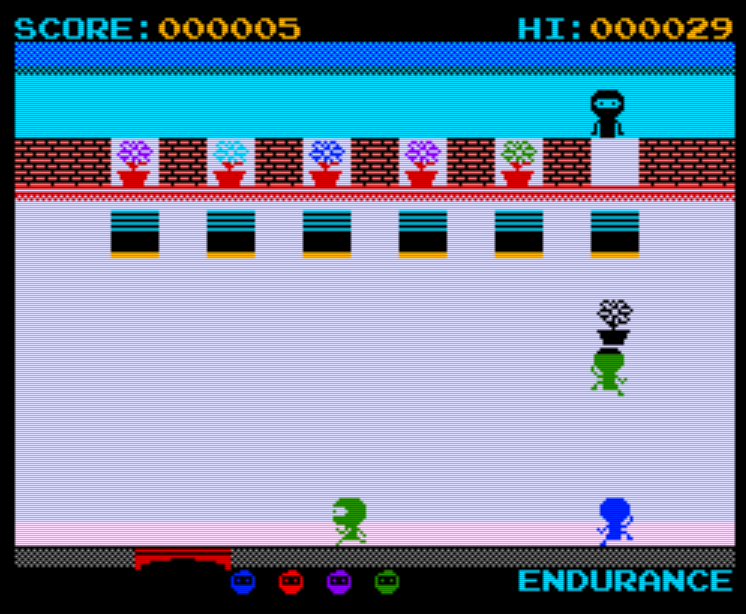
Three ways to defend a garden
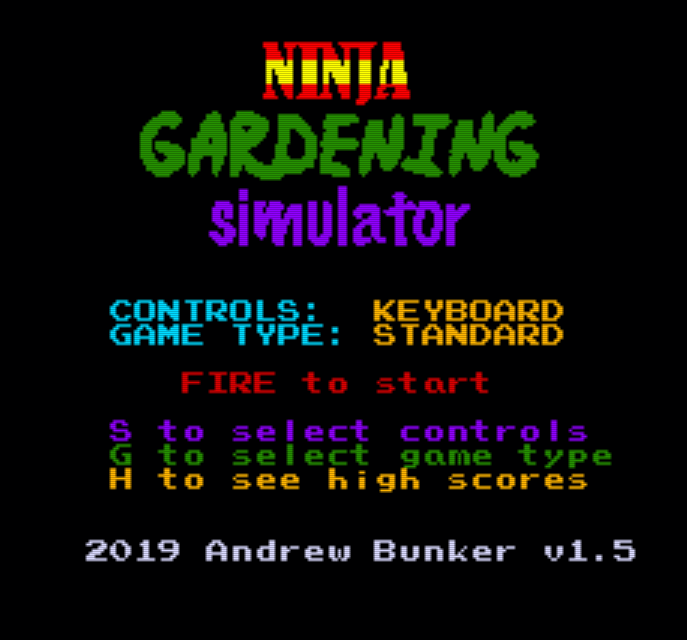
The remake also knows when to stop remaking. The game’s menu — the screenshot below is the real thing, v1.5 — offers three game types. Standard is the faithful one: Crackpots’ rules as Activision wrote them. Enhanced+ and Endurance are Bunker’s own variations on the theme, and the screenshots in this article show both in action — different colour schemes for the climbing clans, different scoring chases, the same six windows waiting at the top of the wall. It’s a small thing, but it’s the difference between a tribute and a game: the 1983 rules are there if you want them, and there’s more on the tape if you don’t. Add the high-score table — the true final boss of every score-attack game — and the package is complete in a way plenty of full-price Spectrum releases in 1983 never managed.
Why it works
Partly it’s the source material — Crackpots’ loop was already a one-more-go machine, and dressing it in ninja colours loses none of its tension. The drop of a pot takes time to fall; a climber two windows away is a judgement call; a wave whose climbing style you haven’t learned yet is a genuine problem arriving at speed. Partly it’s the comedy, which the game never oversells: highly trained assassins, defeated by horticulture. And partly it’s what the game represents. In March 2019 the Spectrum — thirty-seven years old, commercially dead for a quarter of a century — was receiving new games good enough to argue about, built with community tools for community competitions, given away free. Ninja Gardening Simulator is a small game about a gardener with improbable enemies. It’s also evidence, if any were still needed, that the Speccy’s second life is not a nostalgia act. It’s a going concern.
The game is a free download from its itch.io page, for emulators and real hardware alike. Potsy would approve — though he’d probably want a word about whose roof it is.
A note on this post’s history: it originally ran in March 2019 as a 48-word scraped teaser — the opening of somebody else’s news post and a “read the rest” link. The text above is the full story, written for this site; the post keeps its original URL and March 2019 date.
Keep reading: Impossabubble: Dave Clarke Turned Himself into a Bubble, and the Spectrum Got a Platformer — the other ZX Spectrum homebrew feature in this set — another bedroom-coded gem, given its full story.