The plot is a lab accident: somebody’s experiments with bubble-mix were meant to create levitating assassins, you foiled them — and got turned into a bubble for your trouble, with twenty-one of your friends bottled as bubble mixture across twenty-eight screens of traps. Impossabubble, released in February 2018, was Dave Clarke’s first game released on actual cassette tape, something he’d wanted since childhood. Some dreams are very specific. This one floats.
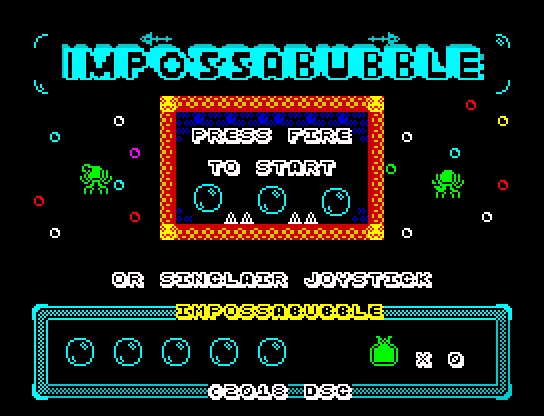
You are the bubble
Most platform heroes can jump. A bubble can’t — a bubble rises, drifts, and is at the mercy of every draught and doorway, which turns out to be a genuinely good idea for a platform game. In Impossabubble you float through a network of twenty-eight interconnected screens, hunting for the bottles that hold your transformed friends — twenty-one of them, each one a frothing vial of bubble mixture waiting somewhere in the complex to be collected. The game’s own status panel keeps the tally in front of you: a row of vial icons along the bottom of the screen, filling in as the rescue proceeds, so the whole quest is always visible at a glance.
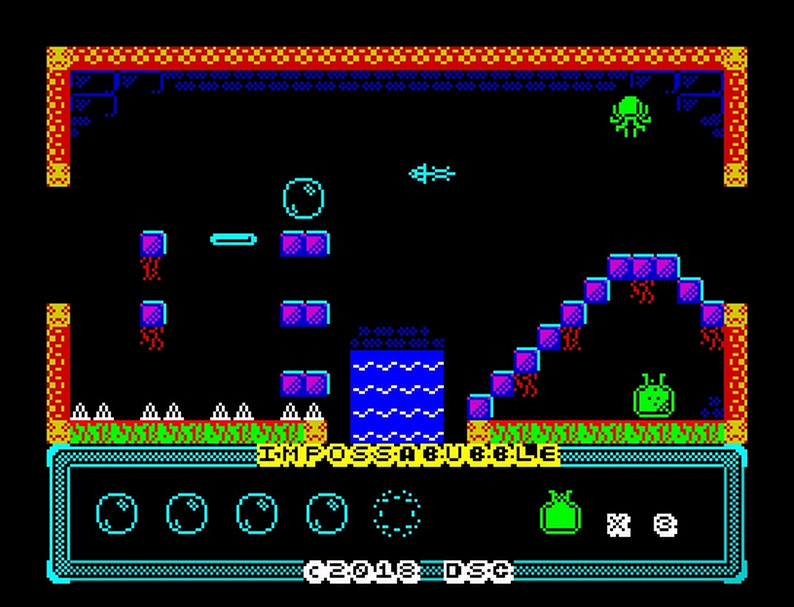
The screens are proper little obstacle courses — platforms to drift between, braziers and machinery to avoid, and the local wildlife very much not on your side. Contemporary reviewers called them “creepy-crawlies”; the game’s own screenshots show the menagerie plainly enough — crab-like crawlers patrolling the floors, a spider waiting in the rafters, a fish cruising its tank of water, and spikes everywhere a bubble least wants to be, which is to say anywhere near the floor. One touch is all it takes. You’re a bubble. The tension is built into the casting.
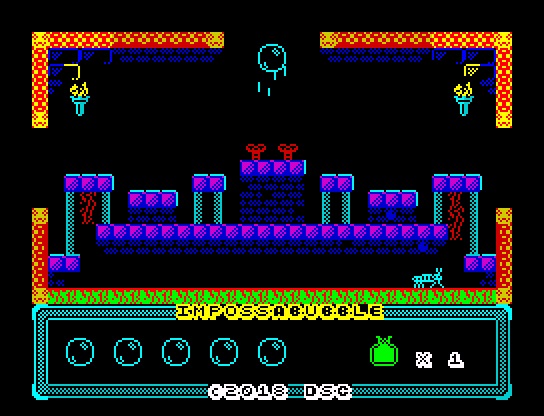
Twenty-eight rooms, twenty-one friends
The structure deserves a moment, because it’s doing quiet work. Twenty-eight interconnected screens is a lot of map for a 48K game, and the interconnection is the point: Impossabubble isn’t a sequence of levels to beat but a little world to learn — which rooms hold vials, which routes are spike-lined shortcuts, which crawler patrols which floor. The contemporary review described being “deposited into the middle” of the network and left to explore it, platforms, obstacles, traps and all. That design — one continuous complex, a rescue tally always on screen, progress you can see filling in along the bottom panel — is borrowed from the flick-screen arcade adventures the Spectrum did better than any machine of its era, and it suits the bubble perfectly. A hero who can’t fight and can barely steer has no business in a linear obstacle course. In a maze, though, a bubble is a detective: patient, curious, and one draught away from disaster.
And disaster is always close. Look at the screenshots in this piece: the bubble’s world is braziers, spikes, water and things with too many legs, arranged with the particular cruelty of a designer who knows his hero pops on contact. The difficulty isn’t a flaw in the concept — it is the concept, right there in the title. Impossible? No. Impossabubble: improbable, fragile, and just buoyant enough to try the next room.
Made the modern homebrew way
Clarke built the game in Arcade Game Designer, Jonathan Cauldwell’s much-loved Spectrum toolkit — the engine room of the modern Speccy homebrew scene — handling code and graphics himself. Two collaborators round out the credits, and both are worth naming because the game wears their work proudly. The music is by David Saphier (who also releases under his scene name em00k — the two credits you’ll find in the wild are the same person), and it is the release’s showpiece: the game came in 48K and 128K versions, and while both play the same, the 128K build carries Saphier’s AY-chip soundtrack, which the contemporary review at Vintage is the New Old praised in terms reviewers usually reserve for commercial classics — “truly excellent music… some really funky stuff,” from a writer who admitted to still listening while he typed. On a 48K machine the same file runs in silence, which makes Impossabubble a small parable of the Spectrum’s two-tier world: same game, but the 128K owners got the soundtrack. The loading screen is by Andy Green, one of the scene’s most prolific pixel artists — the game’s first impression, delivered the traditional way, while the tape hissed.
A childhood ambition, on tape
Here is the detail that lifts Impossabubble out of the weekly homebrew round-up. When the game was announced on February 9, 2018, the announcement carried a line you don’t often see: this would be the first game Dave Clarke had released on tape — an actual cassette, from Monument Microgames — “something he has always wanted to achieve since his childhood days.” Anyone who grew up with a Spectrum understands that sentence in their bones. In 1984, a game wasn’t finished when it ran; it was finished when it existed as an object, in a case, with a loading screen, on a shelf. Thirty-four years later, Clarke closed that loop.
For everyone else, the game arrived the modern way: the digital download went on sale February 10, 2018, for $1.49 — pocket money even by 1980s budget-label standards — as .tap files for emulators and real hardware alike. And it is still there: the game remains on itch.io at the same pocket-money price, and Clarke’s own website, retrobeachman.com, lets you play Impossabubble free in the browser through the JSSpeccy emulator, no download at all. He kept going afterwards, too — his site is a small workshop of later Spectrum and Spectrum Next projects. The bubble was the beginning, not the whole story.
The bottom line
Impossabubble is a modest game with everything in the right place: a hero with a built-in weakness, a rescue you can count on the status bar, twenty-eight rooms that reward learning, a first-rate soundtrack for the 128K crowd, and a cassette release that meant something personal to the man who made it. It asks for $1.49, or nothing at all in a browser — and it gives you a whole little world of spikes, vials and held breath in return. This site’s original coverage was a 48-word scraped stub that stopped mid-sentence. The game deserved the full story — a small, perfectly formed bubble of a platformer, and proof that in 2018 the Spectrum’s bedroom-coding era hadn’t ended. It had just grown up, kept its day job, and started releasing its childhood dreams on tape.
A note on this post’s history: it originally ran in February 2018 as a 48-word teaser scraped from another site’s news post. The text above is the full story, written for this site; the post keeps its original URL and February 2018 date.
Keep reading: Ninja Gardening Simulator: The Spectrum’s Crackpots, With the Ninjas on the Outside Trying to Get In — the other ZX Spectrum homebrew feature in this set — a Crackpots remake the Spectrum never had first time round.