The Sega Saturn is the great what-if of the 32-bit era. In Japan it was a success — Sega’s best-selling home console there, stuffed with arcade-perfect shooters, deep RPGs and 2D games the hardware was practically built for. In the West it was a slow-motion car crash: a surprise early launch, a price tag a hundred dollars too high, and a catalogue that quietly left most of its best games on the other side of the Pacific.
Which means the Saturn’s hidden-gem shelf is deeper than any other console’s. Some of these twelve never left Japan at all. Some got Western releases so small, so late or so weirdly marketed that almost nobody played them. All of them are worth your time in 2026 — and thanks to fan translations, ODEs and emulation, all of them are more playable now than they were at launch. Countdown rules: Western obscurity counts as much as quality, and every game here had to be one I’d actually hand to a friend. Let’s dig.
The countdown
12. Mr. Bones (1996)

Start with the strangest game Sega of America ever published. Mr. Bones is a blues musician raised from the dead by a mad scientist, who rebels and fights back across twenty-odd stages that cannot agree on what genre they are: side-scrolling platforming, rhythm-action guitar solos, first-person bits, FMV, live-action footage, a comedy-club level. It is WarioWare five years before WarioWare, held together with pre-rendered string.
It is also, honestly, a mess — uneven, sometimes barely playable, and absolutely one of a kind. Your skeleton literally loses limbs as he takes damage, which tells you everything about the game’s priorities: charm first, polish whenever. Sega pushed it hard in the US in 1996 and it still vanished. A complete copy runs roughly $90–100 in 2026, which feels right for the Saturn’s weirdest Western exclusive. Play it once and you’ll talk about it forever.
11. Three Dirty Dwarves (1996)
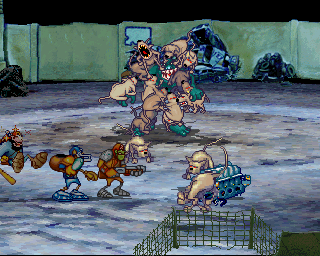
SegaSoft’s cartoon brawler is what happens when a role-playing game dice roll goes wrong and three fantasy dwarves — a warrior, a wizard-ish bruiser and a juggler of lethal bowling balls — get teleported into a modern American city to rescue the kids who summoned them. The setup is pure 1996, and the game commits to it completely: big, hand-drawn-looking sprites, squash-and-stretch animation, and streets full of enemies to flatten in three-player co-op.
Under the jokes it’s a solid belt-scroll beat-’em-up with character-switching mechanics that were genuinely ahead of the curve — you tag between dwarves mid-fight, and downed partners can be revived by literally bouncing them back to life. It reviewed respectably, sold almost nothing, and got quietly forgotten next to Guardian Heroes. It shouldn’t have been. This is one of the most purely fun multiplayer games on the system.
10. Linkle Liver Story (1996)
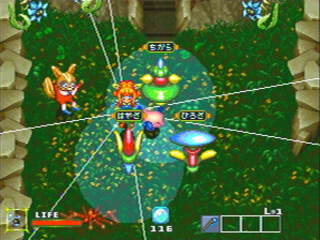
Here is the pattern this whole list exists for: a charming Nextech action-RPG, developed by the team behind much of Sega’s best Genesis work, released only in Japan because by 1996 Sega of America had effectively stopped localising Saturn RPGs. You play Kitsch, a young cat-girl adventurer in a bright storybook world, hacking through monsters in real time, Zelda-style, while a living weapon — a plant-like companion called a Liver — grows and evolves alongside you based on how you feed and use it.
That weapon-raising system is the hook: part pet, part arsenal, years before monster-raising mechanics became an industry. The tragedy is how close it came to travelling — it needed one middling localisation deal. The happy ending is that a full English fan translation arrived in 2019, and in 2026 this is a completely playable, completely delightful weekend RPG. The West missed it for twenty-three years. It doesn’t have to miss it anymore.
9. Keio Flying Squadron 2 (1996)
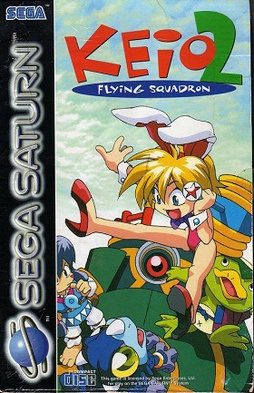
A rare twist for this list: this one isn’t Japan-only, it’s America-only-missing. Victor Entertainment’s sequel to the Sega CD cult favourite reached Japan and — unusually — Europe, but never North America. Rami Nana-Hikari, the bunny-costumed shrine maiden from the first game, returns, and this time the cute-’em-up shooting is only half the game: whole stages switch into side-scrolling platforming, complete with swimming, mine carts and a spot of football against a boss.
It’s a genre-hopping variety pack wrapped in some of the most gorgeous hand-drawn 2D the Saturn ever produced — this is the machine in its element, all colour and sprite-scaling confidence. The platforming is looser than the shooting, and purists grumble, but as a complete package it’s irresistible. The PAL version is the collector’s route in 2026 and it is not cheap; emulate first, fall in love, then decide what your shelf is worth.
8. Bulk Slash (1997)
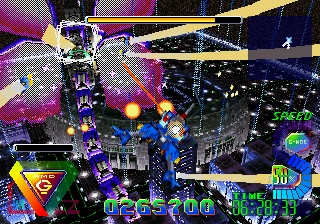
Hudson Soft’s Bulk Slash is my favourite answer to the laziest claim in retro gaming: “the Saturn couldn’t do 3D.” You pilot a transforming mech — walker on the ground, jet in the air — through seven fully 3D city stages, blowing up installations, duelling rival machines and hunting hidden navigators, anime co-pilots who ride along and level up with you. It runs at a smooth clip, the cities feel genuinely open, and the whole thing has the propulsive energy of a great arcade game stretched across a campaign.
Japan-only, of course — 1997 was far too late for Sega of America to take a chance on an anime mech game with no licence attached. For decades the Japanese text kept importers at arm’s length. Then a fan translation in 2021 — with dubbed audio, an astonishing amount of work — opened it up completely. In 2026 there is no excuse left. This is a top-five Saturn action game, full stop.
7. Dark Savior (1996)
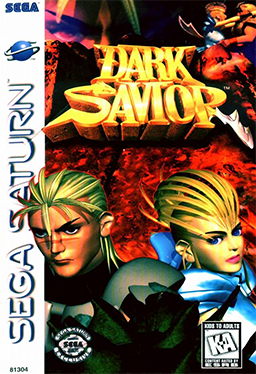
Climax made Landstalker, then made this: an isometric action-RPG about a bounty hunter escorting a monster to a prison island, built around a “parallel scenario” system that has to be the most ambitious structure on the Saturn. Depending on how the opening ship sequence plays out — how fast you move, what you do — the entire rest of the game branches into one of several parallel stories, with different plots, different villains and different endings, all riffing on the same events.
It got a Western release and decent reviews, then got buried — by the PlayStation’s RPG wave, by its own awkward camera, by 1996. Replayed today, the ambition is startling: this is a game about replaying a game, about how small choices reroute a whole story, dressed as a quirky isometric adventure with a capture-and-battle monster system bolted on. Three or four playthroughs, none of them long, all of them different. Nothing else on the system works like it.
6. Albert Odyssey: Legend of Eldean (1997)
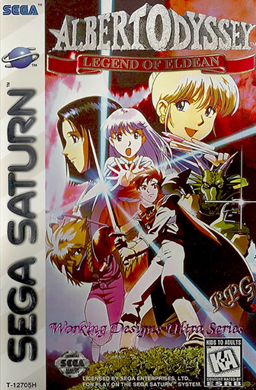
The Saturn’s Western RPG library is so thin that a merely very good one becomes essential — and Legend of Eldean is very good indeed. Sunsoft’s series had lived on the Super Famicom; this Saturn entry is a warm, traditional turn-based RPG with lush 2D towns, a fine orchestral score and a story about a boy raised by winged Harpies that knows exactly what it is and executes it beautifully. No reinvention. Just craft.
Its Western existence is a small miracle: Working Designs localised it in 1997, jokes and all, when almost nobody else was bothering. Naturally it sold modestly, and naturally it now costs serious money — a complete US copy in 2026 can run $250 and up, among the priciest Saturn games in the West. Play the fan-preferred routes, emulate it, borrow it — but play it. It’s the sound of a genre the Saturn was denied, done properly.
5. Elevator Action Returns (1997)

Taito’s 1994 arcade sequel is one of the great lost action games, full stop. The original Elevator Action was a stiff little spy caper; Returns is a gritty, beautifully animated run-and-gun-platform hybrid — three commandos, dozens of elevators, buildings full of doors to kick in, hostages, bombs to defuse, and some of the weightiest sprite work of the decade. Every floor is a little tactical puzzle at gunpoint.
The Saturn port, published by Ving in Japan in 1997, is essentially arcade-perfect — and that was the problem. Arcade-perfect ports of two-year-old coin-ops were exactly what the Western market of 1997 did not want, so it never crossed the ocean. It finally got official Western releases in Taito collections decades later, which tells you how long the wait was. On Saturn, in-period, it’s a masterpiece that might as well not have existed west of Japan. Seek out the port; it even throws in the 1983 original as a bonus.
4. Deep Fear (1998)
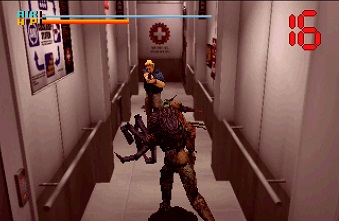
Sega’s in-house answer to Resident Evil, set aboard a sinking underwater research station — and in several ways the cleverer game. Deep Fear adds an oxygen system to the survival-horror formula: air is a resource, rooms flood, and the whole station is a drowning machine that happens to also contain mutants. The pre-rendered backgrounds are gorgeous, the FMV is gloriously hammy, and John Barry — yes, the James Bond composer — contributed music. This was a big-budget, first-party production.
And it was the last Saturn game ever released in Europe, in mid-1998, in tiny numbers, while America never got it at all. Sega’s own flagship horror game, abandoned by its own regional divisions — the Saturn story in miniature. The PAL version is legendarily expensive now, four figures sealed and several hundred loose. Play it via import, ODE or emulation and you’ll find a horror game that deserved to stand next to Capcom’s, not in its shadow.
3. Astal (1995)
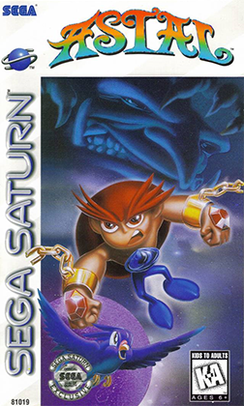
Put Astal on a modern screen and it still stops conversations. Sega’s 1995 platformer is hand-painted 2D at its absolute peak — watercolour worlds, enormous sprites, parallax layers stacked to the horizon — wrapped around a simple, gentle platformer about a strong-armed boy rescuing his friend from a crystal prison. As a game it’s slight: short, easy, over in an afternoon. As a demonstration of what the Saturn was for, it has never been beaten.
Timing killed it in the West. Astal arrived in North America in the Saturn’s chaotic launch window, when every magazine wanted to talk about polygon counts and 2D was suddenly last year’s news. It sold accordingly. The irony is thick: the “old-fashioned” game aged better than virtually every 3D launch title on either 32-bit machine. Complete copies sit around $120–150 in 2026, and the Japanese version — cheaper, same art, minimal text — is the smart buy.
2. Legend of Oasis (1996)

Ancient — Yuzo Koshiro’s studio — made the Genesis cult classic Beyond Oasis, and this Saturn sequel (a prequel, technically) is bigger, prettier and better in nearly every way. Prince Ali, the Golden Armlet, six elemental spirits to recruit and swap between on the fly, each one a tool, a weapon and a key: fire for lanterns and ice-melting, water for crossing and healing, shadow for reaching the unreachable. The world is one vast hand-drawn puzzle box, and Koshiro’s score is, predictably, superb.
It did release in the West, late in 1996, to a shrug — top-down 2D adventures were exactly what the market was sprinting away from, and the Saturn’s Western installed base was too small to sustain it. That’s the only explanation, because on merit this is a top-ten Saturn game outright. At roughly $130–160 complete in 2026, it’s priced like the gem it is. If you play one action-adventure from this list, make it this one.
1. Soukyugurentai / Terra Diver (1996)
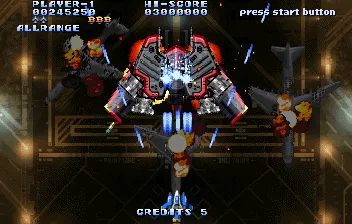
The number one spot goes to the game that defines the Saturn’s Japanese library in a single cartridge. Raizing’s vertical shooter — from the Battle Garegga team, with a Hitoshi Sakimoto soundtrack — hands you three fish-named fighters and one brilliant weapon: hold fire and your ship projects a targeting web, locking onto everything inside it, then unleashes a storm of homing lasers. It turns crowd control into a geometry problem, and every stage is built around it. The ST-V arcade original ran on Saturn-based hardware, so the home port is effectively perfect — with the 4MB RAM cart smoothing the ride.
It never left Japan. Not in 1997, not in the decades of retro re-releases since (a modern port finally arrived only recently, and Japan-first at that). For thirty years, the West’s window on one of the greatest shooters ever made was import shops and word of mouth. Japanese copies remain comparatively sane — around $100 — because Japan actually got to buy it. This is the hidden gem as the Saturn lived it: world-class, beloved at home, and invisible abroad.
The import shelf is the real library
Step back and the pattern is unmistakable. Of these twelve, the majority either never left Japan or reached the West in numbers too small to matter — and that’s not a list of leftovers. It’s the Saturn’s centre of gravity. Sega built a brilliant 2D-and-arcade machine for a home market that loved it, then spent the Western campaign apologising for exactly those strengths.
The Saturn didn’t fail in Japan — and its Japanese library is the receipt. The West didn’t miss a few games. It missed the console’s whole personality.
The good news is that in 2026 the wall is down. Fan translations cover Linkle Liver Story and Bulk Slash, ODEs and imports are cheaper than the Western rarities, and every game on this list is findable. The Saturn the West mostly missed is, finally, the Saturn anyone can play.