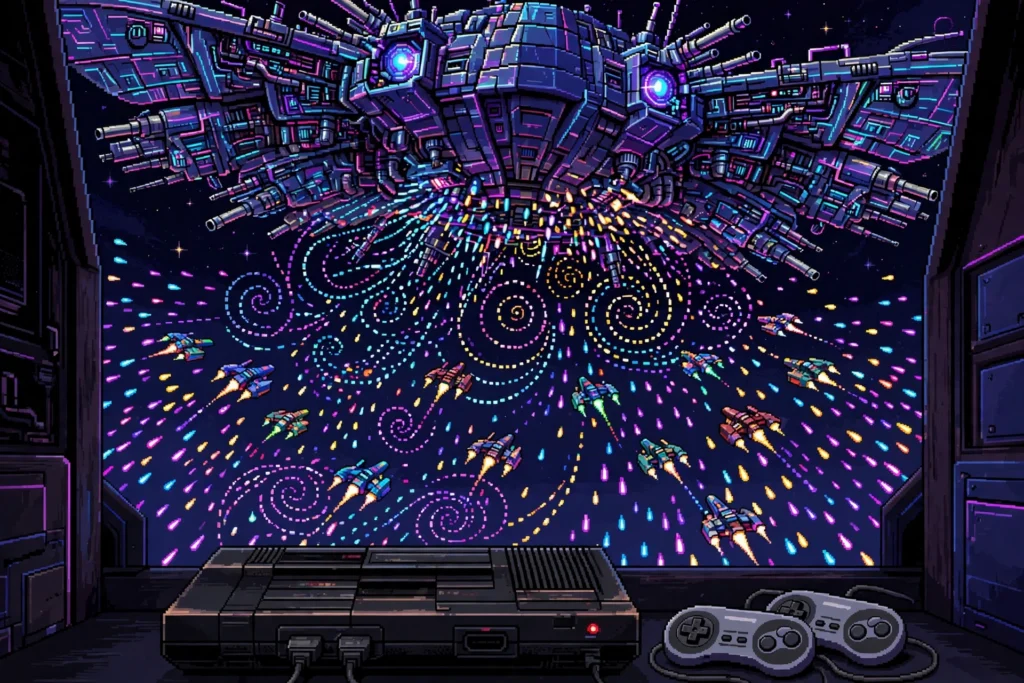
Sega’s marketing department invented “Blast Processing” as a slogan, but the Genesis shmup library is the closest thing to proof it ever existed. The Mega Drive’s fast 68000 and sprite muscle made it the natural home of the early-nineties shooter — and developers noticed. While the SNES produced beautiful, slowdown-prone shooters, Genesis studios shipped games that moved like they had something to prove: parallax stacked on parallax, screen-filling bosses, impossible sprite counts.
This is a ranked countdown of the twelve best of them. Ground rules: Genesis and Mega Drive only, so no Sega CD (sorry, Silpheed — your day will come), and price warnings where they matter, because several cartridges here now cost more than the console did. Counting down from twelve:
The countdown
12. Bio-Hazard Battle (1992)
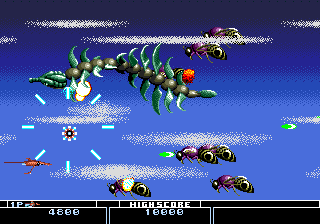
The odd one out, and proud of it. Where every other game here flies a metal ship through metal fleets, Bio-Hazard Battle grows its shooter instead: you pilot a living bio-ship over a planet overrun by mutated insects, worms and things with too many legs. The whole game has a damp, organic squelch no other Genesis shooter attempts, and its soundtrack — all queasy, warping FM tones — is either genius or a dare.
Mechanically it is a solid horizontal scroller with a charge shot and four selectable ships, elevated by sheer atmosphere and some genuinely unsettling boss designs. It never quite reaches the precision of the games above it, which is why it opens the list rather than climbing it. The good news: it remains one of the cheapest games here, still findable loose for the price of a sandwich. Start your Genesis shmup collection with the weird one.
11. Wings of Wor / Gynoug (1991)
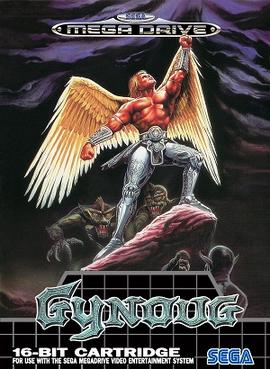
Masaya’s Gynoug — Wings of Wor in North America — casts you not as a ship but as Wor, an angel with frankly enormous wings, blasting through stages that look like H.R. Giger’s sketchbook after a fever. Eyeballs. Teeth. Bosses that appear to be screaming faces stretched across the whole screen. In 1991, on a family console, this was genuinely transgressive stuff, and it still startles.
Under the nightmare imagery sits a competent, sometimes excellent horizontal shooter with a flexible magic system — you collect spells and choose when to unleash them, which adds a layer of resource management most contemporaries lacked. It places here rather than higher because the hit detection can be mushy and the difficulty lurches rather than climbs. But as a piece of pure Genesis weirdness it is essential, and loose copies remain mercifully affordable. Play it for the art direction; stay because the shooting is better than you have been told.
10. Steel Empire (1992)
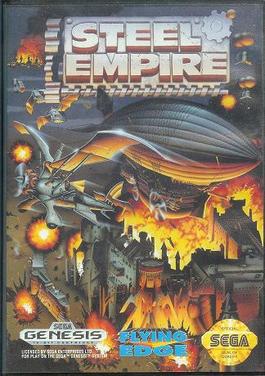
Hot-B’s Steel Empire asks a simple question: what if a shmup, but Victorian? The result is a steampunk shooter — that word barely existed in games in 1992 — where you choose between a nimble biplane and a lumbering zeppelin and take on a world of steam trains, ironclad airships and riveted fortresses. The sepia-and-brass palette gives it a look shared by nothing else on the console.
Its signature system is experience: destroyed enemies drop points that level up your firepower, an RPG idea smuggled into a shooter years before that became fashionable. Forgiving by this list’s standards, Steel Empire is the one I hand to newcomers — challenging enough to respect, gentle enough not to humiliate. Modern re-releases keep the original cartridge honest: boxed copies are collectible but not yet ruinous.
9. Twinkle Tale (1992)
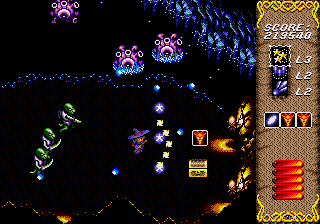
Never released outside Japan, Twinkle Tale is the list’s most charming entry: a vertically scrolling shooter where you are a young witch on foot, wand blazing, crossing a storybook fantasy world. Think Pocky & Rocky by way of Compile — ground-based movement, free-roaming screen space rather than a forced march, and a choice of three upgradable magic types, from homing stars to a devastating dragon summon.
What earns its place is control. Because you walk rather than fly, dodging becomes a ground game — weaving between enemies and terrain with an intimacy flyers never get — and the lush, colourful art holds up beautifully. What keeps it at nine is scarcity doing the talking in the worst way: original Japanese cartridges routinely list at several hundred dollars, making this one of the most expensive games on the entire system. Play it via its modern re-release or not at all — but do play it.
8. Battle Mania Daiginjou (1993)
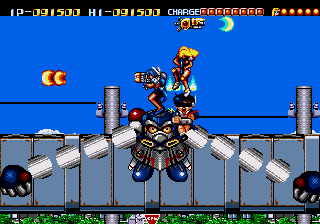
Vic Tokai’s sequel to Trouble Shooter never left Japan, which is a crime, because Battle Mania Daiginjou might be the most fun per megabyte on this list. You play both Trouble Shooters — Madison and Crystal, jetpack-toting mercenaries — one under your control, the other as a floating partner whose aim you set. The stages are pure early-nineties anime delirium: a bathhouse, a deranged game show atmosphere, enemies ranging from salarymen to shrine maidens, all of it played completely straight-faced.
As a shooter it is more exuberant than exacting — the partner system gives you eight-way coverage that trivialises some sections — but the sprite work is huge, the jokes land, and it never stops inventing. The price, sadly, is no joke: genuine cartridges are among the rarest on the Mega Drive and command four-figure sums at the extreme end. This is the list’s strongest argument for why re-releases and emulation matter.
7. Truxton / Tatsujin (1989)
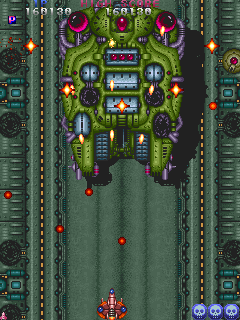
Toaplan basically invented the modern vertical shooter, and Truxton — Tatsujin in Japan — is where the template hardened: three weapons (the screen-eating Power Shot, the piercing Sun Laser, the iconic spread of the Thunder Laser), relentless enemy waves, and checkpoints that send you back powered down and furious. The Genesis port, arriving in 1989 as one of the console’s earliest shooters, is startlingly close to the arcade — the screenshot above is the coin-op, and the home version’s honesty to it is the point.
Why only seventh? Because Truxton is a foundation, and foundations are admired more than loved. It is stern, sparse and brutally hard — a game that respects you so little it loops, harder, forever. But every vertical shooter that followed owes it rent, and Genesis owners got the real thing while it was still new. Cartridges are mid-priced: correct money for a history lesson this playable.
6. Elemental Master (1990)
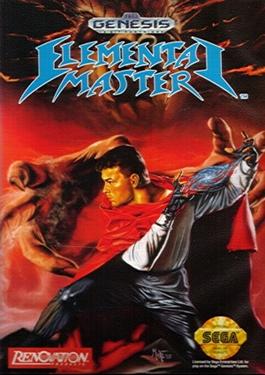
Before Thunder Force made their name, Tecno Soft made this: a vertical shooter where, like Twinkle Tale, you are a person rather than a ship — Laden, a robed sorcerer betrayed by his own brother, fighting through a dark fantasy world on foot. The twist that defines it is directional freedom: you can fire behind you at the tap of a button, and the level design constantly ambushes you from both directions, turning every stage into a two-front war.
Then there is the music. Toshiharu Yamanishi’s soundtrack is, track for track, one of the finest on the Genesis — driving, melancholic FM that collectors cite in the same breath as the console’s best. The elemental weapon system (fire, water, earth and wind, unlocked from bosses and freely switchable) rewards experimentation rather than rote power-up collection. Japanese and Western cartridges both sit in the “expensive but attainable” bracket. A connoisseur’s shooter, and the highest-placed of the on-foot brigade.
5. Eliminate Down (1993)
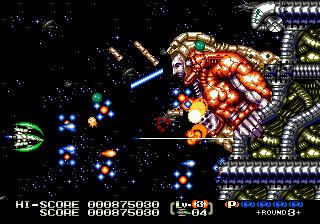
The deep cut that justifies the whole list. Eliminate Down, from tiny studio Aprinet, was a 1993 Japan-and-Korea-only horizontal shooter that almost nobody played at the time — and it plays like the genre’s greatest hits remixed by obsessives. Eight stages, each changing the rules: asteroid fields, organic tunnels, a stage that tips the scrolling on its head. Your ship, the Steel Pyron, carries three switchable weapons and one of the great charged shots of the era.
Technically it is astonishing — huge sprites, minimal slowdown, parallax everywhere — the work of a small team showing the big studios how it was done. Why not higher? Sheer inaccessibility, in both senses: the difficulty spikes cruelly in the back half, and an original cartridge is now one of the most valuable Mega Drive games in existence, with boxed copies reaching well into four figures. The recent modern re-release is a public service. This is the one your favourite shmup developer has played.
4. Gleylancer (1992)
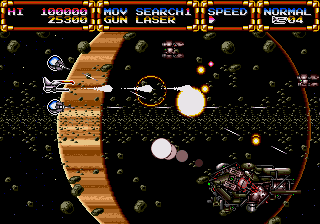
Masaya’s Gleylancer is the thinking player’s horizontal shooter. Your ship is trailed by two gun pods — Movers — and before launch you choose their behaviour from seven formations: chase the enemy, orbit you, lock in place, fire backwards, and more. That single decision reshapes every stage, and experimenting with formations against bosses that were plainly designed around them gives Gleylancer a replayability most of this list cannot match.
It is also, simply, gorgeous — anime cutscenes, a sweeping space-opera story about a young pilot stealing a prototype fighter to rescue her father, and some of the smoothest scrolling on the hardware. The knock has always been that it is too easy, and on default settings that is fair; play it on Hard, where it belongs, and the complaint evaporates. Japan-only on cartridge originally, so originals are pricey — but its modern re-release, with quality-of-life options, is the friendliest way into any game in this top five.
3. Gaiares (1990)
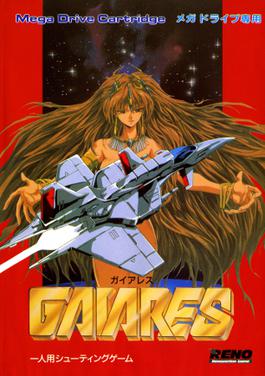
In 1990, Gaiares did something no shooter had done: it let you steal your weapons. Telenet’s TOZ system launches from your ship, latches onto an enemy, and downloads whatever it was firing — homing missiles, lasers, wide spreads, weapons the designers never intended you to combine — each theft upgrading the weapon a level. Power-ups stopped being something you collected and became something you hunted, and every stage turned into a shopping trip conducted under fire.
Around that system sits a huge, lavish horizontal shooter with some of the biggest bosses of its year and a difficulty curve with real teeth — Gaiares does not want to be finished. It loses the top spots only because its checkpoint system can be sadistic and a couple of its eight stages drag. But for invention, nothing in the Genesis library’s first half touches it. Complete copies have climbed steadily; this is now a “buy it when you see it” cartridge.
Gaiares did not give you power-ups. It made you mug the enemy fleet for them, one ship at a time.
2. M.U.S.H.A. (1990)
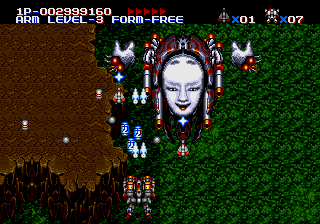
Compile’s Aleste series was already royalty on other systems; M.U.S.H.A. — Metallic Uniframe Super Hybrid Armor — is its Genesis coronation. A vertical shooter set in a techno-feudal Japan, all pagoda fortresses and mechanised warlords, it takes the Aleste formula — power chips cascading from destroyed enemies, a weapon system you build shot by shot, twin option pods whose formation you control — and runs it at a pace the Genesis was supposedly incapable of.
This is the smoothest vertical scrolling on the system, dense with enemies, effects and multi-layered backgrounds, and it barely ever slows down. The soundtrack is a face-melting slab of FM metal. It is challenging but never cheap — the fairest hard game on this list. So why not number one? Only because number one exists. Be warned on price: M.U.S.H.A. is the most notoriously expensive regularly-released Genesis shooter in North America, with complete copies in the many hundreds of dollars. The Switch Online release is the sane person’s route in — the cartridge is for the committed and the fortunate.
1. Thunder Force IV / Lightening Force (1992)
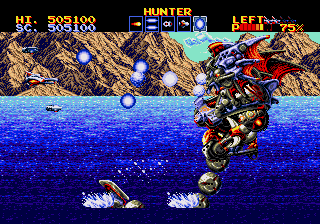
There was never another winner. Tecno Soft’s Thunder Force IV — Lightening Force in North America, typo and all — is the Genesis shooter against which the others are measured, and most of them know it. The Fire LEO-04 “Rynex” carries five weapons, switchable on the fly, plus the series’ beloved CLAW options — and halfway through, it earns the Thunder Sword, a charged blast you aim by holding your fire, still one of the most satisfying weapons ever put in a shooter.
Everything here is the best version of itself: ten stages, vertical scrolling that breaks the screen boundaries mid-stage, bosses that fill the display and then keep coming, and a soundtrack — all galloping FM guitars and impossible basslines — that routinely tops best-of lists for the entire console. It is hard, fair, and endlessly replayable. North American copies are attainable; the Japanese version’s art makes it the collector’s pick. The Sega Ages release on Switch is definitive and cheap. However you play it, play it loud: the Blast Processor’s finest four minutes, stretched across a whole cartridge.
Twelve great shooters — and one that made a marketing slogan sound like an understatement.
Honourable mentions
The bench is deep, which tells you everything about this library. Thunder Force III walked so IV could fly. Granada brings tank-based, free-scrolling shooting that nearly muscled into the twelve; Sub-Terrania is a gravity-haunted oddity that rewards patience like nothing else here. Air Buster and Sagaia are superb arcade conversions, Arrow Flash and Sol-Deace are better than their reputations, and the curious should find Undead Line — a fantasy vertical shooter so hard it loops back around to comedy.
That is the dozen. The Genesis was sold on attitude and speed, and nowhere did it deliver on both like the shooter aisle: stolen weapons, jetpack mercenaries, steampunk zeppelins, living ships — and at the top, a Tecno Soft masterpiece that still humiliates most of what modern hardware produces. Blast Processing was a slogan. These twelve cartridges were the evidence.