
Most preservation horror stories begin with neglect: a warehouse cleared, a tape reused, a server switched off. Tim Cain’s begins with an instruction. Across two videos on his own YouTube channel in 2025 — Game Preservation in April, then a follow-up, My Game Asset Preservation, in June — the co-creator of Fallout described how, when he left Interplay, he was told to destroy his entire personal archive of the game’s development, on the understanding that the company would keep the master copies itself. He complied. Years later, the company came back to him and admitted it had lost everything. His verdict on that sequence of events, paraphrased only slightly, has become the sharpest sentence in the whole preservation debate: organisations that insist on being the sole keeper of something take the authority that comes with that role, but too often decline the responsibility.
What was actually destroyed
Cain’s archive was not a box of souvenirs. By his own account it held early design notes, code for multiple versions of the game, prototypes and the code for the version built on the GURPS tabletop system — Fallout began life as a licensed GURPS game before a dispute over content sent Cain and designer Christopher Taylor off to invent the SPECIAL system instead. In other words, the archive documented not just how Fallout was built, but the roads it nearly took. When he asked himself the obvious question in the videos — why not quietly keep a copy? — his answer was blunt: he had been threatened with legal action, and people delete things when lawyers enter the conversation. A short fragment of his phrasing survives in this draft because it deserves to: they told him to destroy it, and he did.

Interplay, he says, assured him the material was safe because the company would be its archive keeper. Then, a few years after his departure — he left in 1998, during the making of Fallout 2 — the company contacted him asking whether he still had the source, and confessed its own copies were gone. Cain admits he initially assumed he was being lured into admitting he had kept something, so that legal threats could follow. He concluded, eventually, that the loss was genuine.
The correction: the shipped code survived
Here this feature has to correct the way the story travelled in 2025 — including, in places, the way it was headlined. Fallout‘s source code, meaning the code of the game that actually shipped in October 1997, was not lost. Cain said so himself, but the nuance was trampled as the story spread, and in May 2025 Interplay co-founder Rebecca Heineman stepped in to set the record straight. Because Interplay’s MacPlay label was publishing a Mac version, she had been given the source code, archived it as a matter of personal habit, completed the port, and archived the Mac source too. She had, she explained, been quietly archiving code she worked with since her Interplay days precisely because she did not trust the company to do it. Her clarification cuts both ways: she was not a rogue rescuer snatching code from a fire — she was a professional doing, privately and without being asked, the archiving her employer had failed to institutionalise. She has also said that if rights-holder Bethesda ever grants permission, she would release the code she holds.
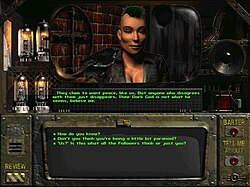
So the honest ledger for Fallout looks like this. The finished game: preserved, still sold, still playable. The release source code: preserved, thanks to one individual’s habit. Cain’s development archive — the notes, prototypes and the entire GURPS branch of the game’s history: destroyed on instruction. And, as the June video added, the original art assets are very likely gone too.
Clay heads and DAT tapes
That June follow-up is in some ways the sadder video. Fallout‘s famous talking heads — those grotesque, expressive faces that loom over its dialogue screens — began as physical clay sculptures, which were digitised; and although the game renders in sprites, those sprites were built from 3D models made in tools such as Maya and Alias. The source files were enormous by 1990s standards and were backed up to DAT tape. Cain does not know what became of that tape, and notes that DAT media starts developing errors within five to ten years anyway. His conclusion, offered without drama, is that the source art is probably all gone. You can still meet the talking heads in the game. You will never again be able to open the file that made them.

Three ways history leaks away
Generalising from his career, Cain offers roughly three mechanisms of loss. First, simple inattention: in the industry’s early decades nobody’s job included archiving, so prototypes and documents were kept by nobody at all. Second, private custody that decays: individuals keep their own work, then lose interest, move house, suffer a dead drive, and the material evaporates with them. Third — the one that plainly angers him — institutional custody without competence: organisations that demand to be the archive keeper, forbid employees from keeping copies, and then do a poor job of the keeping. He says that has happened repeatedly across his career. His later work draws the contrast. At Troika, the studio he co-founded after Interplay, he kept code for games such as Arcanum and The Temple of Elemental Evil — though ownership rules mean keeping is not the same as being free to publish. And he praises Obsidian, where he worked later, for treating end-of-project backup and archiving as a routine part of finishing a game. Preservation, in his telling, is not a technology problem. It is a management decision, made or unmade by people high up.
Why this keeps happening
Step back, and Fallout is the rule wearing a famous name. We have covered the same pattern from the other side of the industry in our feature on Final Fantasy Tactics, whose original source was overwritten during localisation until the true original ceased to exist. The Video Game History Foundation’s 2023 study found that the overwhelming majority of classic games — around 87 percent of those released in the United States — are effectively unavailable through normal channels, surviving, if at all, through exactly the mixture of fan archives, private hoards and luck that saved pieces of Fallout. Cain points approvingly to commercial efforts such as GOG’s preservation work, and to the irony that Fallout itself will likely be remembered a century from now largely because Bethesda made the series enormous — popularity, not policy, acting as the archive.
That is the uncomfortable heart of his argument. The industry does not lack the ability to save its history; hard drives are cheap and Cain, one programmer with a pack-rat instinct, managed it as a side effect of doing his job. What it lacks, too often, is anyone senior willing to own the duty — while simultaneously asserting the legal right to stop anyone else from doing it instead. Authority, in short, without responsibility. Fallout survived that failure by accident and by one colleague’s foresight. The list of games that did not is much longer, and most of them never got a famous designer to make a video about it.