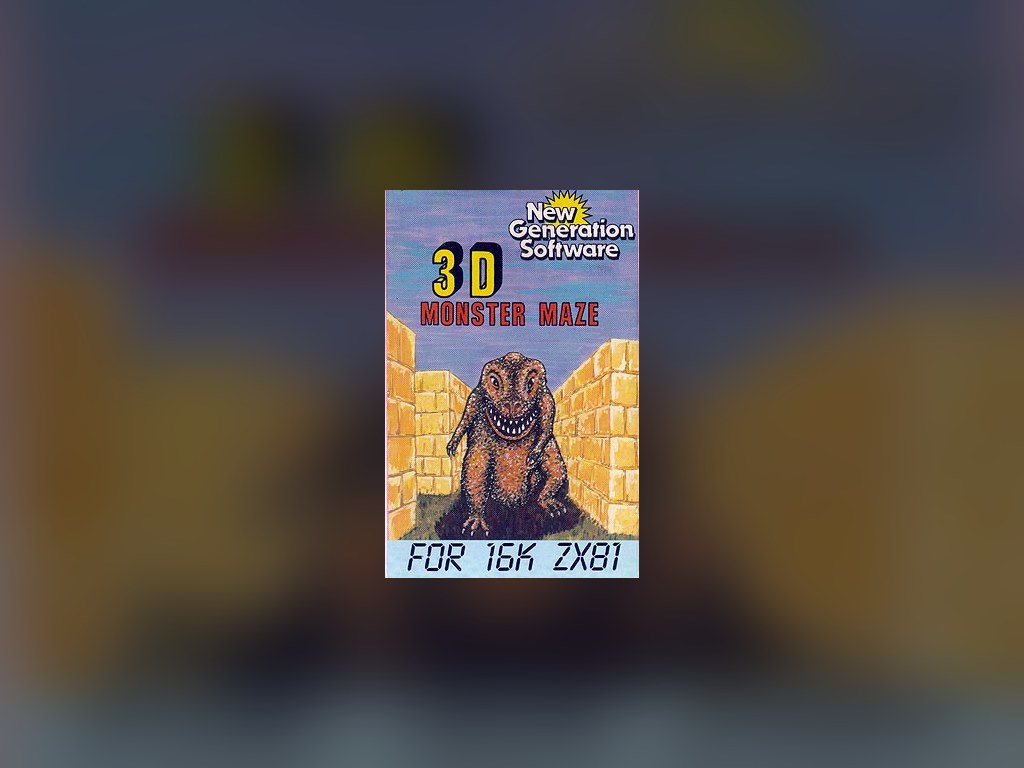
At a glance: 3D Monster Maze · ZX81 · J. K. Greye Software, 1981 · Survival horror maze · Score: 9.5/10
Every genre has a first breath, and survival horror took its in a black plastic wedge plugged into a family television in the winter of 1981. 3D Monster Maze, designed by J. K. Greye and programmed by Malcolm Evans, drops you into a randomly generated 16-by-18 maze rendered in first person, locks the door behind you, and introduces the only other resident: a Tyrannosaurus rex that has not eaten in some time. There is no weapon. There is no health bar, no inventory, no save point. There is an exit, somewhere, and there is Rex, and the whole of gaming’s most durable emotion — the wish to be somewhere else, quickly — is generated by a machine with no sound chip, no colour and no graphics hardware worthy of the name.
The circumstances of its making are part of the legend. Evans was a microprocessor scientist at Sperry Gyroscope in Bristol who received a ZX81 from his wife for his thirty-seventh birthday in April 1981. The maze began as a test of what the little machine could do. Greye suggested the additions that turned an experiment into a game: the theatrical framing, the monster, the hunt. It was Evans’s first game. It became, by common consent of the magazines that reviewed it and the historians who followed, the first 3D game for a home computer and the first workable draft of survival horror — a quarter of a century before Edge magazine said so outright in 2006, calling it “the original survival horror game” and identifying its essence precisely: “fear, panic, terror and facing an implacable, relentless foe who’s going to get you in the end.”
A maze built from full stops and faith
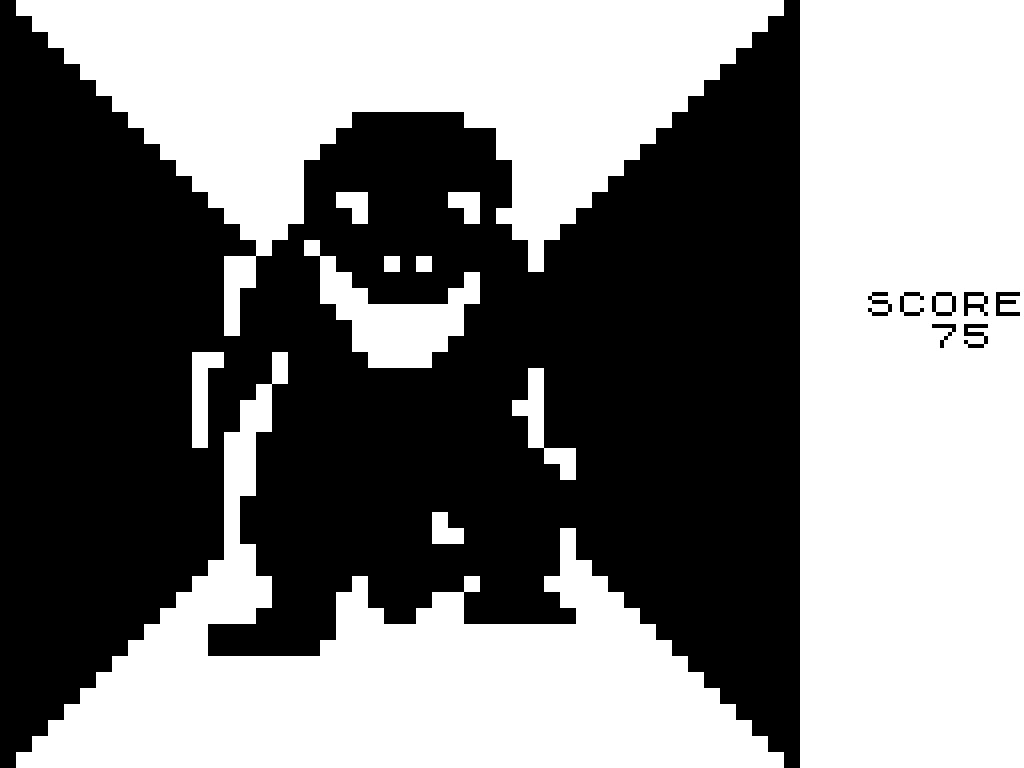
The ZX81 has no bitmap display. Its screen is 32 columns of characters, and its character set includes a family of block graphics — quarters and halves of a character cell in black, white and grey — intended for charts and crude diagrams. Evans built a world out of them. The first-person view is assembled from these blocks: walls step toward a vanishing point in chunky perspective, corridors open and close as you turn, and the illusion holds together because the geometry is honest. Distances read correctly. A junction looks like a junction. When Rex appears at the far end of a corridor, drawn in the same blocky language at increasing sizes as he approaches, your brain does the rendering work the hardware cannot, and what it renders is alarming.
The game needs the 16K RAM pack — the unexpanded machine’s single kilobyte could never hold it — and it uses that memory for the two things that make the design sing: a fresh random maze every game, and an antagonist with intent. Rex does not wander. His behaviour escalates through states that the game reports in a status line at the bottom of the screen: he waits, he hunts, he has seen you, he is running at you. That status line is the game’s sound design. A silent machine cannot give you footsteps or a sting of music, so 3D Monster Maze gives you information instead, and information delivered one line at a time, while you decide whether to run or freeze, produces a tension that many louder games never find.
Rex is calm. Rex is hunting. Rex has seen you. Six words of status text did the work of an entire horror soundtrack, because the ZX81 had no soundtrack to give.
The hunt, forty years on
Playing it now, the first surprise is pace. This is not a slow, stately maze game. Movement is brisk, the view redraws with real urgency, and once Rex commits to a chase the game becomes a sprint through a labyrinth you have only half-mapped in your head. The second surprise is how modern the structure feels. You are unarmed in a hostile space with a single objective — find the exit — and a pursuer whose attention you manage rather than defeat. That is the template later formalised by games with vastly larger budgets: the stalker enemy, the safe route that stops being safe, the exit that might as well be on the moon. 3D Monster Maze has no jump scares because it needs none; its fear is systemic, generated by a simple intelligence in a closed space, renewed every time the maze regenerates.

It is equally a document of its moment. The game’s presentation leans into fairground showmanship — you are ushered into the maze like a punter at a circus attraction — which was Greye’s instinct for selling the impossible: step up, see the monster, mind he doesn’t see you. Computer and Video Games judged it “the best game I have seen for the Sinclair ZX81,” a verdict that looks less like period enthusiasm with every passing decade. Evans founded New Generation Software off the back of it, reissued the game under his own label the following year, and went on to define early Spectrum 3D. The ZX81 original remains the purest version of the idea, because the machine’s poverty is the game’s atmosphere: the darkness is literal, the silence is literal, and the monster is made of the same grey blocks as the walls he hunts you between.
Step right up
Before the maze, the showmanship. The game opens with an animated usher figure who presents the attraction and invites you in — a piece of pure Greye theatre, and a technical flex in its own right, since persuading the ZX81 to animate a character at all was work. Evans later recalled the difficulty of the usher’s bow, which kept threatening to take his head off along with his hat. It matters because it frames the horror correctly: this is a fairground ride that wants to hurt you, a novelty you volunteered for. The score counter ticking away in the corner completes the bargain. You are not a hero clearing a dungeon. You are a paying customer in a cage with a dinosaur, and the points are there to measure how long the entertainment lasted.
That framing also explains the game’s unusual mercy. Being caught is not a failure state so much as the ride ending; the design wants you back in the queue. Sessions are short, mazes are disposable, and the correct response to a mauling is to go again with a better mental map. In an era when most home computer games were still apologising for existing — type-ins, conversions of board games, Invaders in a trench coat — 3D Monster Maze had the confidence of the arcade about it: one idea, perfectly judged, sold with a grin by a man in a top hat, and sharp enough to cut.
Verdict
Some old games are important. A smaller number are important and still frightening. 3D Monster Maze is the ZX81’s masterpiece and one of the foundational texts of British games: the first home-computer 3D, the first survival horror, and proof — delivered within months of the machine’s launch — that a £49.95 computer with a membrane keyboard could make a grown adult’s heart beat faster. If you own one ZX81 tape, it is this one. If you emulate one ZX81 game, it is this one. Rex is still in there, waiting, in 16K of grey blocks, and he has lost none of his patience.

Score: 9.5/10 — The original survival horror game, and still the ZX81’s defining achievement.