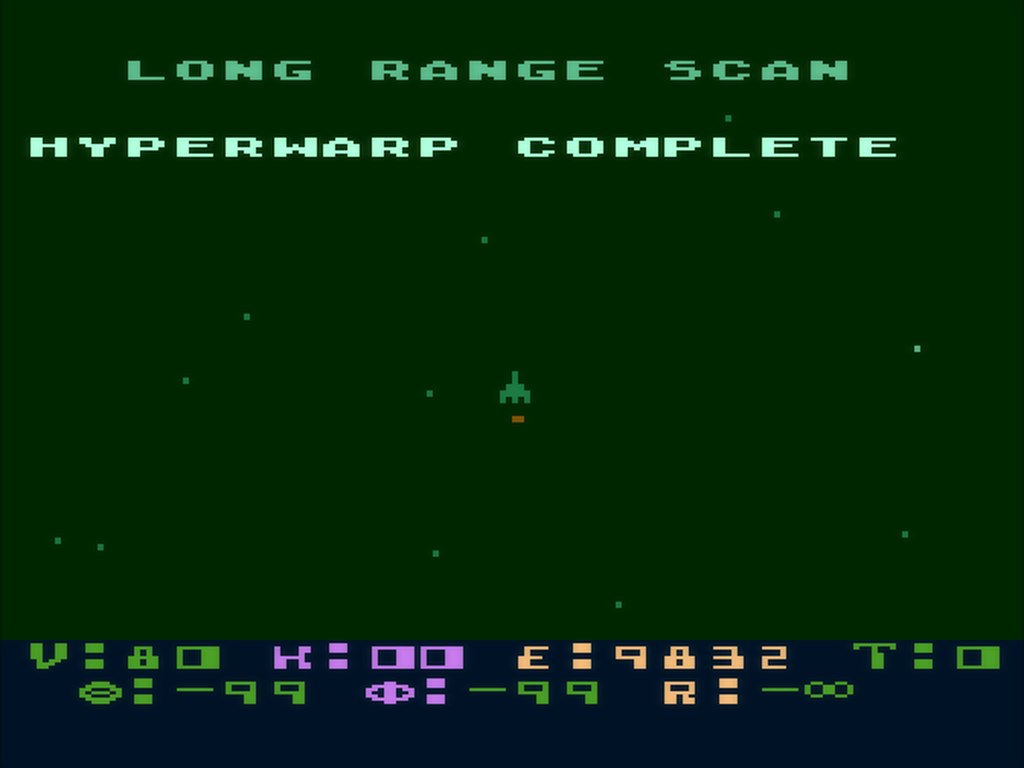
At a glance: Star Raiders · Atari 400/800 · Atari / Doug Neubauer, 1979 · Space combat simulator · Score: 9.5/10
Every games machine gets one title that justifies the hardware, and for the Atari 400 and 800 that title arrived at launch. Star Raiders was not a conversion, not a toy and not a tech demo with a score counter bolted on. It was a complete first-person space war — strategy map, systems management, real-time 3D combat and all — squeezed by Doug Neubauer into an 8K cartridge in 1979, when most home computers were still being used to balance chequebooks in BASIC. People genuinely bought the computer to play this game, and playing it today explains why.
The premise is pulp and perfect. The Zylon empire is sweeping across the galaxy towards your starbases, and you — one pilot, one fighter, one very strained power reserve — are the entire defence. Win, and you earn a rank and a title ranging from garbage scow to star commander. Lose a starbase and the map gets lonelier. Let the Zylons surround one and it is gone, and with it your nearest source of fuel, repairs and mercy.
Two games welded together
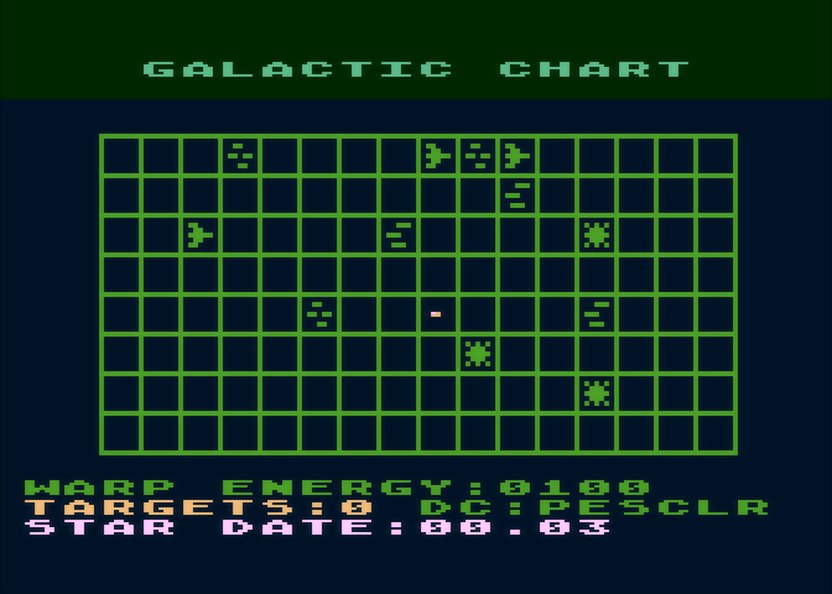
Star Raiders works because it is really two games sharing one power gauge. The Galactic Chart is the strategy layer: a grid of sectors, some empty, some holding Zylon task forces shown as neat clusters of dots, some holding the starbases you cannot afford to lose. You pick a destination, engage hyperwarp, and watch the stars stretch as the computer chews distance into energy. Choosing where to fight is the game. A pilot who chases every skirmish runs dry mid-war; a pilot who thinks three jumps ahead arrives with shields intact and a base at his back.
Then you drop into a sector with company, and the other game takes over: a fast, fluid, genuinely three-dimensional dogfight that was years ahead of anything else in the home. Neubauer’s starfield does not scroll — it flows, stars streaming past with a sense of velocity that still feels right. Zylon fighters (their silhouettes cheerfully borrowed from the era’s television science fiction) jink and weave, firing bolts that you learn to read like pitches. Your attack computer tracks the nearest target with live coordinates, and a good pilot flies by instruments as much as by eye, snapping between fore and aft views to keep a bogey in the gunsight.
Everything can break
The simulation layer is where Star Raiders separates itself from every arcade blaster of its day. Your ship is a collection of systems — shields, photon torpedoes, engines, the attack computer, the long-range scanner, even the hyperdrive — and every one of them can be damaged in a fight. There is no experience quite like limping away from a dogfight with your scanner dead, your computer strobing nonsense and your engines stuttering, burning your last energy on a warp to a starbase you hope is still there. Docking, when you make it, is its own small ceremony: match the station in your sights, slow down, and watch the damage report turn back into a fighting ship.

Energy is the thread tying it all together. Shields drink it. Warps gulp it. Even cruising with everything switched on bleeds the reserves, which teaches the game’s central discipline: switching things off. Veterans fly dark between fights, shields down, computer off, scanner checked in glances — a whole layer of airmanship that no contemporary game asked of its players. On the higher missions this stops being flavour and becomes survival itself, as Zylon numbers swell and the bases come under real, timed threat.
Star Raiders did not just precede the space combat simulator — it arrived with the genre’s grammar already written: the map, the systems, the energy, the rank at the end.
The feel of flight
Technically, the miracle is the frame rate. On a 1.79MHz 6502 with a starship’s worth of maths to do, the combat stays quick and readable, explosions blooming into debris you can genuinely fly through. The sound is pure POKEY theatre — the deep throb of engines, the rising scream of hyperwarp, torpedo fire with real weight. Presentation is minimal because it had to be, but it never feels cheap: the scanner’s wireframe sector view, the strobing damage alerts and that stark galactic chart all read instantly, even now.
What dates it? The keyboard-driven controls assume a proper computer keyboard, which is precisely what the 800 offered and modern players emulating with a gamepad will miss; the first minutes are opaque until the orders of operations (chart, warp, fight, dock, repeat) click. And by design it is a war of attrition — sessions can run long, and a doomed campaign announces itself slowly. These are the honest frictions of a 1979 design, not failures.

A game that sold a computer
Context is not decoration here; it is the review. In 1979 the home computer was a hobbyist’s kit with a keyboard, and the software aisle was type-in listings and text adventures. Star Raiders arrived as a launch title that treated the Atari 800 as a starship — full keyboard as control panel, colour display as viewport, POKEY as the sound of engines — and it made the machine’s asking price legible to people who had never wanted a computer before. Atari knew what it had: the game was demonstrated in stores, bundled in promotions, and whispered about as the reason the 400 and 800 existed. When Stanford’s historians of the medium later drew up their canon of the most important games ever made, Star Raiders stood near the top of the list, in company with Space Invaders and Zork. It is that kind of object.
Doug Neubauer’s own story sharpens the achievement. Star Raiders was essentially a solo work — design, code, even the distinctive engine sounds, which Neubauer built from POKEY’s registers with a musician’s ear (he also composed the famous Solaris theme on the 2600) — produced inside Atari in months. The famous detail that he developed much of it on a system with a fraction of the final memory, and that the whole war fits in 8K of ROM, has passed into legend because the game refuses to feel small. The galaxy is nine sectors wide and it feels like a frontier. That is not a memory trick. That is design density of an order the industry would take a decade to normalise.
The rank at the end of the war
A last word for the game’s cruellest kindness: the evaluation. Survive a mission and Star Raiders grades you like a naval board — style, accuracy, efficiency — and hands you a rank and class that can be genuinely insulting. The scale runs from the heroic down through ‘novice’ and ‘pilot’ to the legendary depths of ‘garbage scow’ and ‘galactic cook’, and the insult lands because the simulation has receipts: it watched you waste energy, watched you miss, watched you let a base die while you chased a dogfight three sectors away. Players in 1980 swapped ranks the way golfers swap handicaps. The game invented the debrief as a design element, and the debrief is why one mission was never enough.
Verdict
Star Raiders is one of the most important games ever made, and — the rarer trick — it remains a genuinely good one to play. The strategy sim and the dogfighter keep interrogating each other: every fight spends the fuel the map told you to save, and every clever jump only matters if you can shoot when you arrive. Later classics from Elite to Wing Commander built cathedrals on this foundation. The foundation itself, 8K of it, still stands.