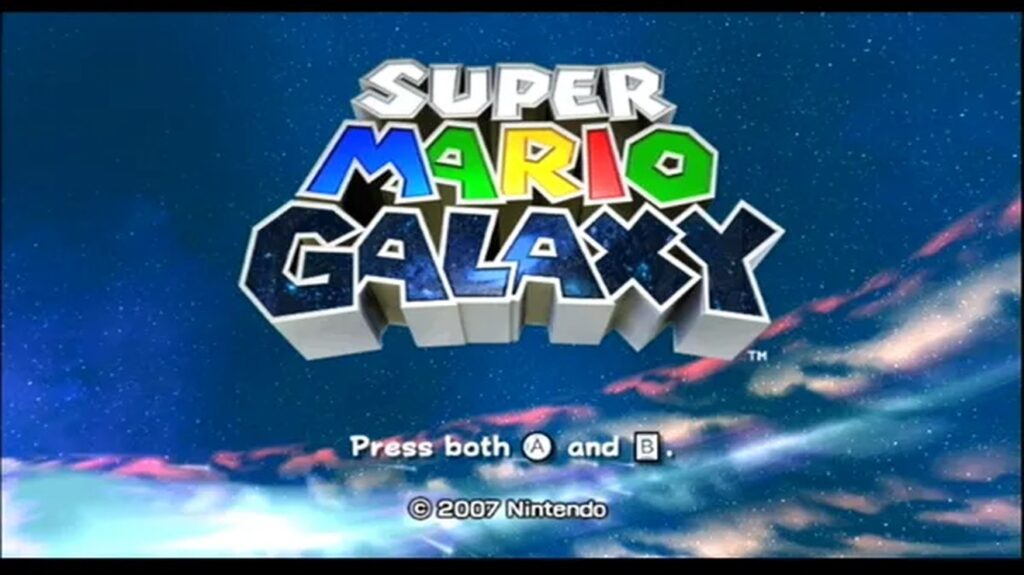
Developer: Nintendo EAD Tokyo · Publisher: Nintendo · Released: November 1, 2007 (Japan) · Platform: Wii · Genre: 3D platformer
Nineteen years ago today, Japanese Wii owners put a plumber on a planet the size of a garden shed, ran him over the horizon and out the other side — and platform games have never quite recovered their sense of direction since. Super Mario Galaxy didn’t just make the best case for Nintendo’s strangest console. It made falling feel like flying.
The Plumber Who Fell Up
Consider the moment. By the autumn of 2007 the Wii was a cultural phenomenon, and a fair question hung over it: could a console built on a television remote actually host a masterpiece? Mario’s own 3D line had wobbled, too — Sunshine was a charming, fussy holiday half its audience bounced off, and five years had passed without a true follow-up to Super Mario 64. The series needed a statement.
Galaxy was the statement, and its genius can be written in one sentence: Mario chases Bowser across a universe of tiny planetoids, each with its own gravity, so “down” is always toward the nearest ball of rock. Run far enough in any direction and you come back to where you started, possibly upside down, possibly still running. Everything in the game — the levels, the camera, the controls, the music — is that one idea, explored with a thoroughness that still takes the breath away.
The Night the Castle Left Town
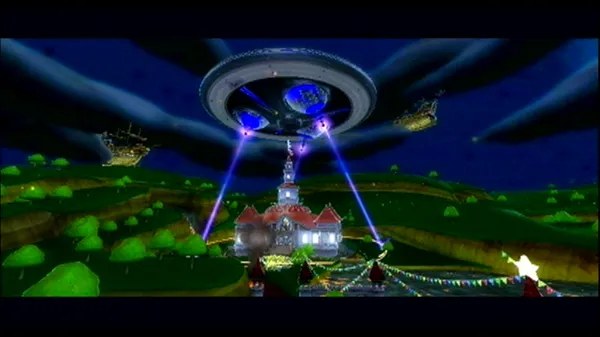
Every hundred years a comet passes over the Mushroom Kingdom and rains Star Bits on the Star Festival. Princess Peach invites Mario to the celebration; Bowser, punctual as ever, arrives with an airship armada and a flying saucer, and lifts the whole castle — princess, Toads and all — clean off the ground and into orbit. Mario, blasted to a tiny planetoid in the scuffle, wakes under an unfamiliar sky and meets the Lumas: small, soft-spoken star children who are waiting, patiently, to be reborn as planets and galaxies themselves.
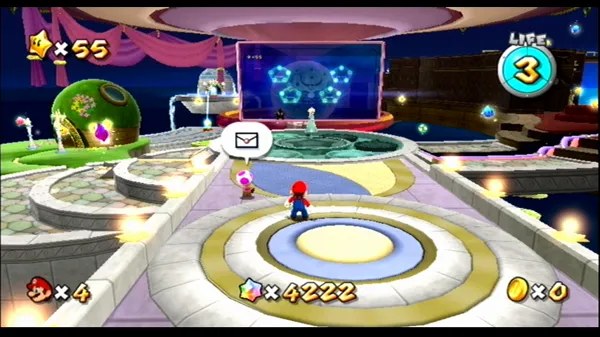
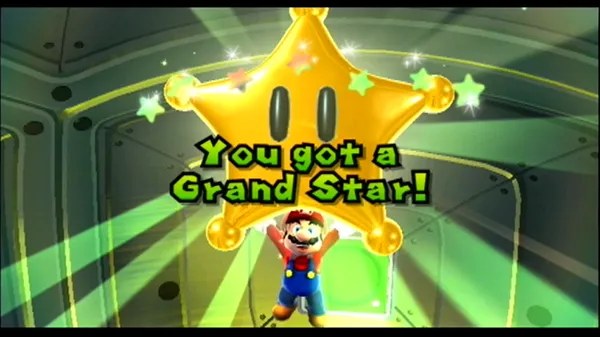
Their mother is Rosalina, who watches over the Comet Observatory, a drifting space station gone dark for want of Power Stars. The deal she offers drives the whole game: recover the stolen stars and the observatory flies again — to the centre of the universe, where Bowser is building a galaxy of his own. Each Grand Star relights one of the observatory’s domes — the Terrace, the Fountain, the Kitchen, the Bedroom, the Engine Room, the Garden — and each dome opens a cluster of new galaxies. Sixty stars buy you the trip to Bowser. One hundred and twenty buy you everything.
Spheres: An Idea Six Years in the Making
The road to those planetoids began at Nintendo Space World in August 2000, where a GameCube tech demo called Mario 128 showed over a hundred little Marios stampeding across a tilting disc. Miyamoto talked for years afterwards about the magic of running on a sphere, where the horizon curls under your feet. The problem was never the idea — it was everything around it: a camera that could follow a hero around a ball without making players ill, controls that stayed intuitive when “forward” kept changing, level design that worked in the round.
The team that finally solved it was Nintendo EAD Tokyo, a young studio whose only credit was Donkey Kong Jungle Beat — a platformer played, gloriously, on bongo drums. Under director Yoshiaki Koizumi, with Miyamoto producing, they prototyped spherical worlds until the solutions emerged. The camera learned to think in gravity rather than compass points. The spin — a shake of the remote that twirls Mario in mid-air — was added as a safety net, a way to correct a jump gone wrong, and it quietly became the game’s signature move. Where other Wii games of 2007 were bolting waggle onto old designs, Galaxy was designed from the physics outward.
Every platformer before it asked where the floor was. Galaxy’s answer — wherever you’re standing — turned the Wii’s supposed limitations into the most liberating idea in the genre.
Running Around the World
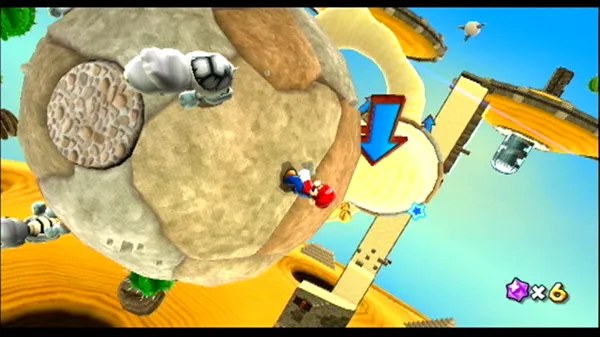
The first long jump settles it. Mario leaps from the grass of the Gateway Galaxy, the ground falls away, the arc keeps bending — and instead of the void, there’s the other side of the world, arriving gently under his boots. Galaxy’s gravity is the most generous physics in games: it catches you. Leap off a planetoid with enough speed and you’ll slingshot around it; fall off an edge and you land on the underside, inverted, the previous “sky” now below you. Within minutes the disorientation turns to delight, and within an hour you’re reading these little worlds fluently.
The structure around that joy is ruthlessly disciplined. Each galaxy is built around a handful of ideas, introduced cleanly, combined, and then — just as they peak — replaced. One star asks you to surf a manta ray around a water track by tilting the remote. The next flips gravity with switches in a 2D passage where the floor becomes the ceiling. A third turns the whole level into a rolling-ball obstacle course balanced on the remote. Later, Prankster Comets remix completed galaxies: race the clock, survive on one sliver of health, outrun a cosmic clone of yourself, hunt a hundred purple coins across a world you thought you knew. The first half is a kindness. The last purple-coin hunts are a contact sport.
The Remote, the Pointer and a Second Pair of Hands
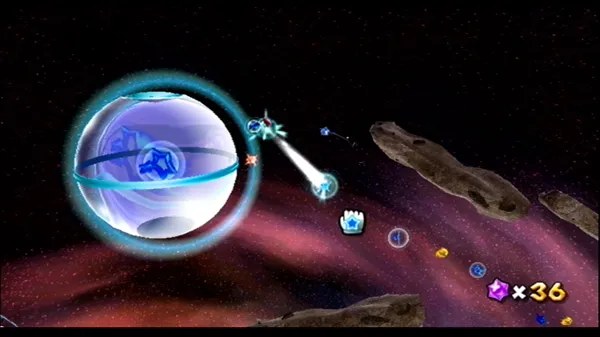
What makes all this sing on the Wii remote is restraint. Mario moves on the Nunchuk stick, jumps on a button, and spins with a shake. The pointer, meanwhile, is given a hundred small jobs: it sweeps up Star Bits, fires them to stun enemies or feed the perpetually hungry Lumas, and grabs the blue Pull Stars that tow Mario through open space. Your eyes play the platformer; your spare hand plays a gentle game of housekeeping over the top of it, and the two never fight.
Best of all is Co-Star Mode, in which a second player picks up another remote and becomes a floating cursor of pure assistance — gathering bits, freezing enemies in place, even making Mario jump. It is one of the earliest and still one of the kindest forms of co-op: a way for a parent, a partner or a younger sibling to be genuinely useful inside a masterpiece rather than merely watching one. Galaxy used the hardware as seasoning on a design that would have been brilliant on any controller — which is why it shamed every game that used the hardware as a substitute for one.
Suits in Space
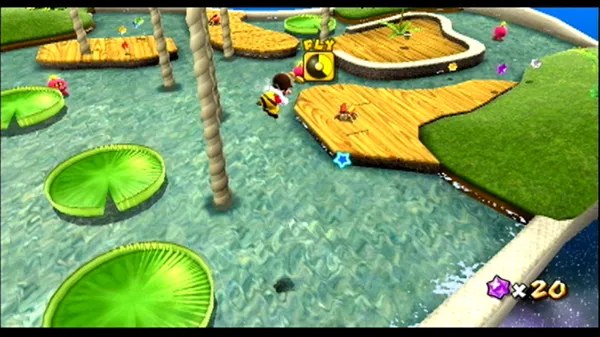
After Sunshine’s single all-purpose water cannon, Galaxy restores the Super Mario Bros. 3 philosophy: a wardrobe of powers, each a bargain. The Bee Mushroom grants flight in short bursts and lets Mario cling to honeycombs and the Queen Bee’s fur — but touch water and it washes away. Boo Mario floats and slips through grates and walls, but the light beams in the Ghostly Galaxy will unmake him. Spring Mario is a coiled catastrophe, bouncing uncontrollably to heights nothing else can reach. Ice Mario skates across lava lakes and freezes waterfalls into climbable walls; Fire Mario is the timed classic; the Rainbow Star is pure invincible sprint. And near the very end, the Red Star finally does the thing the box art promised: it lets Mario truly fly.
Each suit is a small contract — a power with a price, and a level built around both halves of the deal. It’s the variety engine that keeps forty-odd galaxies fresh, and played in sequence with the gravity gimmicks, the comet remixes and the boss planets, it means Galaxy essentially never repeats itself across its twenty-plus hours.
A Storybook in the Observatory
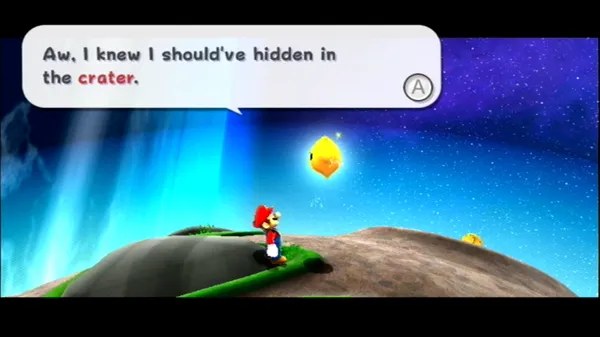
And then, quietly, there’s Rosalina’s library. Chapter by chapter, a picture book unlocks there telling the story of a girl who climbed a hill one night looking for her mother — who was sleeping under a tree on that hill, beneath the earth — and who left the world with a family of stars to search the sky for her. It is, by an enormous distance, the saddest thing Nintendo had ever placed inside a Mario game, and it is entirely optional. You can finish Galaxy without reading a page of it. Almost nobody who found it has forgotten it.
It reframes everything around it. The Lumas’ cheerful willingness to sacrifice themselves — to burst into new planets and galaxies — stops being a mechanic and becomes a worldview: in this universe, things end and become other things, and that is beautiful rather than bleak. A game about gravity turns out to be a game about loss, cycles and carrying on. When the finale arrives and the cosmos itself is unmade and remade, it lands with a weight no Mario game before or since has attempted.
An Orchestra in Orbit
Galaxy was the first Mario game scored for a live orchestra, and you can hear the ambition in the opening minutes. Composer Mahito Yokota, working with series maestro Koji Kondo, talked the production up from the usual synthesised palette to a fifty-piece orchestra, on the reasoning that space deserved a symphony. The main theme sweeps; the observatory theme aches; and “Gusty Garden Galaxy” — all strings and woodwind galloping over a level of floating meadows — has become the modern Mario standard, rearranged across the series ever since. On a console mocked for its modest power, Nintendo simply out-composed everyone.
The Boss at the Centre of the Universe
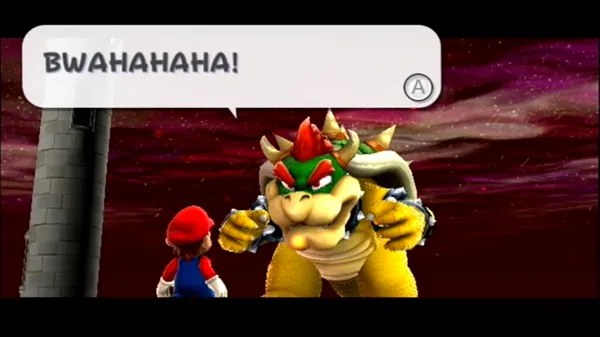
Bowser himself is fought on tiny lava planets, and the series’ oldest dance is transformed by the setting: he stomps, the shockwave rings the whole world, and the trick is to bait his ground-pound onto a glass dome over a magma core — gravity delivers him to the fire. Around those duels sit some of the finest bosses of the era: Dino Piranha circling its egg-planet, the thousand-legged Megaleg, a walking fortress you climb like a small moon, and Bouldergeist, a rock-golem fought with bomb Boos. The closing run — a gauntlet of planets collapsing toward a final confrontation at the universe’s centre — remains the biggest spectacle Nintendo ever coaxed out of the little white box.
Nineteen Years On
The verdict of 2007 was not subtle. Galaxy reviewed at a 97 average on Metacritic, a mark that still parks it among the highest-rated games ever released, and it swept that year’s Game of the Year honours, BAFTA’s Best Game included. It sold nearly thirteen million copies. Its sequel, 2010’s Super Mario Galaxy 2, took the same engine and built a sterner, denser game from its offcuts, and the pair have been the twin peaks of 3D platforming ever since.
The afterlife has been busy: an HD outing in 2020’s Super Mario 3D All-Stars, then in 2025 a definitive Switch edition pairing both Galaxy games together — and in 2026 Rosalina and the Lumas stepped onto cinema screens as the stars of a Mario feature film. Nineteen years on, the reason Galaxy survives every re-release is simple: its central idea is geometry, not technology, and geometry does not date.
Playing It in 2026
The Switch pairing of Galaxy and Galaxy 2 is the easy door in — sharpened visuals, a traditional control option, all of it intact — and the version most players should reach for. But do try the original once if you can: on a real Wii, with the pointer sweeping Star Bits off a CRT while the orchestra swells, Galaxy’s two-handed rhythm makes a case no port fully reproduces. However you board the observatory, board it. This is the best game on the Wii, and it isn’t especially close.
Score: 9.8 / 10 — A perfect idea, perfectly executed, on the console nobody expected it from. Super Mario Galaxy is the Wii’s masterpiece and one of the finest platformers ever made — nineteen years on, falling up has lost none of its joy.