On 30 September 1999, Ensemble Studios released a real-time strategy game about the Middle Ages, and the Middle Ages have been contested ever since. Age of Empires II: The Age of Kings did not invent its genre, and it was not the flashiest RTS of its year. What it did was refine the form so completely, economy, warfare, history and multiplayer in one perfectly tuned machine, that a quarter of a century later it supports a professional tournament circuit, ongoing expansions and a player count most modern sequels would envy. This is the story of how a game about trebuchets became effectively immortal.

The Formula
The genius of Age of Kings is balance, in every sense. Thirteen civilisations, Britons to Byzantines, Japanese to Mongols, share one elegant technology tree and diverge through unique units, bonuses and architecture, distinct without being unlearnable. You shepherd a civilisation through four ages, Dark, Feudal, Castle, Imperial, in the genre’s most satisfying progression curve: a scrappy village of foragers becomes a walled town, becomes a castle-dotted power, becomes an empire of trebuchets and champions. Underneath runs a real economy, four resources, villagers whose allocation is a constant live decision, farms that exhaust, gold that runs out, relics that pay rent forever. Combat resolves through readable counter-systems: spears break cavalry, cavalry run down archers, archers fear skirmishers, and everything fears the onager. And presiding over the battlefield, in a blue robe, arms raised, is the monk, whose conversion chant, the immortal “wololo”, could steal your finest knight and your composure in the same nine seconds.
History Lessons with Teeth
The five campaigns were the game’s Trojan horse into a million childhoods. William Wallace teaches the basics in Scotland; Joan of Arc, Saladin, Genghis Khan and Barbarossa then march you across three continents of medieval history, narrated with a storyteller’s gravity that made the history feel like inheritance rather than homework. Ensemble’s researchers salted the game with an encyclopedia of the period, and a generation of players absorbed more working knowledge of the Hundred Years’ War from these missions than from any classroom. The scenarios are also properly hard in the later stretches, history with teeth, teaching siegecraft by demanding it.

The Zone, the LAN and the Long Tail
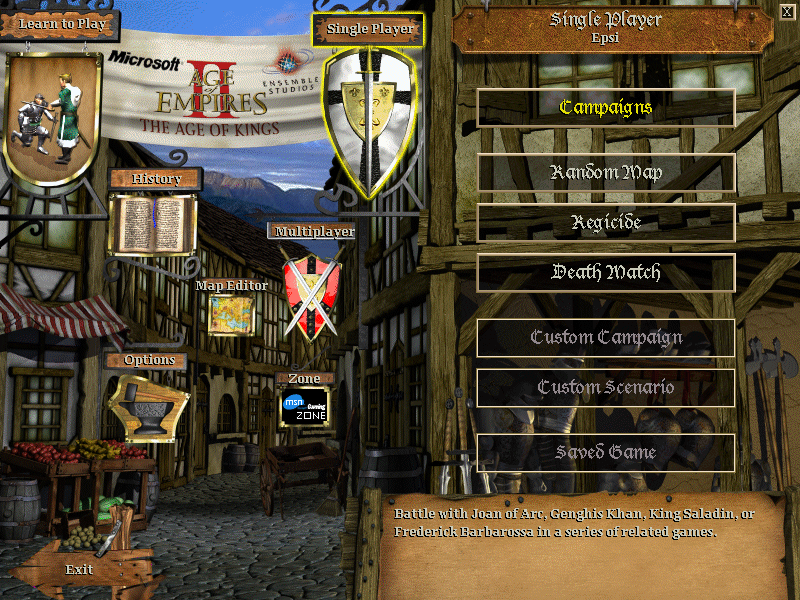
Multiplayer is where Age of Kings became a permanent institution. On the MSN Gaming Zone and across a thousand office and university LANs, it settled into the ritual form it keeps today: eight players, random maps, diplomacy that lasts exactly as long as it is convenient. The 2000 expansion, The Conquerors, added the Aztecs, Mayans, Huns, Koreans and Spanish and tuned the formula to a competitive edge. Then the game simply refused to die. When official servers closed, the community built its own, on Voobly and through fan patches, keeping the competitive scene alive through the genre’s leanest years. Forgotten Empires, a mod team, became an official studio. An HD Edition arrived in 2013 with new expansions. The scene’s greatest player, TheViper, became a professional. The king was not restored. He had never actually left.
The Definitive Afterlife
The 2019 Definitive Edition is the afterlife made official: rebuilt visuals, a re-recorded score, quality-of-life features players had requested for twenty years, and every expansion gathered in, with new campaigns and civilisations continuing to arrive in DLC long after release. The civilisation count has climbed past forty. Red Bull’s Wololo tournament series, named, of course, for the monk, draws the game’s elite to castle LAN finals and six-figure prize pools the 1999 team could not have imagined. The Definitive Edition matters to this retrospective for one reason above all: it changed almost nothing essential. The game being celebrated at modern esports scale is recognisably, mechanically, the game Ensemble shipped in 1999, its balance refined but its soul unedited.
The Modern Masters
The strangest chapter of the story is the most recent: Age of Kings became a spectator sport. Streaming gave its marathon matches a second stage, and a cast of personalities turned expertise into theatre. Norway’s TheViper dominated for a decade with a speed and game-sense that made the twenty-year-old engine look modern; Canada’s Hera inherited the crown; casters like T90Official built cottage industries out of community games, low-Elo legends and the game’s endless supply of collapses and comebacks. The Red Bull Wololo series, launched in 2020, draped the whole scene in medieval pageantry, finals staged in a German castle, production values from another sport entirely. None of this was planned by Ensemble, most of whose members had scattered to other studios years before. It happened because the game underneath is legible: a viewer who has never played can read a match’s story from the map, the ages, the castles on the hill. Esports are usually manufactured. This one precipitated, slowly, out of a game that refused to be switched off.
There is a craft lesson in the longevity too. Ensemble tuned Age of Kings for the hardware of 1999 and the modems of 1999, and the resulting modesty, small system requirements, readable sprites, a simulation that chugs happily on anything, meant the game never became technically obsolete. It has now outlived the studio that made it, the platform that launched it and most of the genre conventions it was born into. Games are supposed to be products. This one became infrastructure.
Why It Endured
Credit, too, to the sound of the thing. Stephen Rippy’s score, all lutes, drums and patient menace, gives each civilisation’s climb a dignity that synth-orchestral bombast would have cheapened, and the soundscape beneath it, the farm’s scratch, the blacksmith’s ring, the horn of a war elephant, is a masterclass in information design: veteran players read a battle by ear. The voice lines have passed into folklore, from the monk’s chant to the taunt menu’s cheerful abuse, and the Definitive Edition’s re-recorded soundtrack treats the original compositions with the same curatorial respect as the gameplay. A game this old should sound like a museum piece. It sounds like a place. It sounds, exactly twenty-five years later, like home.
Plenty of beloved RTS games are fossils now, preserved by nostalgia and fan patches. Age of Kings escaped fossilisation because its design has no fashionable parts to date. Nothing in it chases a trend: no hero units with ability bars borrowed from another genre, no concession to spectacle over readability. A match tells a story with a beginning (the Dark Age scramble), a middle (raids, castles, treachery) and an end (the Imperial Age’s rolling thunder), and it tells that story at a pace a human can narrate. It is also, not trivially, a game about building as much as destroying, farms and town centres and wonders raised against the clock, which is the quiet truth inside its very long title: the destruction is famous, but the construction is why people stay. The millennial medieval masterwork, our original stub called it. Twenty-five years on, the masterwork part is the easy bit to prove. It never stopped being played long enough to become retro at all, and on the evidence of its current player counts, prize pools and expansion schedule, it has no plans to start.