Ask most people to picture a Genesis in 1992 and they will picture speed. Sonic looping the loop, a Madden cartridge still warm in the slot, Mortal Kombat with the blood code entered before your parents got home. Sega’s black box was the arcade machine, the sports machine, the loud kid in the room. If you wanted an epic quest — a world map, a party, a hundred spells — the received wisdom said you bought a Super Nintendo and a Square game.
I believed that for about a month when I was a kid. Then a friend lent me a cartridge with a battery save and a manual thick enough to stop a door, and I spent a whole summer on a planet called Motavia. The Genesis did not just have RPGs. It had strange, ambitious, sometimes punishing RPGs that did not sound like anything on the other system, and looked at fantasy from a sci-fi angle Nintendo rarely touched.
That reputation gap was partly marketing. Sega of America sold attitude, not forty-hour stories, so a lot of these games arrived quietly, rented once, and disappeared. Some never left Japan in their own era at all. Which is a shame, because taken together this library has tactics, dungeon crawlers, action RPGs, isometric adventures, and one of the greatest traditional RPGs ever made.
So here is my ranking — twelve Genesis RPGs, counted down to the one I would hand somebody who still thinks Sega could not do epic. Argue with the order all you want. That is half the fun.
The countdown
12. Phantasy Star III: Generations of Doom (1990)

I am putting the flawed one first, and I am doing it with affection. Phantasy Star III is the black sheep — slower combat, muted colors, a backtrack-heavy world — but its central idea is still braver than most RPGs attempt today. You do not play one hero. You play a prince, choose who he marries at the end of his chapter, then play his child, and then his grandchild. Three generations, branching families, different party members depending on a wedding decision you made hours earlier.
That structure turns an ordinary save-the-world plot into a family saga, and when the late-game reveal connects this medieval-seeming world back to the series’ science-fiction roots, it genuinely lands. The battles drag and the dungeons are plain, I will not pretend otherwise. But ambition counts for something, and no other Genesis RPG took a swing this weird.
11. Warsong (1991)
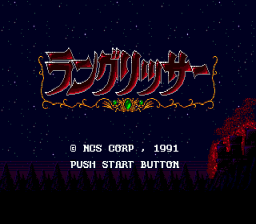
Before Fire Emblem was a household name over here, Warsong — Langrisser in Japan — was quietly teaching Genesis owners how good a strategy RPG could feel. You do not just move heroes around a grid. Every commander hires mercenary units, keeps them alive to gain experience, and watches a single bad charge dissolve an entire company. Terrain matters, class promotions branch in satisfying ways, and the battles feel like actual wars instead of chess with swords.
What I love most is the scale. Your hero is powerful, but he is also one bad positioning mistake away from being surrounded and cut down by spearmen he should have respected. The story is standard fantasy fare, admittedly, and the presentation is plain even for 1991. But mechanically this is deep, tense stuff — a tactics game that respected your intelligence years before the genre had its Western moment.
10. Pier Solar and the Great Architects (2010)
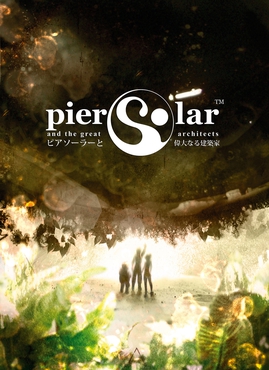
Yes, the date is right. Pier Solar arrived in 2010, a brand-new Genesis RPG built by fans at WaterMelon, shipped on a real cartridge with a real box, for a console that had been commercially dead for over a decade. That alone would earn it a footnote. What earns it this spot is that it is actually good — a warm, traditional adventure about three friends chasing a cure for a sick father and stumbling into something much larger.
The pixel art is gorgeous, easily among the prettiest on the system, and the soundtrack even shipped on a CD you could pop into a Sega CD for enhanced audio — a trick straight out of a 1993 fever dream. It is long, sometimes too in love with its own random encounters, and the difficulty spikes are real. But as proof that the Genesis RPG never truly died, nothing else comes close.
9. Shining in the Darkness (1991)
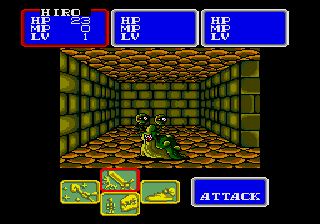
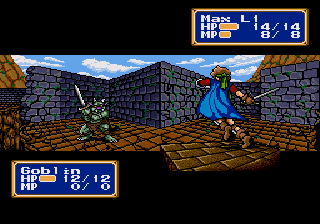
This is where the Shining series began, and it is not a tactics game at all — it is a first-person dungeon crawler, all hand-mapped corridors, sudden monster portraits, and that creeping dread when your lantern dims deep in the labyrinth. One single dungeon, visited again and again, growing stranger and deadlier as you descend. By modern standards that sounds thin. In practice it is hypnotic.
Part of the charm is economy. You return to the same castle town, the same shops, the same king, and those familiar faces make each dive feel like a real expedition rather than a menu between set pieces. The monster art, drawn big and colorful, still has personality to burn, and Climax and Sonic! Software Planning clearly already understood pacing and polish. Later Shining games went bigger and, honestly, better — but this dark little labyrinth is where the magic started, and it still casts a spell.
8. Crusader of Centy (1994)
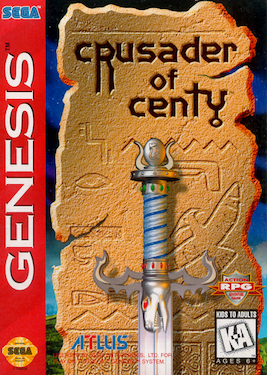
Everyone calls Crusader of Centy Sega’s answer to A Link to the Past, and for once the comparison is fair — top-down swordplay, puzzle-filled dungeons, a bright storybook world. But stick with it and Centy reveals its own strange heart. Your hero loses the ability to talk to other humans early on and can only speak to animals, and the game builds its whole emotional arc around that isolation.
Instead of collecting items, you collect animal companions — a penguin that freezes enemies, a cheetah that makes you faster, a dog you will become embarrassingly attached to. Swapping pairs of them to solve puzzles gives the back half a flexibility Zelda never attempted. It arrived late, sold poorly, and now costs a small fortune on the secondhand market. Play it however you legally can. It is short, sweet, and far more thoughtful than its cute box art suggests.
7. Beyond Oasis (1994)
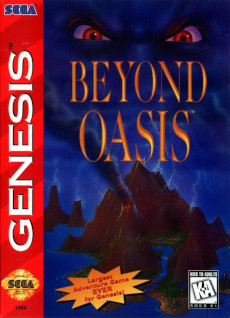
Beyond Oasis — The Story of Thor overseas — is what happens when an action RPG remembers it is also a brawler. Prince Ali does not just poke enemies with a dagger in polite turn-based fashion. He runs, jumps, does spinning kicks and street-fighting combos, and juggles skeletons like he wandered in from Streets of Rage. Ancient’s combat feels loose and joyful in a way most 16-bit action RPGs never managed.
Layered over that is a tidy elemental summon system: find a spirit of water, fire, shadow, or plant life, then call it out by striking the right surface — water from a stream, fire from a torch. The puzzles built around that idea stay clever without ever stopping the action cold. Yuzo Koshiro’s studio made this, and while the soundtrack is moodier than his famous work, the whole package has confidence. Brief, beautiful, and endlessly replayable.
6. Monster World IV (1994)
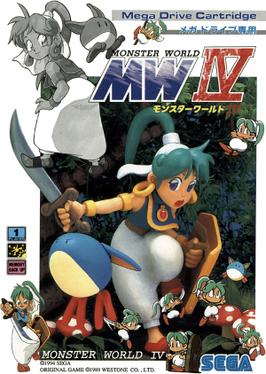
The great heartbreak of this list is that Monster World IV never got an English Genesis release in its own era — Western players waited until 2012 for an official translation. What we missed was the best Wonder Boy game ever made: a side-scrolling action RPG starring Asha, a green-haired girl with a scimitar, a shield, and a devoted little Pepelogoo creature who helps her glide, double-jump, and reach secrets.
Every dungeon is a small masterpiece of locked doors, genie lamps, and hidden heart containers, and the Arabian Nights art direction is so lush it barely looks like Genesis hardware. Combat is simple, yes, and the platforming asks more of you than the fighting does. But the warmth of this game is undeniable. Asha’s adventure feels hand-made, generous, and quietly sad in places you do not expect. A lost classic, finally found.
5. Landstalker (1992)
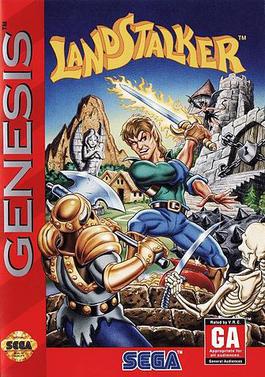
Landstalker is the isometric adventure that made a generation of us misjudge the same jump four hundred times — and love it anyway. You are Nigel, a treasure hunter chasing a king’s hoard with a fairy named Friday riding shotgun, through towns, caves, and the diabolical Greenmaze. The diamond-shaped viewpoint makes depth a puzzle in itself, and yes, some platforming sections will test your faith. I say that as a compliment, mostly.
Because when Landstalker clicks, nothing else on the Genesis feels like it. The world is dense and interconnected, the towns are full of oddball humor, and the dungeons reward observation instead of brute force. Climax squeezed real personality out of every sprite, and Nigel’s swordplay, while simple, keeps exploration snappy. It is the kind of flawed, characterful game that modern remakes sand down into nothing. Leave its edges exactly where they are.
4. Phantasy Star II (1989)
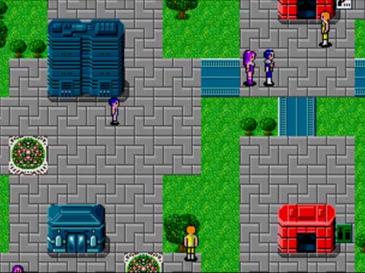
Phantasy Star II hit in 1989, when most of us still thought console RPGs meant Dragon Warrior, and it felt like it had arrived from the future — because its story is set a thousand years into one. A computer called Mother Brain runs the terraformed planet Motavia, something has gone catastrophically wrong, and agent Rolf and his companions are sent to find out what. What follows includes one of the most famous deaths in gaming history — you know the one — years before that kind of loss was fashionable.
I will be honest about the cost of admission: the dungeons are mazes designed by a sadist, the encounter rate is relentless, and you will grind. But the bleak, questioning science fiction underneath was years ahead of its peers, and its ending still sparks arguments. This is the Genesis RPG as pioneer — harsh, visionary, unforgettable.
3. Shining Force (1992)
If Warsong was tactics for the hardcore, Shining Force was tactics for everybody, and I mean that as the highest praise. Twelve fighters on a grid, each one a person — a centaur knight, a birdman, a mage who looks like a toddler and hits like a truck, a hamster-adjacent mascot I would die for. Between battles you walk around real towns, talk to your army, buy gear, and resurrect your fallen. That downtime turns units into characters.
The genius is in the restraint. No permadeath anxiety, no spreadsheet of weapon triangles — just clean positioning, terrain, and the delicious decision of who gets the last hit and the experience that comes with it. Promoting a favorite at level ten and watching them come back transformed never gets old. For a lot of us, this was the first strategy RPG we ever finished, precisely because it wanted us to finish it.
2. Shining Force II (1993)
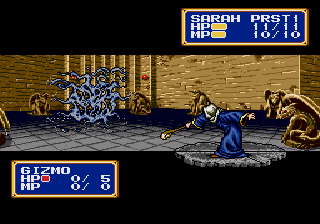
Everything the first Shining Force did, the sequel does bigger, longer, and — this is the part people undersell — weirder. The adventure opens out into a proper explorable world map, the story runs twice as long, and the roster goes gloriously off the rails: a tortoise, a phoenix, a robot, a vampire baron, and a secret character or two I will not spoil even thirty years later. Finding them all felt like playground legend stuff.
The battles grow teeth, too. Kraken limbs erupting from the sea, chessboard fights, bosses that genuinely punish a lazy formation — the difficulty curve here respects the player the first game trained. Bowie’s quest to stop Zeon is classic fantasy, but it is told with such pace and charm that classic feels like a feature, not a limitation. This is my personal favorite Genesis RPG, and on a different day I would argue it into the top spot.
1. Phantasy Star IV: The End of the Millennium (1993)
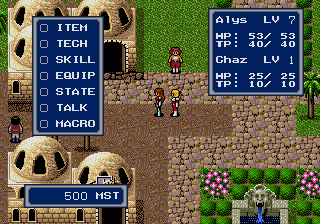
But on this day, and most days, the crown belongs to Phantasy Star IV. Sega looked at a series built on grinding, mazes, and beautiful cruelty, and made the finale fast, generous, and emotionally complete. Hunter Chaz and the android Wren, the mysterious Rune, a return to a dying Motavia a thousand years after Part II — every thread from three games is picked up and tied off with real confidence.
The craft is everywhere. Manga-style cutscene panels give the story a visual punch no rival matched. Combination attacks reward experimenting with your party’s skills. The dungeons are fair, the pacing is breathless, and the final stretch reaches for genuine cosmic melancholy and gets there. It is the rare 16-bit RPG with no asterisk — no “great, but grind first,” no “great, but import it.” Just great. If the Genesis only got to keep one epic, this is the one.
The verdict
Look back over that list and notice the range. Nintendo’s 16-bit RPG legacy runs largely through a handful of towering studios. Sega’s runs through dungeon crawlers and tactics games, isometric experiments and Arabian Nights platformers, a homebrew epic released when the console was old enough to vote. The Genesis library is smaller, stranger, and in places harder to love — and that is exactly why I love it.
The Genesis was never the console without RPGs. It was the console whose RPGs you had to go looking for — and they rewarded the search every single time.
So if your Genesis only ever spins arcade ports and sports carts, give one of these a weekend. Start with Shining Force if you want strategy without the headache, Beyond Oasis if you want action, and Phantasy Star IV if you want the masterpiece. Then come back and tell me where my ranking went wrong. I will be here, somewhere on Motavia, still defending it.