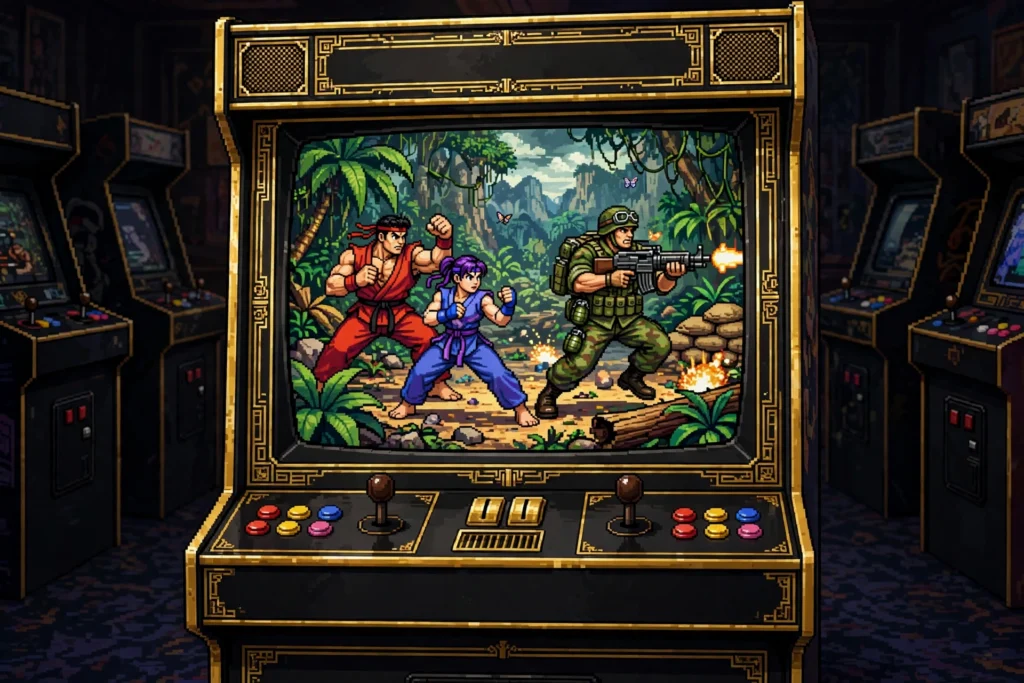
Every console generation has a machine most of us only ever saw behind glass, and for the 16-bit era that machine was the Neo Geo. SNK launched the AES home system in 1990 at $649 — in 1990 money — with cartridges that cost over $200 apiece and were roughly the size of a hardback novel. It earned the Rolls-Royce nickname honestly: absurd, luxurious, and completely uninterested in whether you could afford it.
Here is the thing the price jokes miss, though. The Neo Geo earned the attitude. The home cartridges were not ports of the arcade games — they were the arcade games, bit for bit, because the AES and the MVS arcade board were the same hardware. SNK kept feeding that hardware for fourteen years — long enough for developers to squeeze miracles out of it, while Genesis and SNES owners squinted at compromised conversions.
The result is one of the strangest, strongest libraries ever assembled: fighting games of unreasonable depth, shooters of unreasonable beauty, and sports games that still embarrass their modern descendants. Narrowing it to fifteen essentials hurt. Plenty of classics sit in the honorable-mention pile, glaring at me. But a list has to be a list — so here is mine, counted down to the one game I would save from a fire.
The countdown
15. Neo Turf Masters (1996)
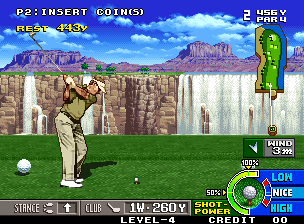
I am starting with a golf game, and I will defend that anywhere. Nazca — the team behind Metal Slug — made this, and you can feel it in every pixel: the waterfalls, the mesa backdrops, the golfer’s impossibly smooth swing animation. But the beauty is not the point. The point is a three-click swing meter that is simple to learn and genuinely hard to master, wind that actually matters, and rounds that move at arcade pace instead of televised-golf pace.
Nearly thirty years later, people who have never touched another golf game still fire this up. “On the gween!” lives in my head rent-free, — a 1996 arcade golfer became the system’s great comfort game, and that tells you how well it was made.
14. Magical Drop III (1997)
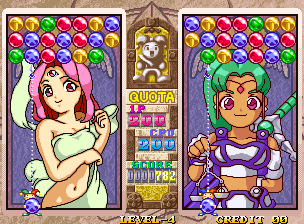
Data East’s puzzle series hit its peak here, and it is not close. You play a little jester at the bottom of the screen, grabbing colored drops and throwing them back to match three and clear the board — except the board is descending, your opponent is burying you with every chain they land, and the whole thing moves at a speed that turns your brain to soup in the best way.
What lifts it above a dozen other puzzle games is the chain system: reactions you only half-planned, then riding the chaos. Against a friend it becomes a shouting match within ninety seconds. Puzzle games are supposed to be relaxing. This one is a contact sport, and it is glorious.
13. Blazing Star (1998)
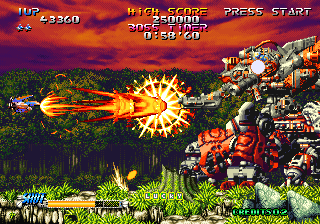
Yumekobo had an impossible brief with Blazing Star: follow Pulstar, one of the most beautiful shooters ever made, on the same hardware. Their answer was to go bigger — more ships, more bullets, more pre-rendered spectacle per square inch than the Neo Geo had any right to display, all wrapped around a scoring system built on chaining and a charged shot that rewards aggression.
It is friendlier than its predecessor, which is precisely why it lands here as the shooter I hand to newcomers. The difficulty curve is honest, the bosses are screen-filling monuments, and the Engrish encouragement — “You fail it!” — has become shooter folklore. A technical showcase that never forgot to be a game first.
12. Shock Troopers (1997)
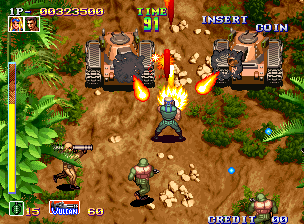
Everyone wanted to be Metal Slug in 1997, but Saurus went a different direction: straight up. Shock Troopers is an overhead run-and-gun in the Ikari Warriors tradition, massively upgraded — eight mercenaries with distinct stats, a dodge roll that was years ahead of fashion, branching routes through jungle, mountain, and valley campaigns, and the choice to attack solo or as a three-person team that shares one life bar.
That team mode is the genius stroke. Swapping soldiers mid-firefight to match the weapon to the moment gives the whole game a tactical pulse most overhead shooters never find. It never got a home port in its own era, which kept it a secret for years. It should not have been one.
11. Windjammers (1994)
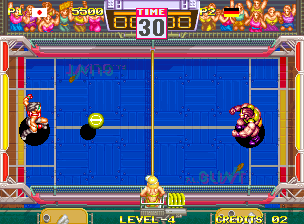
Windjammers is Pong after a decade of weight training and a serious attitude adjustment. Two players, one flying disc, goals split into three- and five-point zones — and from that skeleton Data East built the most purely competitive game on the system. Curve throws, lobs, charged super shots that set the disc on fire: the moveset is tiny and the mind games are endless.
Matches last minutes and friendships end over them. Every rally is a negotiation — are you guarding the five-point corner or baiting me into guarding it? — and the whole thing reads perfectly at a glance, which is why it still fills tournament brackets and got a full modern sequel. Some games are deep. Windjammers is distilled.
10. Baseball Stars 2 (1992)
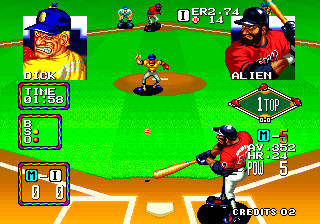
Forget simulation. Baseball Stars 2 understood that baseball on an arcade board should be about enormous men hitting the ball so hard the outfield might as well be decorative. The sprites are massive, the animations are swaggering, and the power-up bats — earned by beaning, naturally — turn at-bats into home run derbies waiting to happen.
Under the cartoon violence sits a genuinely sharp game: fielding is snappy, base-running is a real gamble, and fifteen fictional teams give the whole thing personality modern licensed games cannot buy. This came out in 1992, four years into the 16-bit wars, and I would still rather play it than most baseball games released since. Sometimes charm is a mechanic.
9. The Last Blade 2 (1998)
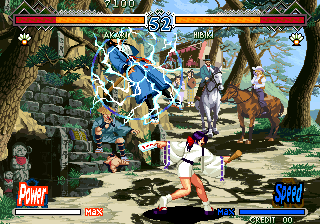
If Samurai Shodown is a thunderstorm, The Last Blade 2 is snowfall — quieter, colder, and in its own way more dangerous. Set at the end of the samurai era, it is a weapons fighter about a dying world, and SNK painted it like one: falling leaves, burning villages, duelists silhouetted against grey skies. It is, shot for shot, the most beautiful fighting game on the system.
It plays as good as it looks. The Power and Speed modes split every character into two philosophies, the deflect system rewards ice-cold timing, and the whole dance happens at a pace that feels like an actual sword fight — patient, then suddenly over. Elegance is an underrated fighting-game virtue. This is its monument.
8. Twinkle Star Sprites (1996)
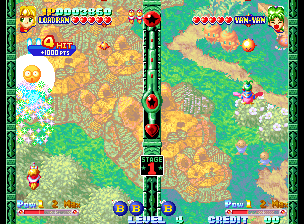
ADK looked at the vertical shooter, looked at the versus puzzle game, and committed an act of genre fusion that should not work: a competitive shoot-’em-up. Two players, split screens, and every enemy you destroy rains trouble onto your opponent’s side. Chains send fireballs across. Big combos summon boss attacks. You are playing a cute shooter and a fighting game simultaneously, and both halves are trying to kill you.
The sugar coating is real — this is a parade of magical girls and dessert-colored bullets — but do not mistake it for softness. At high level this is one of the most frantic, strategic games on the Neo Geo, a cult object that inspired imitators for decades and still has no true equal.
7. Metal Slug X (1999)
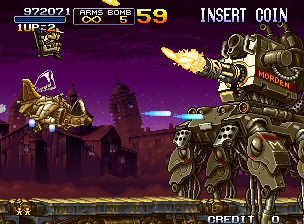
Metal Slug 2 was a masterpiece with a stutter: the slowdown was so famous it became part of the game’s identity. SNK’s response, Metal Slug X, is the rare remake nobody argues with — the same campaign rebuilt on a refined engine, slowdown banished, remixed enemy placements, new weapons, and a difficulty curve with its teeth properly sharpened.
For years this was my answer to “which Metal Slug should I start with,” and on some days it still is. It is leaner than the third game and meaner than the first, ninety minutes of perfectly paced cartoon warfare where every screen hides a joke, a prisoner, or a tank with your name on it. The definitive version of a definitive game.
6. The King of Fighters 2002 (2002)

By 2002 the King of Fighters series had spent years piling on systems — strikers, armor modes, counter modes — and 2002’s great decision was subtraction. Out went the strikers and the storyline. In came a dream-match roster of 43 fighters, the classic three-on-three format, and one of the finest-tuned fighting engines SNK ever built, with the MAX mode cancel system that combo artists still study.
The result was a competitive monster. KOF 2002 became the series’ folk game across Latin America and Asia, and its Ultimate Match revision is still played seriously today. It is on this list because stripping a series to its essentials is harder than embellishing it — and nobody stripped better.
5. Samurai Shodown II (1994)
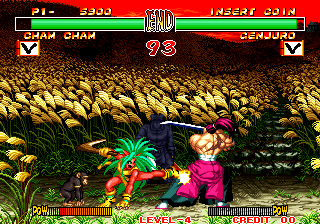
In 1994, fighting games were about combos. Samurai Shodown II had the nerve to be about single hits. One clean heavy slash could take a third of your life bar, which turned every match into a knife-edge negotiation of distance and nerve — footsies before the genre had a word for it, played with swords, on stages so gorgeous they belonged in a museum.
SNK widened everything from the first game: a bigger, weirder roster (a German knight, a Mayan warrior, a man fighting with a pillar), hidden bosses, taunts, the series’ first parry-like flourishes. It ruled arcades when fighting games ruled everything, and its central lesson — that patience can be thrilling — still separates it from everything louder.
4. Pulstar (1995)
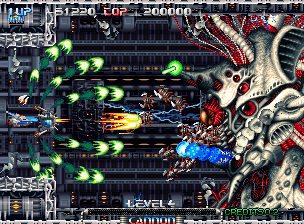
Aicom built Pulstar as a love letter to R-Type, and then rendered that letter in some of the most astonishing pre-rendered graphics of the decade — biomechanical leviathans and deep-space dread that made arcade-goers stop and stare in 1995. Underneath the spectacle is pure memorization-school shooting: a chargeable beam, a detachable pod, checkpoints that send you back stripped of power-ups and full of shame.
Yes, it is brutally hard. That is the genre’s contract, and Pulstar honors it while looking like a game from five years in the future. Blazing Star, its official follow-up, is the friendlier recommendation; Pulstar is the greater achievement — the shooter that proved the Neo Geo could out-pretty anything in the arcade while out-punishing it too.
3. The King of Fighters ’98 (1998)

There is a reason people still call this the king. After four chapters of storyline, SNK stepped back and built a celebration instead: 38 fighters drawn from the whole saga, the refined Advanced and Extra modes letting you pick your philosophy of movement and meter, and balance tuned until nearly the entire enormous roster could genuinely compete.
It became the series’ benchmark — the game every later KOF is secretly judged against, the one that headlined tournaments for decades and earned a full remake a decade later. Team fighting has never felt this complete: three characters, one shared momentum, comebacks built into the format’s bones. If the Neo Geo’s fighting library is a crown, this is the biggest jewel in it. Almost.
2. Garou: Mark of the Wolves (1999)

Fatal Fury had been running for eight years when SNK did something ruthless: they benched Terry Bogard’s whole generation, jumped a decade forward, and built Garou around Terry’s adopted son, Rock Howard, and a roster of heirs, strangers, and one very tired legend in a bomber jacket. Then they gave it animation so fluid people mistake it for a game ten years younger.
The systems sing, too — the T.O.P. gauge that turns a sliver of your life bar into a power zone, Just Defend rewarding the exact frame of a block, feints and breaks that keep pressure honest. It plays like the genre’s future because it was. SNK’s 2D swan song is a top-two finish on any honest Neo Geo list, and a sequel finally arriving a quarter-century later tells you the world never forgot it.
1. Metal Slug 3 (2000)
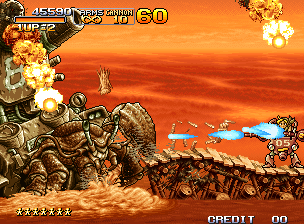
Was it ever going to be anything else? Metal Slug 3 is the best argument the platform ever made for itself — Nazca and SNK detonating the run-and-gun formula in every direction at once. Branching paths in nearly every mission. Zombie outbreaks, alien abductions, camel-mounted desert charges, a launch into space for a finale that refuses to end. Every route hides another idea, animated frame by loving frame.
The first two games were great. X was the refinement. This is the explosion — the longest, strangest, most generous game in the series, made by people who knew exactly what the hardware could do and did all of it at once. Put a stranger in front of one game to explain what the Rolls-Royce of consoles was for. It is this one. It was always this one.
The verdict
Fifteen games, and look at the spread: fighters and shooters, yes, but also golf, baseball, puzzle chaos, and a flying-disc duel that still starts arguments. The hardware was a luxury item, but the library was no museum piece — it was SNK and its partners spending fourteen years finding out how much excellent one machine could hold.
The Neo Geo was the Rolls-Royce of consoles — but these fifteen games are why it was never just a status symbol. It was a library worth the ransom.
Start with Metal Slug 3 and Windjammers if you are new, graduate to Garou when you are ready to get serious, and keep Neo Turf Masters installed forever for days when you just need to hear “On the gween.” Then tell me what I left off — Sengoku fans, Viewpoint faithful, I know you are out there. You might be right too.