At a glance: Star Chaser · Sik · Sega Mega Drive / Genesis, November 2015 · Competitive maze game for up to four players, human or computer-controlled · Single-screen rounds against the clock · Editorial coverage only. A note on honesty, stated once and meant throughout: the surviving record for this game is thin — a handful of short contemporary reports and one widely shared screenshot — so this feature separates what is documented from what can only be reasonably inferred, and says so when it does.
Some homebrew releases arrive with press kits, trailers and interview tours. Star Chaser arrived the older way: a forum post, a free file, and a screenshot that ricocheted around the retro news sites for a few days in mid-November 2015 before the scene moved on. It deserves better than oblivion, because what that screenshot shows is genuinely appealing — a bright, clockwork little contest for up to four players, built for a console whose greatest multiplayer memories were already twenty years old when the game appeared. This is the story of Star Chaser as far as the record supports telling it, and an honest account of where the record runs out.
What the game is
The documented facts, drawn from the contemporary reports by RetroCollect and Vintage is the New Old in November 2015, fit in a paragraph. Star Chaser was created by the homebrew developer known as Sik and released, free of charge, through the GenDev community at SpritesMind — the long-running forum that serves as the Mega Drive development scene’s workshop and town square. It is an arcade contest in which each player steers not a character but a coloured ball, racing around a walled maze to collect stars as they form. Up to four balls compete at once; any slot not taken by a human being is filled by a computer opponent, so the full four-way contest works just as well solo. Contemporary coverage singled out its pace — “fast-paced” and “frantic” are the words that recur — and noted one plain limitation: the game shipped without sound.
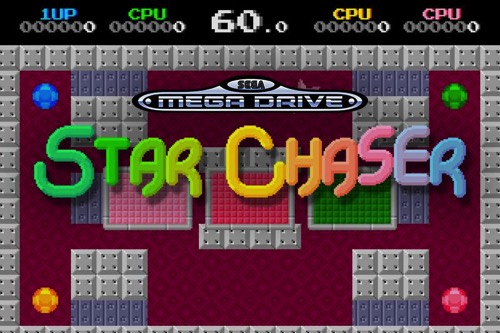
The widely circulated Star Chaser image, via Vintage is the New Old: the game’s title over one of its mazes. The heads-up display tells the design story — four scoring slots across the top, the first marked 1UP and the rest CPU, with a 60.0 counter in the centre: a one-minute, four-way scramble, against friends or against the machine.
That screenshot rewards a closer look, because it is effectively the game’s whole design document in one frame. The maze is compact and symmetrical, broken into coloured zones — pink, red, green — with the competing balls starting at the corners in matching colours. The centre counter reads 60.0: rounds are timed, a minute of mayhem rather than an endurance test. There are no lives, no levels to unlock, no story to skip — no lives counter at all, in fact, because the clock does the eliminating. It is a party game reduced to its skeleton: one screen, one clock, four rivals, and a fresh star always forming somewhere you are not. Games of this shape live or die on the quality of the chase, and the maze’s tight lanes and open junctions suggest a designer who understood that a good scramble needs both bottlenecks to fight over and escape routes to flee through.
Four players on a two-port console
The four-player ambition is the most interesting thing about Star Chaser, because the Mega Drive was never naturally a four-player machine. Two controller ports were the standard Sega shipped, and four-player gaming on the hardware always meant extra equipment — a multitap in the second port, in the style of the era’s beloved Micro Machines sequels, whose J-Cart went further still and built extra ports into the cartridge itself. Whether Star Chaser‘s four human slots were reached via a multitap is, frustratingly, one of the details the surviving reports do not spell out, and this article will not pretend otherwise. What can be said is that the design is perfectly shaped for the format: simultaneous, single-screen, instantly readable, with computer players guaranteeing the full chaos even when only one controller is plugged in. The great four-player games are never really about the player count. They are about the noise a room makes. A one-minute round, a shared screen and a star appearing in the far corner from three of you — that is a recipe for noise.
The developer: a scene fixture (with hindsight)
The name on the game carries weight in its community, and later history — labelled hindsight, since none of it was knowable in November 2015 — explains why. Sik, an Argentina-based developer long active on SpritesMind, became one of the Mega Drive scene’s most respected technical minds: the person other developers asked when the hardware refused to cooperate. Later coverage of the modern Mega Drive scene records Sik providing technical assistance on both Tanglewood and Xeno Crisis, and going on to build Arkagis Revolution, a top-down shooter whose rotating-screen trick drew admiration precisely because so few programmers could have made the Mega Drive do it. Seen in that light, Star Chaser reads as an early calling card: small, clean, complete, and quietly ambitious about the one specification — four simultaneous players — that the hardware makes awkward.
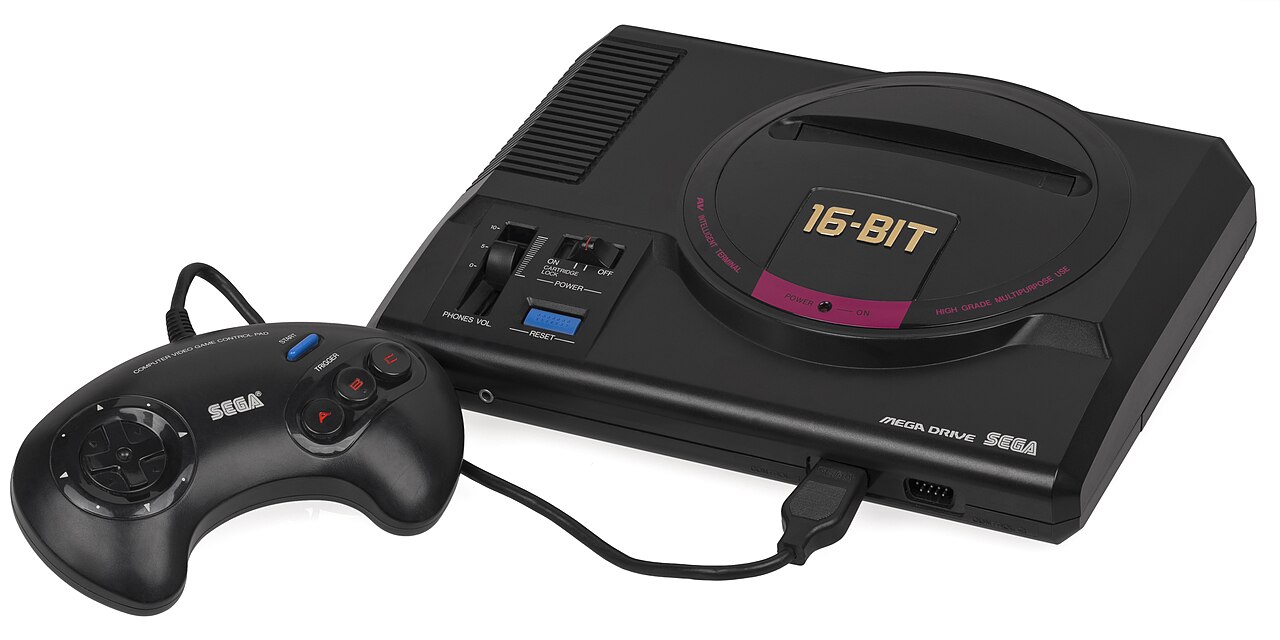
A Japanese Mega Drive and its controller, photographed for Wikimedia Commons. Star Chaser was made for this hardware a quarter-century after its launch — and made, unusually, for four pairs of hands at once, with computer opponents filling any empty slot.
Where the record runs out
And here the honest part. Beyond those November 2015 reports, Star Chaser left almost no paper trail that research for this feature could find: no reviews in the retro press, no interview with its creator about the game, no physical cartridge edition, no sequel, no later update that announced itself to the wider world. It is entirely possible that more was said in forum threads that search engines no longer surface well; the GenDev community discussed its own work constantly, and forum history is the first thing the internet forgets. Rather than invent a richer biography for the game, this feature prefers to state the gap plainly — and to note that the gap itself is data. The Mega Drive homebrew scene of 2015 ran on exactly this kind of release: one skilled person, one neat idea, one free game given away to a few hundred people who still cared. Most of those releases were never reviewed, never sold, and never written up beyond a paragraph. Star Chaser at least got its paragraph, twice over.
A minute at a time
Judged on what survives, Star Chaser was a modest thing done well: a one-minute, four-way scramble through a bright maze, generous enough to fill its empty seats with computer rivals and honest enough to ship without sound rather than with bad sound. Its creator went on to become one of the scene’s essential engineers, which makes this little game a footnote in a significant career — but footnotes are how scenes remember themselves. Somewhere, the files still sit on a forum server, waiting for the next person to spend sixty seconds chasing stars. That is not a bad afterlife for a game that asked for so little and, by every surviving account, delivered its minute of mayhem exactly as promised.