
Most cancelled games stay cancelled. In December 2025, John Romero stood on a panel stage in Madrid and explained, to applause, why his would not — at least, not entirely. The unannounced shooter his Galway studio had spent years building for a major publisher was gone, killed the previous July when its funding was pulled in the middle of Microsoft’s sweeping Xbox cuts. But Romero Games itself had lived through it, and the work had not been thrown away. The project had been redesigned from the ground up into what he called a “much smaller game” — an indie-scale shooter built partly from pieces of the far bigger one, which he valued, in a phrase that has followed the story ever since, at roughly fifty million dollars’ worth of finished development. GamesRadar+ reported the remarks on December 10, 2025, drawing on a recording of the panel that Eurogamer had spotted. It was the first substantial update on the studio in five months — and, characteristically for this story, it raised almost as many questions as it answered.

Vintage personal computers and CRT monitors on display. John Romero co-created Wolfenstein 3D, Doom and Quake on hardware of this era at id Software; three decades later, his Galway studio’s most ambitious shooter became one of the highest-profile casualties of the 2025 Xbox cuts. Photo: Wikimedia Commons.
What Romero actually said in Madrid
The setting matters, because almost everything the public knows about the new game comes from one appearance. Romero was speaking at Salón del Videojuego de Madrid 2025, the Madrid video game show, on a panel devoted largely to his career. As PC Gamer, PCGamesN and others reported from the recording on December 10, he opened the subject himself: “We survived the cancellation of a huge game.” He put the cancelled production’s scale at “110 people working on the game every day for years,” and described its replacement in deliberately paradoxical terms. The new game, he said, has nothing to do with the previous game as a design — the design is completely different — yet it incorporates a lot of elements from it. “We’re not starting at ground zero,” was his summary, before the line about having fifty million dollars’ worth of material the team could lift pieces from and place into a brand-new indie production.
Two other remarks from the panel define what little is known about the smaller game’s character. First, it remains a shooter; Romero said he had never played anything quite like it apart from that basic fact, and that the things players do in it would feel unfamiliar. His comparison was about the sensation of exploring somewhere strange — he invoked the experience of wandering into Elden Ring’s world for the first time and repeatedly wondering what on earth a place or creature was — rather than about genre, difficulty or structure. Second, he framed the shrinkage as a creative benefit rather than only a wound: the people now building the game are department directors who, on the big production, rarely got to write code or produce design work personally. On a small team, he argued, they get to do the thing they are good at themselves — and that, he said, is why small teams are great.
What Romero did not provide is just as notable. No title, no footage, no platforms, no release window and no engine were announced for the new game. And when PCGamesN followed up, Romero Games declined to comment on whether it had secured a new publisher or fresh funding. That silence matters when weighing the word “saved,” which appeared in many headlines that week: as of the December reports, the studio had confirmed survival and active redesign work, but not the money behind it.
A new dawn, announced in 2022
The cancelled game entered the public record on July 19, 2022, with a hiring announcement rather than a reveal. Romero Games — the independent studio John Romero and his wife Brenda Romero founded in Galway, Ireland, on August 11, 2015 — declared that it was working with a major publisher on “an all-new FPS with an original, new IP,” built in Unreal Engine 5, and recruiting across design, engineering and art. The studio called it a new dawn and stressed that shooters were the foundation its careers were built on. Nothing else was ever officially shown: no name, no screenshots, no trailer. Brenda Romero told PC Gamer at the time that the team was deliberately not boarding the hype train — a notable stance from John Romero, whose post-id project Daikatana had become a cautionary tale about over-promotion two decades earlier.
The studio making it was small by blockbuster standards but decorated. Romero Games’ catalogue before the big shooter included the family-built Gunman Taco Truck in 2017, Brenda Romero’s Prohibition strategy game Empire of Sin, published by Paradox Interactive in December 2020, and John’s two unofficial Doom episodes, Sigil (2019) and Sigil II (2023), which were later folded into the official Doom + Doom II re-release. The new FPS was plainly a step up in scale from all of that: by 2024, coverage put the team at more than 75 developers, working on-site, remotely and in hybrid arrangements from the Galway base.
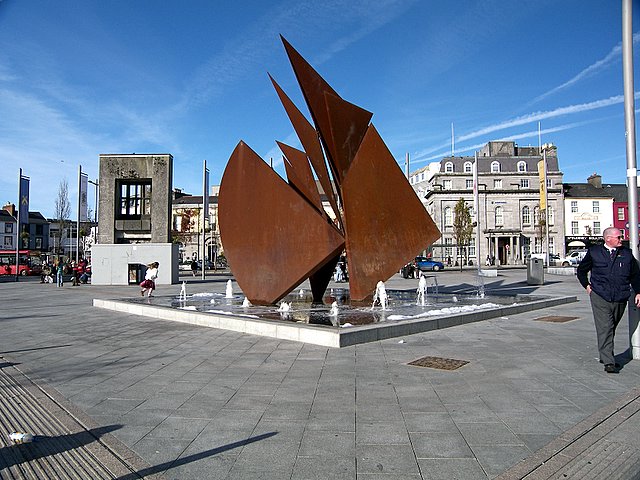
The Quincentennial Fountain in Eyre Square, Galway — its sails evoke a traditional Galway hooker boat. Romero Games has been based in Galway, on Ireland’s west coast, since John and Brenda Romero founded it there in 2015. Photo: Wikimedia Commons.
July 2025: the week the funding vanished
The end arrived with Microsoft’s July 2025 restructuring, in which roughly 9,000 jobs were cut across the company. Inside Xbox, the same wave cancelled Rare’s Everwild and the Perfect Dark reboot, closed The Initiative outright, and ended ZeniMax Online’s unannounced MMO. Romero Games learned its fate on the evening of Wednesday, July 2. In a statement posted July 3, Brenda Romero said the studio had been told its publisher was cancelling funding for its game alongside several other unannounced projects elsewhere, describing the move as a strategic decision taken at a high level, far above the studio’s visibility or control. She stressed that the team had hit every milestone on schedule, drawn consistent praise and cleared every internal review gate — and that she and John were heartbroken.
One detail the studio has never supplied is the publisher’s name. Romero Games has consistently said confidentiality agreements prevent it from identifying the backer, adding only that some may infer it from public information. Former employees were less guarded: several posting about losing their jobs that week named the Xbox layoffs directly, and reporting by VGC and others identified the unnamed publisher as Microsoft, with some accounts specifying its Bethesda publishing operation. Microsoft has not, in the sources checked for this article, publicly confirmed a Romero Games publishing deal ever existed. The honest summary is that the timing, the employee accounts and the wider pattern of that week’s cancellations point one way, while the contract itself remains undisclosed.
Closed, not closed, and the problem of counting people
Within forty-eight hours, the story briefly became a closure story. Irish reporting led the confusion: an anonymous employee told The Journal that everyone was out of a job, that the team had met the publisher the day before with no warning, and that, for the moment, the studio was closed while attempts were made to find other funding. LinkedIn posts from departing staff said similar things, and The Irish Times reported that up to 100 jobs were to be lost at the Galway developer. Those accounts were not invented — people plainly were losing their livelihoods that week — but the studio pushed back on July 7 with a formal correction. Funding had been pulled and the game cancelled, it said, and the entire staffing of the studio had to be reassessed; but Romero Games was not closed, its team had been in the studio that day discussing next steps, and several publishers had already made contact about helping bring the game to completion, with those opportunities under evaluation.
The employment numbers in this story deserve care, because four different figures circulate and they measure four different things. Company filings cited by Irish outlets put Romero Games’ direct employment at 42 people, directors included, at the end of 2024. VGC described a team of more than 75 developers in 2024. The studio’s own site suggested over 100 developers on its books, and Irish reporting described a wider project footprint of more than 100 contributors worldwide — contractors, remote staff and support roles beyond the Galway payroll. Finally, Romero’s own Madrid figure was 110 people working on the game daily. None of these numbers proves the others wrong; they are concentric circles, from payroll to total project reach. What no source checked for this article establishes is a verified final tally of redundancies, or the size of the team that remained after the reassessment the studio announced. Any report stating flatly that “110 people were laid off” — or, at the other extreme, that nobody was — is going beyond the record. What is documented is many individual departures in July 2025, a staffing reassessment, and a much smaller production by December.

A DECpc 425SE Color laptop, a 486-era machine of the kind on desks when Doom arrived in December 1993. Romero’s December 2025 pitch for the new game leaned on that heritage: a veteran team returning to hands-on making, at a fraction of the cancelled production’s scale. Photo: Wikimedia Commons.
The autumn of talks, and the fifty-million-dollar fallback
Between July and December, Romero gave one significant interview, to Gamereactor, reported on October 29, 2025 by Time Extension, GamesRadar+ and Pure Xbox among others. Its most important revelation reframed the whole salvage operation: the studio, he said, owned the intellectual property, the code and everything about the cancelled game. The big version was, by his estimate, about midway through development when the money stopped, with around fifty million dollars already invested in it. A lot of companies, he said, were interested and still talking; a new partner picking the project up would effectively receive that investment for free. And if no deal for the big game emerged, the same fifty million dollars’ worth of assets could instead be used to make another thing. Read after Madrid, that autumn interview is the fork in the road made public: finish the large game with someone else’s money, or cut a smaller one from its cloth. By December, Romero was describing the second path as the live one — though he did not say the first had been formally abandoned, and the studio would not discuss funding either way.
The leak that its own studio demolished
December also produced the cautionary tale this coverage needed. On December 22, Insider Gaming reported details of the cancelled game from unnamed sources: that it had been known as Hellslayer, that it starred a priest fighting demons, that its combat loop borrowed Hotline Miami’s instant-restart rhythm, and that it had been in development for nearly a decade. The claims raced through secondary coverage within days, often hardening into fact as they travelled. Then, on December 30, PCGamesN published a correction from the one source that outranks anonymous ones. Brenda Romero told the site the report misrepresented the game: she had no idea where the rumour came from, it was wildly inaccurate, there was no priest in the game, and it was nothing like Hotline Miami. The name, the premise and the ten-year timeline all stand unconfirmed — and the premise stands directly contradicted by the studio’s co-founder. Readers meeting those details elsewhere should treat them as disputed, which is why this article has not built on them.
Where the smaller game stands
So what, in the end, is actually known? A Galway studio founded by two of the industry’s most recognisable designers announced a big, publisher-backed, original-IP shooter in 2022 and built it, quietly and apparently competently, for three years. In July 2025 its funding was cancelled as part of the largest single wave of Xbox cuts in years; many of its people left; the studio denied, correctly as far as later events show, that it had closed. Through the autumn it talked to interested companies while holding an unusual asset — full ownership of a half-finished production Romero values at fifty million dollars. In December 2025 its founder announced the outcome: not the big game rescued intact, but a completely redesigned, much smaller indie shooter assembled partly from its predecessor’s elements, promising an unfamiliar kind of exploration, and being built hands-on by the senior staff who remain. In the sources checked for this article through October 2026, no title, date, platform, publisher or footage for that smaller game has followed, and Romero Games has announced no further change in its status; its website remains live, and the December account of a studio at work on the redesign is the last detailed word.
There is a fitting symmetry in it, and Romero clearly knows it. The designer who helped invent the blockbuster shooter in the shareware era, and who once saw a career nearly ended by a blockbuster’s hype, is now making his argument at the opposite scale: that a small team of veterans, working directly on the thing itself and unburdened by a nine-figure production’s machinery, might build the more interesting game. Whether the result justifies the Elden Ring comparison is unknowable until Romero Games shows it. But the December panel settled the question the July headlines had asked. Doom’s co-creator lost the biggest game of his independent career — and the studio, shrunk to something closer to the size that made him famous, is still standing, still building, and not starting from ground zero.