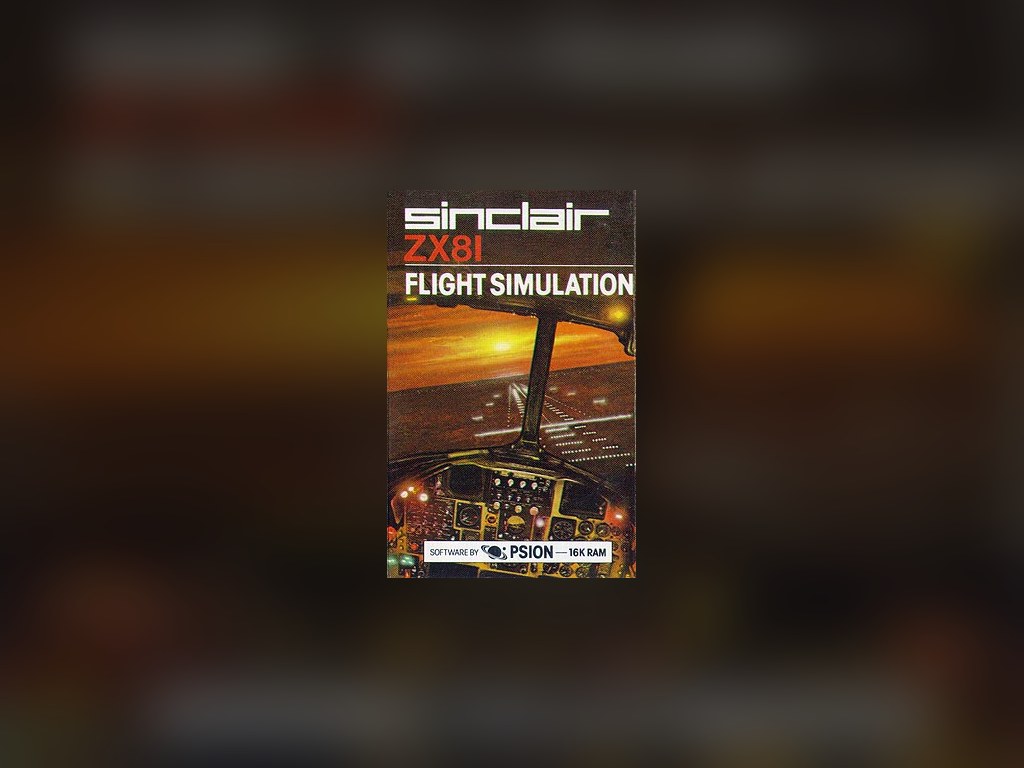
At a glance: Flight Simulation · ZX81 · Psion, 1982 · Flight simulation · Score: 9.0/10
The most improbable sentence in British gaming history might be this one: the benchmark flight simulator of 1982 ran on a ZX81. Psion’s Flight Simulation — written by Psion, marketed by Sinclair Research, released in May 1982 for the 16K machine — put you in the cockpit of a highly manoeuvrable light aircraft with a working instrument panel, a moving horizon, navigation aids, and a full perspective view of the runway on final approach. On a computer with no colour, no sound, no graphics hardware and a keyboard like a printed tea towel. Popular Computing Weekly ran out of vocabulary in public: “No words can do justice to this most elegant of programs… You will not see a better games program till Psion create one for the Spectrum.” The market agreed. The ZX81 version reached number one in February 1983, Psion’s managing director David Potter later put total sales of the program around 250,000 copies, and it stayed in the machine’s top ten for over a year.
Context sharpens the miracle. Flight Simulation arrived when the ZX81 software scene was still mostly type-ins and arcade conversions of variable honesty, and it demonstrated — to an audience of adults as much as children — that Sinclair’s little wedge could host a serious simulation: a program that modelled something real, continuously, and demanded to be learned rather than merely survived. Fathers bought it. The RAF-adjacent bought it. It was the ZX81’s respectable face, the cassette you showed visitors who thought the machine was a toy, and Psion rode it to become the defining software house of the machine’s official catalogue.
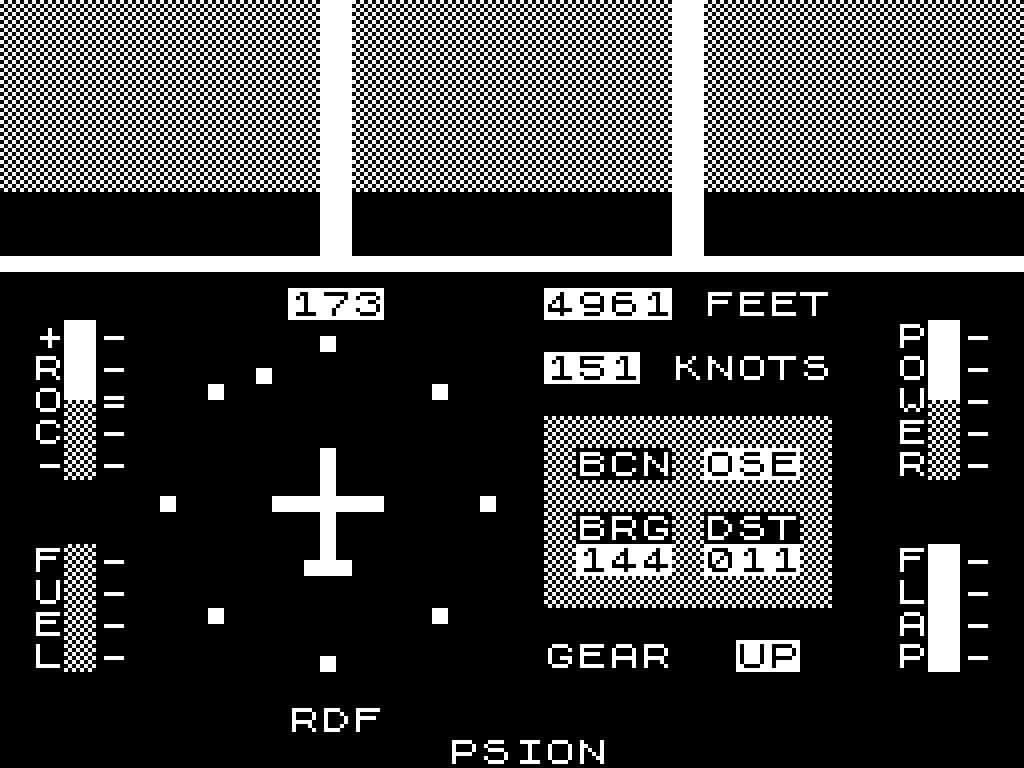
The view from the cockpit
The screen divides into the two things a pilot needs: the world and the numbers. Ahead, through the windscreen, a horizon line that pitches and rolls as the aircraft climbs, dives and banks — drawn in the ZX81’s block graphics and all the more convincing for its restraint. Below and around it, the panel: dials, digital readouts and bar displays reporting speed, height and fuel, an artificial horizon, and the navigation system that ties the whole exercise together, with radio beacons to find and a runway that resolves, on final approach, into a genuine perspective view. Contemporary reviewers kept returning to the same astonishment — ZX Computing called it “superb” and said it made “very good use of the power and the graphics of the ZX81” — because the program’s machine code keeps all of this moving together, smoothly, when the machine’s BASIC contemporaries could barely scroll a maze.
The flying model rewards patience and punishes theatre. This is a light aircraft, not an arcade cabinet: inputs have consequences with momentum attached, the ground arrives with finality, and landing — the whole point, the exam the program sets you — requires lining up on the runway, managing your descent, and arriving at the right speed rather than the most exciting one. Generations of players have a shared memory here, of the runway growing in the windscreen at the end of a long, careful approach, and of how often it ended in a crumpled heap a field short. The program’s limited instructions were a period complaint, and a fair one; Psion had built a simulation that really needed a manual’s worth of teaching, and shipped something closer to a leaflet. Would-be pilots taught each other, in playgrounds and offices, which is its own kind of documentation.
Flight Simulation did not ask whether the ZX81 could do this. It simply did it — instruments, horizon, beacons and all — and let every other programmer on the machine deal with the consequences.
The yardstick
Spectrum Computing’s retrospective on the later Spectrum version states the original’s position plainly: Flight Simulation “became the yardstick by which other ZX81 programs were measured — programs of any kind, not only flight programs.” Hewson’s rival Pilot, written in BASIC, arrived after it and suffered by the comparison, its responses lacking the Psion program’s machine-coded smoothness. When the Spectrum launched, Psion’s conversion was the jewel of Sinclair’s initial software range — the same program, in colour, with a higher-resolution horizon — and it topped the Spectrum charts too, in May 1983. The ZX81 original is the purer document, though. On the Spectrum it is impressive. On the ZX81 it is impossible, and the impossibility is the pleasure: every instrument on that panel is a small refusal to accept what the hardware was supposed to be for.
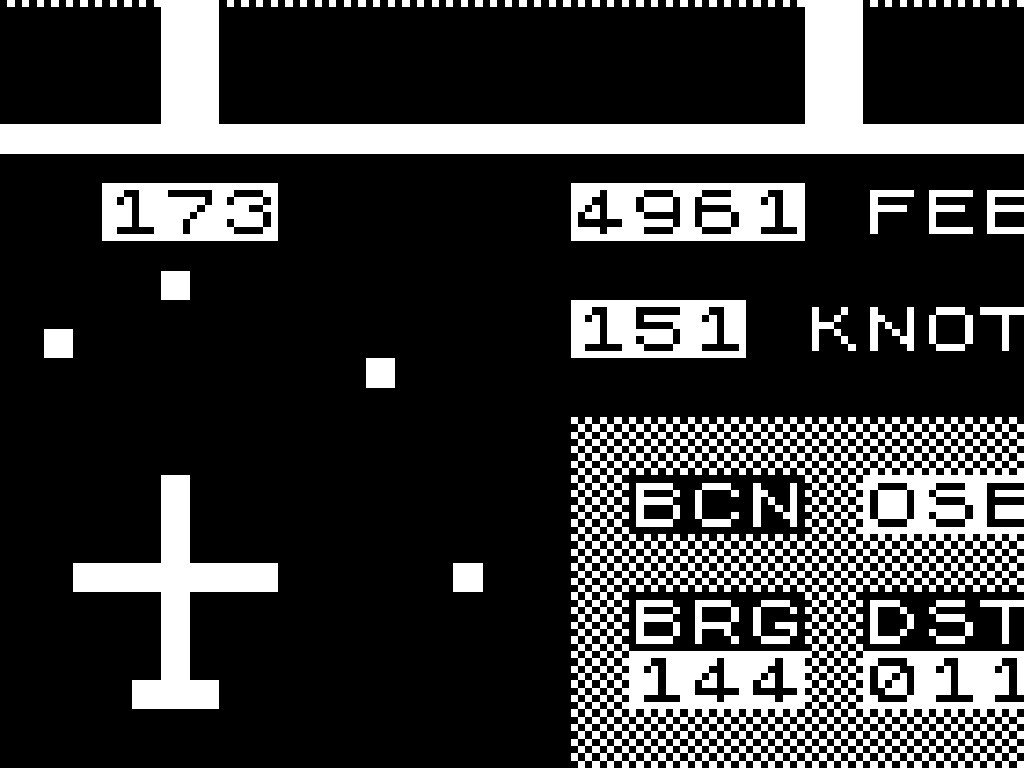
It also marks the moment Psion became Psion — the professional software house whose Flight Simulation money and reputation underwrote a future that led, by a winding road, to the Organiser and a place in PDA history. All of it traces back to a black-and-white cockpit on a £70 computer, drawn in blocks, flown in silence, landed — occasionally, gloriously — by people who had never touched a real aircraft and now knew, roughly, why landing one is hard.
What the Spectrum version confesses
The surest way to see the ZX81 original’s achievement is to read what its own sequel needed a better machine to add. Spectrum Computing’s account of the Spectrum conversion lists the enrichment plainly: the horizon redrawn in higher resolution, a couple of runways to fly between, and a fuller suite of navigational aids — ILS, compass, altimeter, radio beacons to tune into — around the same small, high-performance twin-engined aircraft, with take-off, in-flight and final-approach options. Every item on that list is an elaboration of something the ZX81 program already does in blocks: the instruments, the beacons, the perspective runway. The Spectrum version is the original with the resolution turned up. The original is the one where a room full of Psion programmers first proved that a home computer at the bottom of the market could hold a continuous, modelled world — airspeed, altitude, heading, geography — and update it as one system. Flight simulation as a home genre does not begin with the famous names of the later decade. It begins here, in black and white, at number one in the ZX81 charts in February 1983.
There is a social footnote the sales figures earn. Potter’s quarter-million copies were not bought by children alone; the program’s legend in British households is disproportionately paternal — the simulator the father commandeered, the landing attempted after bedtime, the approach flown in silence at midnight. The ZX81 is usually remembered as a child’s first computer. Flight Simulation is the evidence it was also, in a great many houses, the father’s.
Verdict
Flight Simulation is the ZX81’s prestige title: the best-selling, best-reviewed program in the official catalogue, and the one that proved a home computer at this price could simulate rather than merely imitate. Its cockpit remains genuinely flyable, its approach to the runway genuinely tense, and its existence genuinely absurd. If Mazogs and Monster Maze were the machine’s imagination, this was its ambition — and ambition, it turned out, sold a quarter of a million copies.
Score: 9.0/10 — The yardstick by which all other ZX81 programs were measured. It still flies.