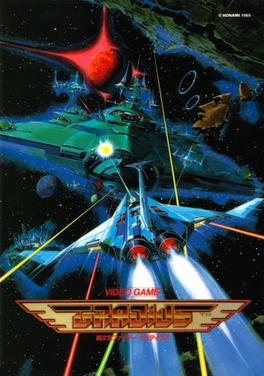
Every arcade regular knew the sound of a run ending. Not the explosion — explosions were constant — but the particular quiet that followed, when a player who had been motionless for ten minutes finally leaned back, rolled their shoulders, and fed the machine another coin. The one-credit clear, the 1CC, is the refusal to make that second payment. It means finishing an arcade game — a machine engineered, tuned and priced to kill you repeatedly — on the single credit you started with. No continues. No topping up. One coin, one life’s worth of mistakes already spent in practice, and a credit roll earned outright.
It sounds like a stunt. In the shoot-’em-up world it is closer to a discipline, and two games from the genre’s founding decade still define it: Konami’s Gradius (1985) and Irem’s R-Type (1987). Both are old enough to be museum pieces. Both are still being cleared, looped and argued about by players who treat them not as nostalgia but as instruments — and the culture that surrounds the 1CC remains one of the most demanding, and quietly welcoming, in all of retro gaming.
What a 1CC Actually Asks of You
The first thing to understand is that a one-credit clear is not primarily a test of reflexes. Reflexes matter, the way a pianist’s fingers matter, but nobody sight-reads their way through R-Type’s third stage. A 1CC is the end product of study: dozens, sometimes hundreds of failed attempts converted into knowledge. Where does the game place its cheapest trap? Which enemy wave can be neutralised before it fires? Which stretch of scenery is secretly the safest place on the screen? The player who clears a shooter on one credit has rebuilt the whole game inside their head, and the run itself is simply the performance of something already learned.
This is why the arcade setting mattered. A credit cost money, and continues cost more, so the economics of the cabinet taught the curriculum: you could pay to blunder forward, or you could pay in time instead, learning the game a stage at a time on a single coin per visit. The operators, after all, had tuned their machines for turnover: a game nobody could beat in ninety seconds earned nothing, but a game nobody could beat at all earned less, so difficulty was calibrated to sit exactly between those two failures — hard enough that mastery took months, legible enough that mastery always felt one insight away. The 1CC is the player answering that calibration on its own terms. Home ports eventually removed the meter running in the background, but the standard survived the move. A clear bought with continues is a film you have watched. A 1CC is a piece you can play.
Gradius: A Metronome With Lasers
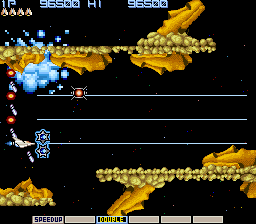
Gradius built its entire identity around one invention: the power-up bar. Destroyed enemies drop capsules; each capsule advances a highlight along a menu of upgrades — speed, missiles, a second shot pattern, laser, a trailing duplicate ship called an Option, and a shield. You choose when to cash in. It is an elegant system that turns every second of play into a small financial decision, and in a 1CC attempt it becomes the game’s true clock. Spend too early and you crawl, underpowered, into the stages that punish slowness. Hoard too long and one unlucky bullet deletes a stockpile you never got to use.
Worse — better — the game keeps score of your diligence. Gradius raises its internal rank, its difficulty pressure, the more powered-up you become, so the fully armed Vic Viper faces angrier enemy fire than the bare one. Dying is therefore doubly cruel: you lose the ship and the entire arsenal, and you are reinserted mid-stage, slow and naked, at a checkpoint populated by enemies balanced for a stronger craft. Veterans call these recovery points, and learning them is a separate syllabus inside the main one. Many a Gradius 1CC has been saved not by brilliance in the good times but by rehearsed, unglamorous survival in the bad ones. Every shooter since has lived in this system’s shadow — the upgrade bar is the genre’s most imitated piece of interface design — and the 1CC runner studies its economy the way a chess player studies openings: the first dozen capsules are a solved argument, and the artistry starts where the solution ends.
R-Type: The Puzzle Box That Shoots Back
If Gradius is rhythm, R-Type is architecture. Irem’s game moves at a stately scroll and fills its stages with machinery that must be disassembled in the correct order. At the centre of it all sits the Force: a detachable orb that can fly free, dock on your nose, or guard your tail. It blocks enemy fire. It can be parked inside a boss’s weak point and left to chew. Nearly every famous set piece in the game — the circling warship of stage three, the corridors that seal around you later — resolves into a question about where the Force should be, and the answer is rarely “attached, where it started.”
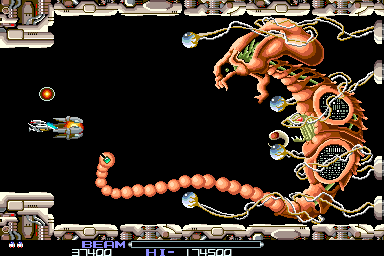
This is what makes R-Type the thinking player’s 1CC. Its stages are close to deterministic: the game deals nearly the same hand every time, so defeat always carries information. You were standing in the wrong corridor when the wall closed. You detached the Force a second too late. The run teaches, the next run applies, and progress is measured in screens, then stages, then — one ordinary evening — the final boss folds and the credits roll over a ship still on its first coin. Players describe the sensation less as triumph than as relief mixed with disbelief: the machine has run out of surprises. Memorisation, so often treated as a dirty word in game design, is here the entire pleasure — the game becomes a text you can recite from memory, and a 1CC is simply the recitation going right, in public, on the first take.
The Ladder Above the Ladder
Here is the beautiful cruelty of the form: clearing the game is the beginning. Most classic shooters loop — they restart at a higher difficulty, with faster, denser fire and enemies that spit bullets as they die. A 1CC of the first loop invites the question of the second. Beyond that waits the no-miss clear, finishing without losing a single life, an achievement that converts a half-hour performance into a half-hour tightrope walk. The games themselves never change. The ceiling is entirely inside the player, which is why a forty-year-old arcade board can still hold a community’s attention: there is always a cleaner run.
And that community is the surprise. For a scene built on punishing difficulty, shmup players are famously generous with their knowledge. Routes are documented, replays are published and annotated, and a stranger’s first 1CC — of anything, however modest the game — is greeted like a graduation, because everyone offering congratulations remembers the exact weight of their own first hundred failures. There is no credential to buy and no difficulty setting to hide behind; the achievement means the same thing in every language, which may be why it travels so well.
Why It Matters More Now
Modern design mostly treats frustration as a defect. Checkpoints bloom every half minute, failure is cushioned, and difficulty quietly bends toward the struggling player. Much of that is humane, and plenty of wonderful games are built on it. But something real was traded away: the possibility of a game demanding to be mastered, and meaning it. The 1CC survives as a standing argument that mastery is its own reward — that a short, fixed, knowable game can ask more of you than a hundred-hour one, because everything it asks is fair, visible and learnable.
It helps that the barrier to entry has never been lower. Gradius and R-Type sit inside cheap, legal collections on every modern platform, with save states and stage practice that the arcade generation would have considered witchcraft. Use them in training without shame — every serious player does. Then, when you are ready, take the vow that turns practice into the real thing: one credit, no continues, and when the run dies, it dies. Start smaller than the legends if you like; a gentle console shooter cleared honestly teaches the same lessons as a brutal arcade one. Learn a stage at a time. Keep notes, even if the notes are just “stage four, don’t be greedy at the volcano.” The first clear will take weeks. It is supposed to. Somewhere in those weeks, between the failure you understand and the run where everything holds, is the entire point: the games were never unbeatable. They were waiting for you to become the kind of player who beats them.
Keep reading: Heavy Metal: The Making of Metal Slug · Fifty Frames Per Second: The Making of Uridium · the Arcade system archive
1 comment