Some mobile games get a ladder. This one got a deity first. On 27 February 2025, during the Pokémon Day edition of Pokémon Presents, Pokémon Trading Card Game Pocket laid out the biggest week of its young life: a brand-new themed booster, Triumphant Light, arriving the very next day and built entirely around Arceus — the Pokémon credited in the series’ own mythology with creating the universe — plus a Pokémon Day giveaway campaign, and, tucked into the end of the trailer almost as an afterthought, the two words competitive players had been demanding since launch: ranked matches, due at the end of March. This post is dated that day, but it is written with the benefit of everything that happened next, because February 27 turned out to be the moment Pocket stopped being just a collecting habit and started becoming a competitive game — growing pains and all.

Pocket was designed to live on a phone and be played in spare minutes — two free packs a day and battles short enough for a bus ride. (Photo: Océanos y dados, CC0, via Wikimedia Commons)
A Launch That Printed Money
To understand why one February announcement mattered so much, it helps to remember how absurd the game’s first four months had been. Pokémon TCG Pocket launched worldwide on 30 October 2024, co-developed by Creatures Inc. — the company behind the physical card game — and DeNA, and published by The Pokémon Company. The pitch was the physical hobby distilled for a phone: open two booster packs free every day, build a binder of digital cards with shimmering “immersive” treatments, and battle with a stripped-down rule set — 20-card decks instead of 60, energy that arrives automatically each turn, and matches decided by the first player to score three points.
The numbers that followed were closer to a phenomenon than a launch. The game passed 10 million downloads within two days of release, according to reporting at the time, and the money moved just as fast: analytics firm AppMagic estimated that Pocket reached $100 million in player spending in only 17 days, and $202.2 million across its first 31 days, per PocketGamer.biz’s reporting of those estimates — within touching distance of Pokémon GO’s legendary first month. Then, in the very same press release that confirmed Triumphant Light’s release date, DeNA announced the milestone that framed the whole Pokémon Day celebration: Pocket had surpassed 100 million downloads worldwide, less than four months after launch. A card game that many industry watchers expected to be a pleasant nostalgia side-project had become one of the biggest mobile games on Earth.
The Missing Piece: A Reason to Win
And yet, for all that success, Pocket had a hole in the middle of it — and the hole was shaped exactly like a leaderboard. Versus battles existed from day one, but they were casual-only: you could queue up, win or lose against a stranger, and gain almost nothing either way. The game’s competitive energies had to vent themselves through limited-time emblem events, which rewarded raw win counts over a fortnight, and through fan-run tournaments organised on community platforms. There was no ladder to climb, no rank to defend, and no matchmaking structure standing between a brand-new player with a starter deck and a veteran running the format’s most ruthless coin-flip combination.
That gap hurt in both directions. Newer and free-to-play players, who open packs more slowly than subscribers, kept running into polished meta decks with nothing at stake and little chance to learn. Experienced players, meanwhile, had collected everything the casual queue could teach them; outside event windows, a win earned a trickle of experience points and not much else. The battles themselves were quick and charming, but a battle you cannot lose anything in eventually stops feeling like a contest. Ranked play — persistent tiers, points that move, seasons that reset, rewards that scale with where you finish — was the obvious fix, and the community had been asking for it, loudly and continuously, since October.
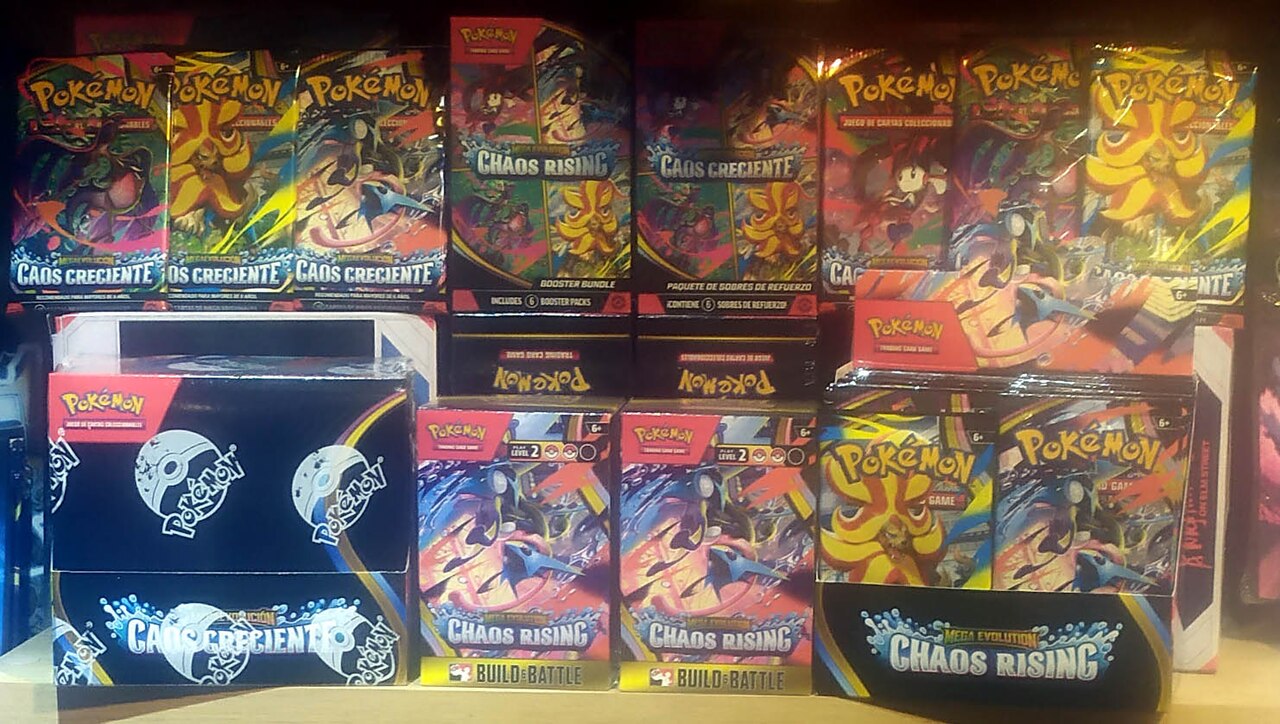
The physical Pokémon TCG on shop shelves — the hobby Pocket digitised, complete with the daily ritual of opening packs. (Photo: Fernando Ma, CC BY-SA 4.0, via Wikimedia Commons)
Pokémon Day: Free Packs With a Floor Under Them
Before the ladder arrived, though, Pokémon Day itself brought the celebration the original headline called a “special event” — really a pair of promotions detailed in DeNA’s announcement. The headline gift was simple and generous: one free copy of each of the three Genetic Apex booster packs — the Mewtwo, Pikachu and Charizard packs from launch — with every one of them guaranteed to contain at least one card of four-diamond rarity or higher. In a game where the rarest pulls are a lottery, a guaranteed floor under a free pack is a genuinely player-friendly gesture, and the gift window was long, running from 27 February through to the end of April. Alongside it ran a set of special Pokémon Day missions, live from 28 February to 27 March, paying out rewards that included trade tokens, pack hourglasses and new display backdrops.
Read together, the giveaway and the ranked announcement were clearly one strategy. The free high-rarity cards fattened everyone’s collection a month before the ladder opened, and the missions kept players logging in daily through March. Pocket was, in effect, spending February and March making sure that when ranked matches finally switched on, the whole enormous player base — all 100 million downloads of it — would show up with decks worth playing.
Enter God: The Triumphant Light Expansion
The set that carried the announcement arrived on 28 February 2025. Triumphant Light was Pocket’s second themed booster and its fourth expansion overall, catalogued as set A2a — a companion release to January’s Space-Time Smackdown, continuing that set’s focus on Sinnoh, the region from Pokémon Diamond and Pearl. According to Bulbapedia’s set records, it contains 96 cards in total: 75 in the main set and 21 secret cards. Its new Pokémon ex cards were Leafeon ex, Glaceon ex, Garchomp ex, Probopass ex — and, presiding over all of them, Arceus ex. The Hisui region from Pokémon Legends: Arceus got its due as well, with the wardens Adaman and Irida appearing as Supporter cards.
Arceus was not chosen as the face of the set by accident. In Pokémon lore, Arceus is the Original One, the being said to have emerged from an egg in the void and shaped everything that exists — which is why the original version of this story joked about the gacha “adding God itself.” Triumphant Light leaned into the theology mechanically, too: a family of cards carried brand-new Link Abilities, effects that switch on or grow stronger while you have Arceus or Arceus ex in play, turning the creator god into the sun that a whole solar system of smaller cards orbits. The Arceus ex card itself is a study in flexible power — 140 HP, a Colourless typing that lets it slot into any deck’s energy mix, an Ability called Fabled Luster that makes it immune to Special Conditions, and an attack, Ultimate Force, that hits for 70 damage plus 20 more for each Pokémon on your opponent’s Bench, topping out at 130.
How the God Performed
So how did the deity actually play? Extremely well — but with a twist worthy of a creation myth: Arceus ex’s most successful partner was another god. Space-Time Smackdown’s Dialga ex, the legendary ruler of time, could use its Metallic Turbo attack to attach energy directly to a benched Arceus ex, charging the big attack ahead of schedule. Then Arceus ex would rotate in and start swinging for up to 130 a turn. In the first tournament snapshot after release, reported by TheGamer from Limitless TCG data, the Arceus ex/Dialga ex pairing was simultaneously the most-played deck in the format and its highest win rate, at 58.62 percent.
The twist was that god did not win everything. Wargamer’s report on Ursiiday’s Pocket Weekly — the game’s largest regular community tournament, whose 1 March edition drew some 1,500 decks — recorded Arceus ex/Dialga ex filling seven of the top ten places, a show of consistency few decks ever manage. But first and second place both went to a godless Fighting deck built on Lucario and Rampardos, and the set’s humblest card became a folk hero: Sudowoodo, the imitation tree Pokémon, whose Fighting Headbutt deals bonus damage to ex Pokémon and could, as players quickly discovered and gleefully shared, chop the creator of the universe down in two turns. The reception, in other words, was about as healthy as a new set can hope for — Arceus ex was a genuine chase card that reshaped the meta around itself, yet the format kept finding answers, including one shaped like a tree.

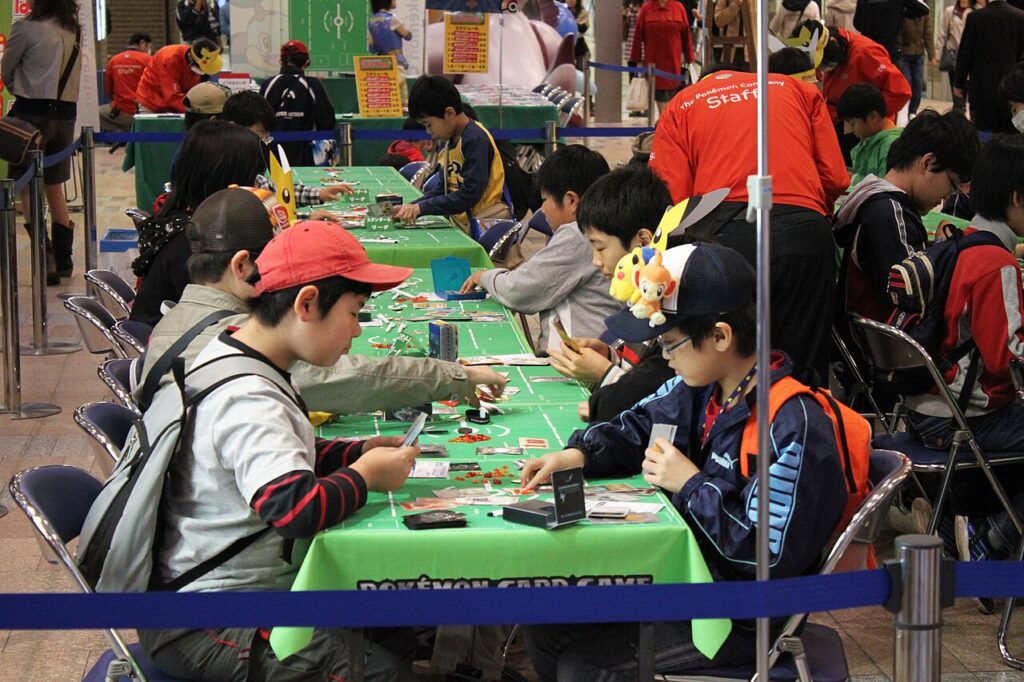
Competitive card play at a fan convention — the culture Pocket’s ranked ladder set out to recreate inside the app. (Photo: Klapi, CC BY-SA 4.0, via Wikimedia Commons)
Ranked Arrives — and the Grind Begins
True to the Pokémon Day promise, ranked matches went live on 28 March 2025, launching alongside the next themed booster, Shining Revelry, with the first season — designated Season A2b — running through 27 April, according to Serebii’s season records. The structure Pokémon players would have sketched on a napkin is exactly what arrived: five ranks named for the game’s capture devices, running Beginner, Poké Ball, Great Ball, Ultra Ball and finally Master Ball, with the first four split into tiers. Wins paid out 10 points; the cost of losing scaled with your altitude, from nothing at all in Beginner, to five points in the Poké Ball and Great Ball ranks, seven in Ultra Ball and a full ten in Master Ball. Win-streak bonuses sweetened the lower ranks to help players climb out of them, and season-end rewards ran from emblems to as many as 100 pack hourglasses for those who finished highest.
The first reaction was relief — the feature players had requested for five months was real, and the early ranks were friendly by design. Then the arithmetic of the summit sank in. One community calculation, reported by GameRant, estimated the climb to Master Ball at roughly 152 matches for a player winning 70 percent of their games — and a forbidding 1,139 matches at a 45 percent win rate. ComicBook’s reporting on the first season captured the mood among those who did make it: players who reached Master Ball described the push through Ultra Ball, where streak bonuses disappear just as the opposition sharpens, as a grind they would not recommend, with more than a few concluding that stopping at Ultra Ball offered the best exchange of time for rewards. The ladder had given Pocket’s battles meaning, but it had also exposed the game’s oldest tension: in a battle system where coin flips and opening hands carry so much weight, a ranking system has to work very hard to feel like it measures skill rather than stamina.
To the developers’ credit, the system did not stay frozen in its first form. The game’s own fine print acknowledged that AI opponents fill out matches at certain ranks — a quiet disclosure that surprised players who discovered it — and later in 2025 the team announced quality-of-life changes including win-streak bonuses extending into the top ranks and protection against dropping out of Ultra Ball or Master Ball mid-season. Those fixes amount to an admission that season one was the rough draft. But rough drafts are how live games learn, and the direction of travel was set on a February morning when a three-word news stub — a god arriving tomorrow — turned out to be the smallest possible summary of the month Pocket grew up.
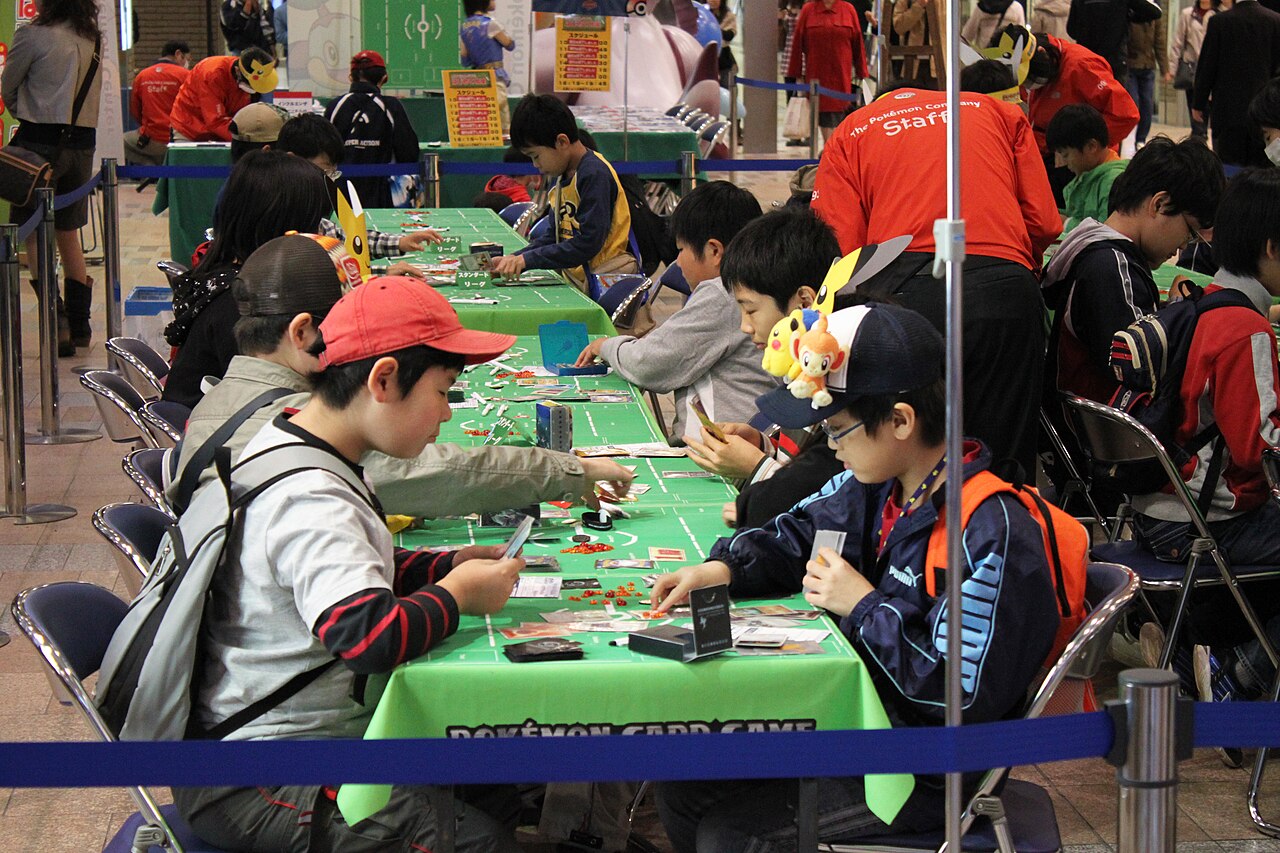
Organised physical Pokémon card play in Japan — the face-to-face roots of a game whose digital ladder now hosts millions. (Photo: MIKI Yoshihito, CC BY 2.0, via Wikimedia Commons)
The Verdict on February 27
Look back at that Pokémon Day announcement as a whole and it is hard to find a bigger single day in Pocket’s history. A 100-million-download milestone, confirmed in DeNA’s own release. A giveaway engineered to arm the entire player base. A themed set that put the creator god of the Pokémon world at the top of the meta — respectably, but beatably, with a pretend tree among its counters. And at the end of March, the ranked ladder that converted all that collecting into competition: imperfect, grindy at the summit, quietly patched with bots and later with mercy rules, but unmistakably the feature the game had been missing since October. Pocket’s first months proved people would open packs for nothing but the joy of opening them. February 27, 2025 was the day the game set out to prove they would fight for something, too — and mostly, it did.