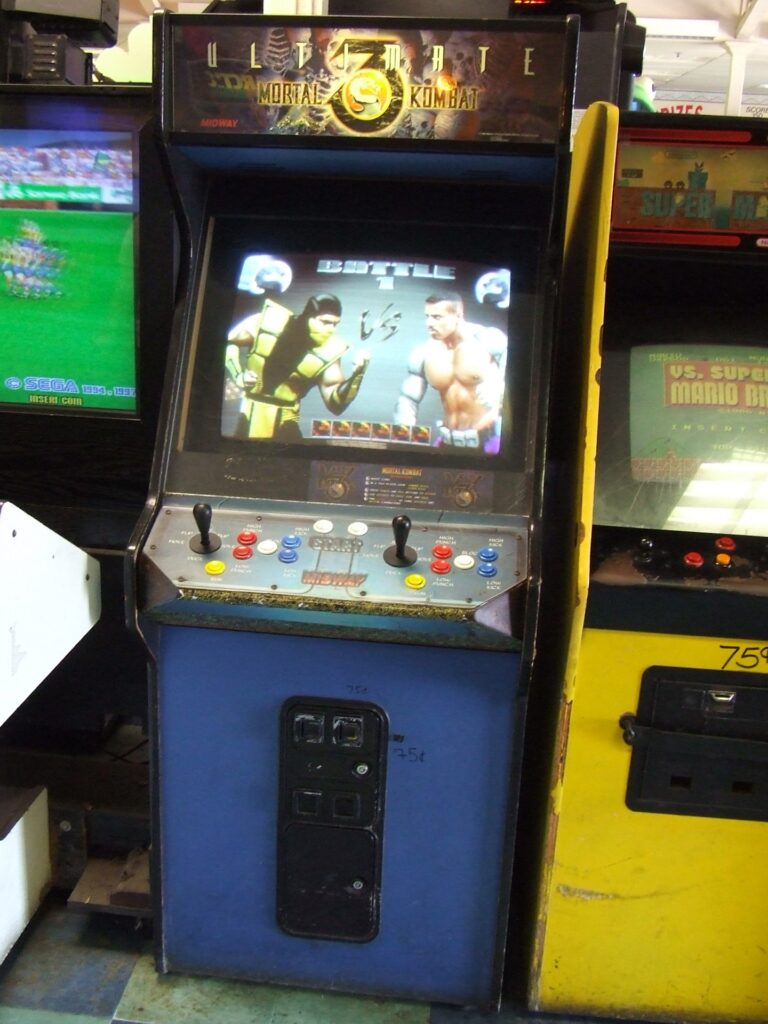
Every fighting-game community keeps a story it tells in a lowered voice, about a version almost nobody played and nobody could prove still existed. For Mortal Kombat, that story wore a marquee for nearly three decades. It concerned a networked edition of Ultimate Mortal Kombat 3 built for a Midway service called WaveNet, tested briefly in a handful of arcades, then unplugged and dismantled until the game itself became a rumour with a control panel. In August 2025 the rumour ended. Digital Eclipse announced that the WaveNet edition would be included in Mortal Kombat: Legacy Kollection, emulated and playable by anyone for the first time. GamesRadar, reporting the reveal on 21 August 2025, called it the holy grail of MK lost media. That phrase belongs to the fans, and this feature will keep it in quotation marks where it belongs — because the interesting part of the WaveNet story is how much of it can actually be documented, and how much of it cannot.
A Network Before Arcade Networks Were a Thing
Start with the name, because the name is one of the few facts every source agrees on. WaveNet expands to Williams Action Video Entertainment Network. Williams was Midway’s parent world — the Chicago coin-op giant behind both companies — and in the middle of the 1990s it was exploring an idea that sounds ordinary now and sounded like science fiction on an arcade floor then: connect cabinets in different locations so strangers could fight each other without standing shoulder to shoulder, and use that same connection to push new software out to operators.
That second half matters. The plan recorded for WaveNet was not simply online matches. Williams intended to use the network to upload whole games and updates to cabinets, supplying that content to arcade owners at no charge in exchange for a share of the revenue those games earned. Read that again with modern ears and it describes, in outline, the digital storefront and the live-service patch — a decade before either became the default way games reached players. In 1996 an arcade game arrived on a board, was installed by hand, and stayed exactly as shipped until someone physically swapped chips. WaveNet proposed that a cabinet could change overnight, down a wire, from headquarters.

The game chosen to carry the experiment was a sensible one. Ultimate Mortal Kombat 3, released in arcades in 1995, was the definitive revision of Mortal Kombat 3 — faster, rebalanced, expanded — and it was the last 2D entry in the series that co-creator Ed Boon programmed himself. If you wanted a competitive game with a proven audience of repeat challengers, the kind of players who would care about facing someone in another building, UMK3 was the obvious test subject. The WaveNet build added one headline attraction of its own: Noob Saibot, the pitch-black ninja who had previously appeared only as a hidden opponent, became selectable. The WaveNet edition remains, in the documented record, the only arcade version of the game in which he is a playable character, reached in the original test by a versus-screen method that began, fittingly, by selecting Kano and holding a fistful of buttons.
Why Almost Nobody Ever Played It
Here the record narrows to a corridor. The WaveNet edition was never given a general release. It was location-tested only in the Chicago area — Midway’s home turf — and in San Francisco, over a dedicated connection routed back to Midway headquarters in Chicago. The commonly cited test window runs through 1996 into 1997, which is why Digital Eclipse’s own announcement described a version that had not been playable anywhere since 1997. Outside those two metropolitan areas, most arcade players at the time never knew the thing existed at all. There was no home port, no later compilation appearance, and nothing to buy.
Cost did much of the killing. The version of the story repeated by Arcade History, by the game’s reference entries, and by most later reporting says the test used a dedicated T1 line, and that a T1 installation cost several thousand dollars per arcade, plus a few hundred dollars more for each cabinet attached to it — at a moment before ordinary broadband existed and when a T1 was the only guaranteed way to move serious data into a business. Midway reportedly subsidised the line during testing to make the proposition survivable for operators. Even subsidised, the economics asked an arcade owner to pay business-grade telecoms prices so that customers could do something they had never asked for, because they had never seen it done.
And here is where an honest feature has to flag a crack in the record, because the T1 detail is not uncontested. In a 2013 post on the Arcade Museum forums, a contributor describing direct involvement with the tests insisted the machines did not use T1 at all — that a T1 would have cost a fortune — and that the test sites ran on ISDN lines paid for by Midway. The same account names specific test locations, among them Diversions, Dennis’ Place for Games, Gala West, Gala North and Friar Tuck’s, plus the lunchroom at the Midway office itself. It also describes the practical problem that no brochure would have admitted: lag. On slow connections, the account says, fast characters became disproportionately powerful — Kabal is named — because some moves landed before a distant opponent could realistically react, block or counter. A programmer outside the core Mortal Kombat team was, by this account, brought in to soften or add delay to the moves being abused that way.
Which connection story is true? The responsible answer is that the T1 version is the one carried by the bulk of published secondary sources, while the ISDN correction rests on a single forum account, however specific its details sound. Neither should be swallowed whole. What both versions agree on is the underlying verdict, and that agreement is the real history: the connection was expensive, the speed was marginal for a game decided in fractions of a second, and the technology of the moment could not deliver the experience the concept promised at a price an arcade could pay. One oft-repeated coda captures the era neatly — a location that kept its line after testing ended eventually took the WaveNet game out in favour of a Golden Tee, a golf game content with a humble dial-up connection. Golf could wait for its turn down a slow wire. A fighting game could not.

Documented Fact, Community Legend
When the test ended, the infrastructure was dismantled, and the trail goes properly cold. Reference sources state plainly that it is highly unlikely any WaveNet test games were released to the public afterwards, and that no ROM image dumps of this version were known to exist. That absence is precisely what built the legend. A game that thousands played and can still be found proves itself. A game that perhaps a few hundred people played, in two cities, behind a connection nobody else had, becomes whatever the community needs it to be — and the community, over 28 years, needed it to be a grail.
So separate the piles. Documented: the service existed, under that expanded name; the game existed, as a distinct and final arcade revision of UMK3; it offered networked matches and a playable Noob Saibot; it was tested in Chicago and San Francisco and then withdrawn; and for decades afterwards there was no public way to play it and no known dump in circulation. Also true, but softer: glimpses of a cabinet carrying a WaveNet marquee in documentary footage fuelled years of hope that hardware survived somewhere in Midway’s successor companies, and fan wikis repeat that a WaveNet reference even turned up as an achievement name in a later Mortal Kombat collection — a nod that kept the word alive for players who had never seen the thing itself. Not documented at all: the sweeping claims that sometimes attach themselves to lost-media stories, that cabinets were deliberately destroyed in some purge, or that a complete, secretly playable version sat in a private collection all along. Nobody reputable has produced evidence for those, and this article will not pretend otherwise.
21 August 2025: The Reveal at Gamescom
The preservation moment, when it came, was staged as a surprise ending. On 21 August 2025, during the Xbox Showcase at gamescom in Cologne, Digital Eclipse, Atari and Warner Bros. Interactive Entertainment unveiled the final line-up for Mortal Kombat: Legacy Kollection. The headline additions were the two much-maligned PlayStation spin-offs, Mortal Kombat Mythologies: Sub-Zero and Mortal Kombat Special Forces, alongside the already announced Mortal Kombat Trilogy with its load times drastically cut. Then the trailer offered one more thing: the WaveNet edition of Ultimate Mortal Kombat 3, described in the announcement as a version that had not been playable anywhere since 1997, now emulated and preserved for the first time, and making its debut as a playable release inside the Kollection.
Note the careful wording, because it is accurate. This was not a rediscovery of a retail product. It was the first full release of a test build — the moment a prototype-grade artefact, which had previously existed as location-test hardware and then as a file, became something any player could legally buy and run. EventHubs, covering the reveal the following day, reported the community’s understanding of where the code had survived: it appeared the ROM had been preserved somewhere within NetherRealm Studios, Midway’s successor as the home of Mortal Kombat. Digital Eclipse has not, in the material cited here, published a romantic warehouse story about finding a dusty cabinet, and readers should be wary of retellings that supply one. The verifiable core is smaller and better: the ROM survived institutionally, and the right studio finally asked for it.
What Digital Eclipse Actually Had to Rebuild
The most revealing account of what happened next comes from Shacknews’ long making-of feature on the Kollection, centred on engineer Dan Filner, the outside specialist Digital Eclipse brought in for its hardest emulation problems. Filner recounts that producer Stephen Frost came to him with the possibility of the original WaveNet ROMs, in words close to: it is legendary, and nobody has had it before. Filner’s job had two halves — get the ROM running, and deal with its online play — and he started by comparing the code against ordinary UMK3, which it closely resembled. The difference announced itself in an extra block of memory addresses. The WaveNet build, during its power-on self-test, tried to write to and check addresses the standard game never touched. That, Filner concluded, was where the program believed its modem lived.
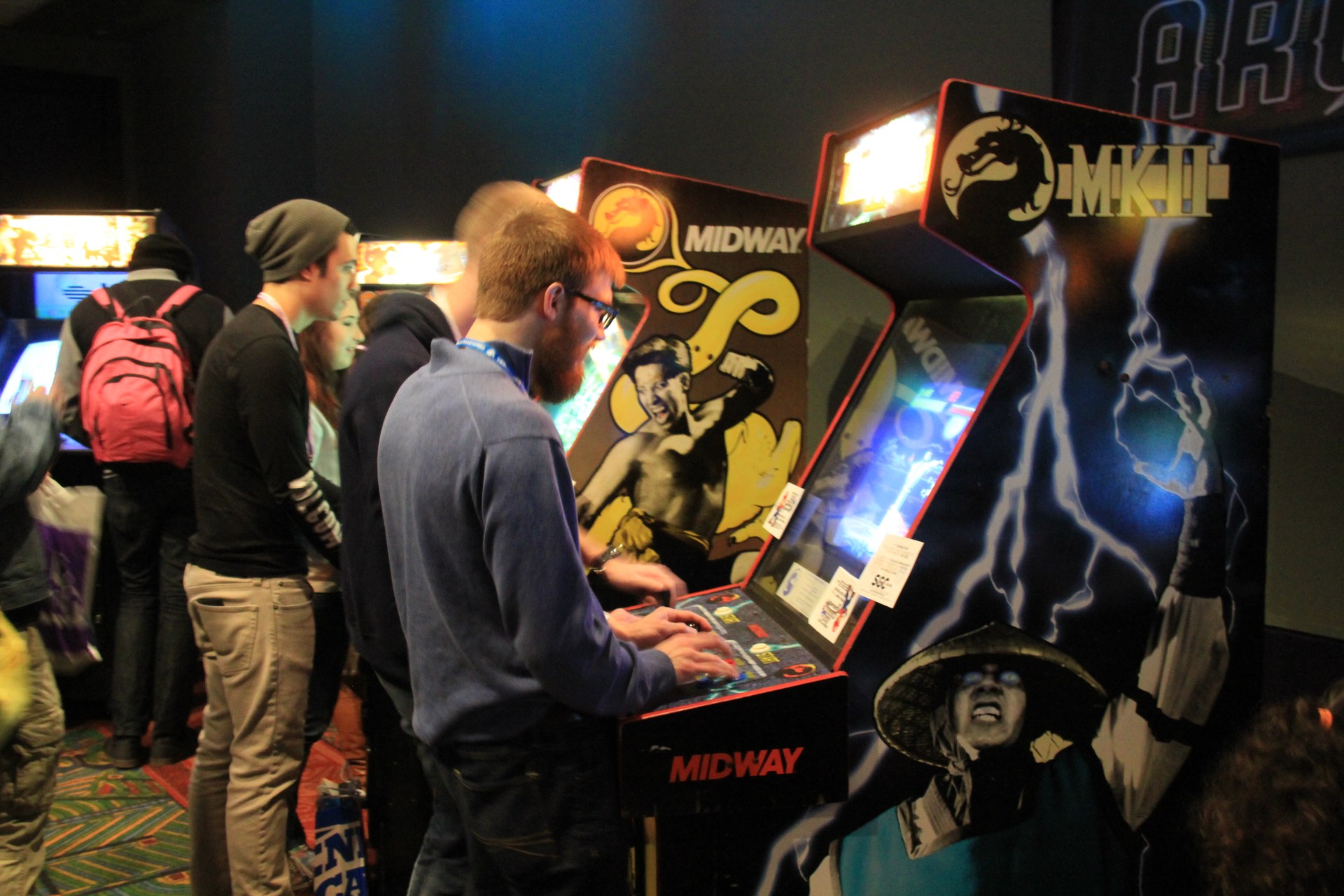
Then comes the caveat that defines the whole rescue, and it deserves plain language. Digital Eclipse had only the ROM — not the original source code, and not the server. The server half of WaveNet, the Midway-side system that matched players between arcades, is dead and gone. So the WaveNet edition as shipped does not attempt to contact it. Online challenges instead run through the same modern infrastructure the Kollection provides for its other multiplayer games, with rollback netcode. Filner’s summary, as reported by Shacknews, is that until somebody finds the source code or an actual working WaveNet server, the game will be playable as if two people were standing in front of the same machine — not as if they were in separate places, experiencing the original remote ritual. That is not a complaint; it is the honest shape of preservation. The game survived. The world it was wired into did not, and no amount of emulation can resurrect a telephone network, a headquarters server and a 1996 Chicago arcade around a ROM.
30 October 2025 and After: A Flawed Victory, Not a Flawless One
Mortal Kombat: Legacy Kollection launched digitally on 30 October 2025 across PlayStation, Xbox, Switch, Switch 2 and PC, with physical editions following on 12 December. The critical verdict was broadly warm: review aggregators settled around 84 out of 100 on PlayStation 5 and Xbox Series X/S and 78 on PC and Switch 2, with scores such as 9 out of 10 from GameSpot and Push Square and 8 out of 10 from IGN. The documentary material, the breadth of versions — 23 games and variants spanning 1992 to 2003 — and rescues like WaveNet drew consistent praise.
The players’ launch verdict was rougher, and the irony is impossible to miss. A collection celebrated for saving a pioneering online fighting game shipped with online play as its weakest feature. At launch, players reported input lag, distorted audio and missing or incomplete features; online play was limited to random matches, without the lobbies and private rooms competitive players expected. The Steam user rating sat at Mixed. By 4 November, refunds were being reported on the PlayStation Store, and Digital Eclipse issued a patch the same day; a hotfix around the same period improved the audio buffer for online play and, in a detail UMK3 players will appreciate, fixed an issue that could make the game reboot after a Scorpion fatality. Lobbies, cross-platform play and further features arrived only in later updates. In other words, the modern team spent its first weeks doing publicly what Midway learned privately in 1997: networked fighting games live or die on latency, and good intentions do not lower it.
None of that overturns what was achieved with WaveNet itself. Judged as preservation, the inclusion does exactly the thing the community asked for across three decades: it takes a balance revision of a beloved game — the final arcade word on UMK3, with its unique playable Noob Saibot — out of the realm of forum posts and second-hand descriptions and puts it on a menu, next to its siblings, where anyone can test the old claims for themselves. Judged as a time machine, it comes with the label Filner effectively wrote for it: you are playing the game, not the network, and not 1997. The grail, it turns out, was never a cabinet in a warehouse. It was a file that outlived the phone lines it was built for — and a reminder that in this medium, the things most worth saving are usually the ones that were hardest to sell the first time around.