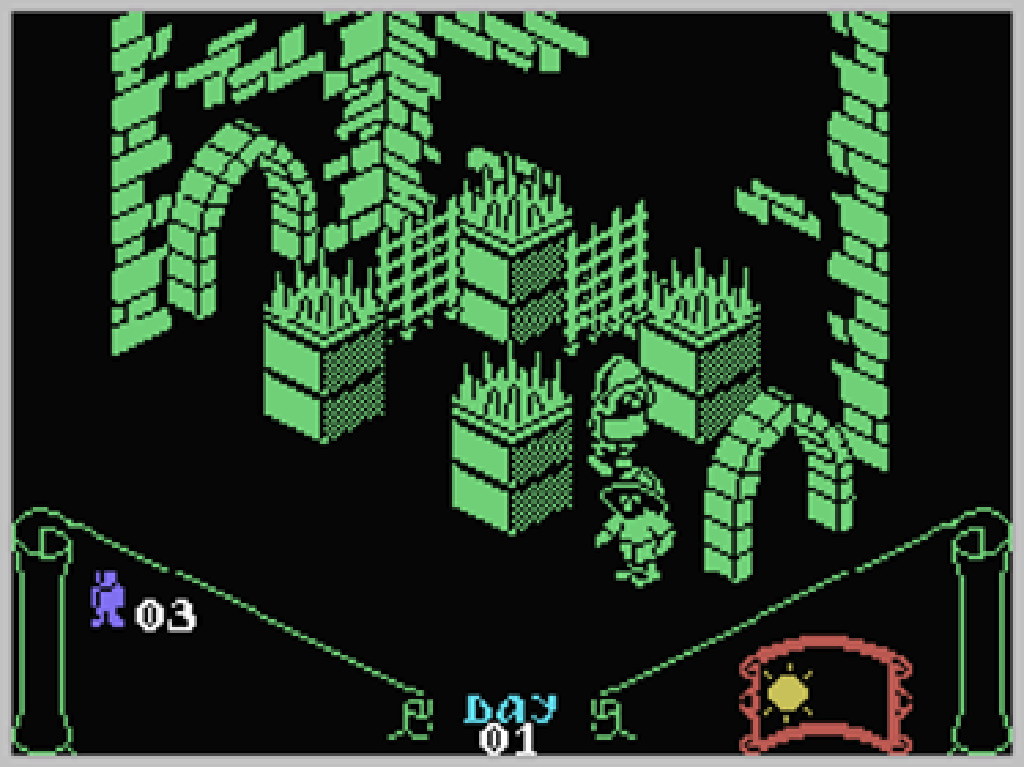
Imagine it is November 1984 and you have just loaded a Spectrum game that does not look like a Spectrum game. The screen shows a stone chamber in three dimensions — real depth, objects stacked on objects, a little explorer who can walk behind pillars, climb onto tables and drop through trapdoors — drawn in clean isometric perspective with everything correctly hidden behind everything else. On a 48K machine that most programmers were still coaxing into drawing two-dimensional caverns, it did not look like an evolution. It looked like a message from five years in the future. That game was Knight Lore, and the gasp it drew from the British industry in 1984 has never quite been equalled by a single home-computer release.
Knight Lore was the third adventure of Sabreman, the pith-helmeted hero of Sabre Wulf and Underwurlde, and the showcase for Ultimate Play the Game’s Filmation engine, built by Tim and Chris Stamper at their Ashby-de-la-Zouch studio. The plot is gothic pulp of the best kind: Sabreman is cursed, and every nightfall he transforms into a werewulf — the transformation sequence, the little man convulsing into the beast, is still startling — giving you a day-and-night cycle in which some passages, guardians and routes behave differently depending on what shape you are in. In a castle stuffed with traps and treasures, you must gather the objects of a cure and deliver them to the wizard Melkhior’s cauldron before the forty days and nights of the curse run out.
Filmation: The Engine That Bent the Machine
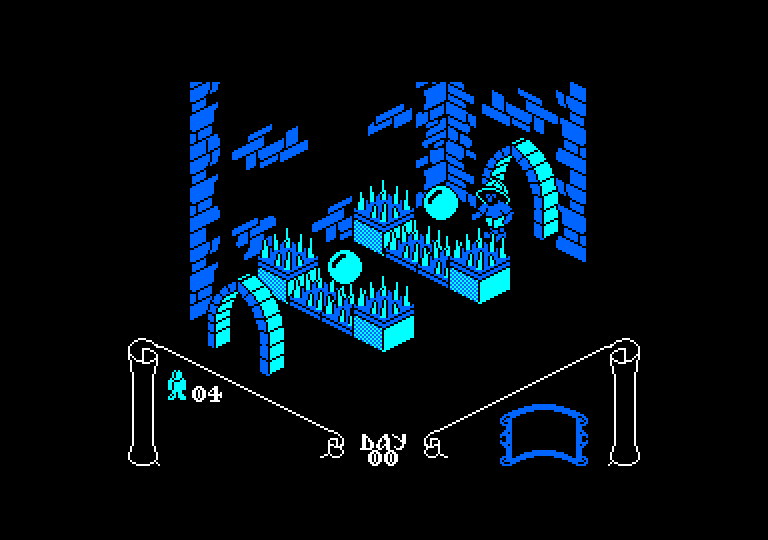
The technical achievement deserves slow explanation, because its cleverness is easy to mistake for magic. Isometric games existed before Knight Lore, but Filmation’s trick was masked, prioritised drawing: every object in a room knew its place in the depth order, so Sabreman could pass behind a chest, emerge from behind a pillar, stand on a table and have a block pushed beneath him, all with correct overlap, in a room full of moving guardians, on a processor with no graphics hardware to help it. The rooms themselves are single screens — nearly eighty of them — but they feel architectural rather than flat, because height is real in them. A jump is a genuine negotiation with gravity and geometry. You fall, you climb, you stack. The Spectrum had presented its world as a stage flat for three years; Knight Lore gave it interiors.
There is a famous piece of industry lore attached to this, and unlike most lore it is essentially true, confirmed by the Stampers themselves in later years: Knight Lore was finished roughly a year before it was released. Ultimate sat on it. The reasoning was coldly commercial — a game this far ahead would have crushed the market for the company’s own earlier titles, including Sabre Wulf, which players might never have bought had they seen what was coming — and the delay meant that when Knight Lore finally appeared it landed not as a promising step but as a detonation. Competitors who had been proudly shipping flat arcade adventures suddenly looked like they were working in a previous decade. Crash magazine’s reviewers, not a panel given to restraint failures, treated it as a landmark, and the young British industry reorganised its ambitions around it within months: the isometric adventure became the prestige genre of the Spectrum’s middle years, spawning Head Over Heels, Get Dexter, Batman and a hundred lesser Filmation imitations.
A Castle That Runs on a Clock
What keeps Knight Lore at the top of the pile, rather than merely first, is that the technology serves a genuinely well-made adventure. The castle is a proper puzzle-box. Objects interact: some are ingredients for the cure, some are tools, some are traps dressed as help, and several rooms are small logic problems in architecture — which block to push, which guardian’s patrol to ride, whether to attempt a passage as man or as wulf. The day-night cycle is not a graphical flourish; it is a second state for the whole map, changing what threatens you and what you can do, and the werewulf’s higher, springier jump opens routes the man cannot take. Death is frequent but information-rich, and the forty-day limit gives the whole quest a pressure that pure exploration games lack. You are not wandering Melkhior’s castle. You are working against a curse, on shift.
The compromises are real and worth naming. The game is essentially monochrome within each room — the price Filmation exacted for its speed and clarity — though the single-colour rooms change hue as you travel and the effect, in person, is more stylish than limiting: it reads as engraving, all line and shadow. Movement can feel deliberate to players raised on faster heroes; Sabreman walks with a measured tread, and isometric controls — up meaning up-the-screen diagonally — take an evening to become instinct. And it is hard in the authentic Ultimate manner: spikes, falling blocks and guardians conspire with the clock, and the final stages of an ingredient hunt, deep in the castle with days running out, are as tense as anything the 8-bit era produced.

The Year in a Drawer
Think again about that year in the drawer, because it tells you everything about Ultimate at their peak. This was a company that refused interviews, printed no programmers’ names on its boxes, charged a premium £9.95 for Sabre Wulf when the market standard was nearer six, packaged its games like artefacts — and was so far ahead of its rivals that it could treat a finished revolution as inventory, to be released when the timing suited the catalogue. The confidence borders on arrogance and was entirely justified. When Knight Lore did ship, in its oversized box with Sabreman picked out against the castle, it did not merely sell: it redefined what a Spectrum game was allowed to look like, and it taught a generation of British programmers — Jon Ritman, the Oliver Twins’ generation, every bedroom coder who stared at those rooms and asked how — that the little rubber-keyed machine had far more in it than anyone had yet asked of it.
Ultimate themselves reused Filmation for Alien 8 and returned to Sabreman’s world in the monochrome dungeons of later releases, before the Stampers sold the label, walked away from the Spectrum entirely and rebuilt themselves as Rare — a second career, on Nintendo hardware, somehow even more successful than the first. Knight Lore sits at the hinge of both stories: the summit of the Spectrum years and the first public evidence of the design intelligence that would later produce Donkey Kong Country and GoldenEye. Few games are both a machine’s masterpiece and a company’s founding myth. This one is.

Verdict
Knight Lore is the easiest 9.5 this shelf will ever award. As a technical act it has no Spectrum peer; as a game — a timed, two-shaped, object-juggling quest through one of the great video game castles — it survives its own legend and plays, today, like the prestige adventure it was. Load it having only ever seen screenshots and the rooms still produce that 1984 intake of breath, followed by the realisation that the depth is not a trick of the artwork but a place you can climb around in. The Filmation revolution started here. Forty years on, it has not been surpassed on the machine it was built for — only inherited from.