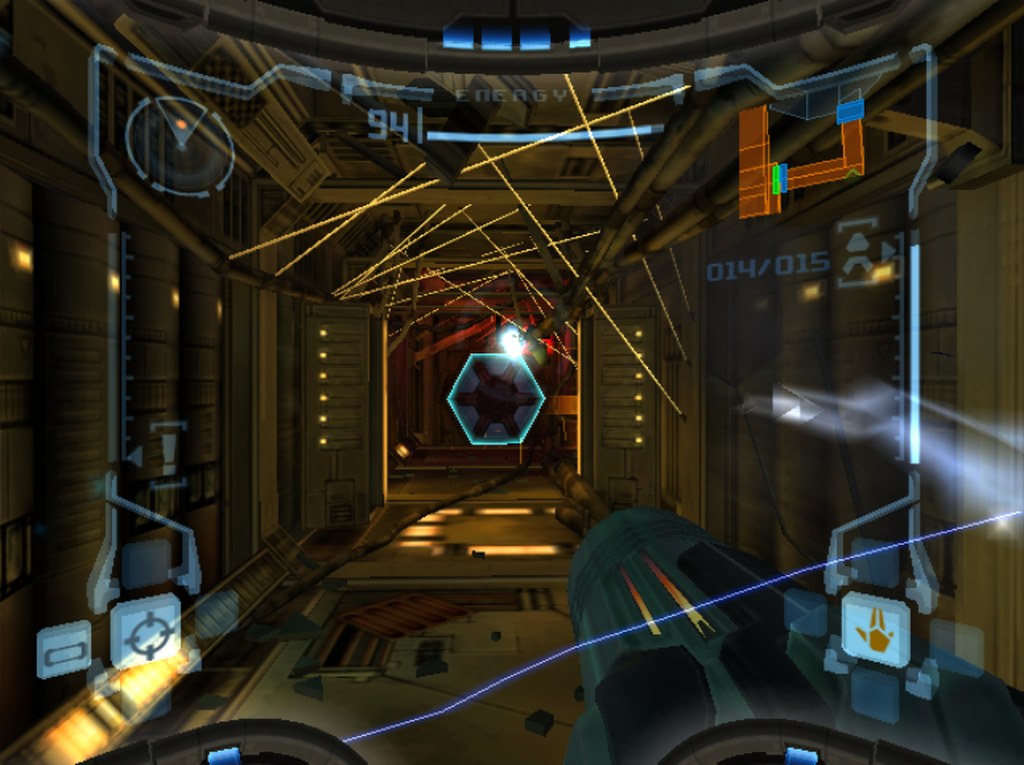
At a glance: Metroid Prime · GameCube · Retro Studios / Nintendo, 2002 · First-person adventure · Score: 9.5/10
It should not have worked. In 2002, Metroid had been silent for eight years, and Nintendo handed one of its most beloved series to a young studio in Austin, Texas, and told the world the new game would be played in first person. Fans braced for a shooter with a Samus skin — a betrayal of everything Super Metroid stood for. What Retro Studios delivered instead was the most faithful translation a 2D masterpiece has ever received: Super Metroid’s loneliness, exploration and atmosphere, rebuilt from inside the visor. Metroid Prime is not a first-person shooter that happens to star Samus. It is a Metroid game, and the first-person view is simply where its isolation feels most complete.
Tallon IV, scanned and understood
The masterstroke is the Scan Visor. Where other games of the era delivered story through cutscenes and codec calls, Prime delivers it through archaeology. The ruined Chozo civilisation of Tallon IV, the Space Pirates’ Phazon experiments, the ecology of every creature that tries to kill you — all of it is written into the world and read at your own pace, through your own curiosity. Scanning is not a collectible chore bolted onto a shooter; it is the storytelling, and it turns every room into a question. What happened here? What is that machine for? Why did the Chozo leave warnings carved in light? Few games since have trusted the player this much, and the trust pays off in an atmosphere of genuine, scholarly dread.
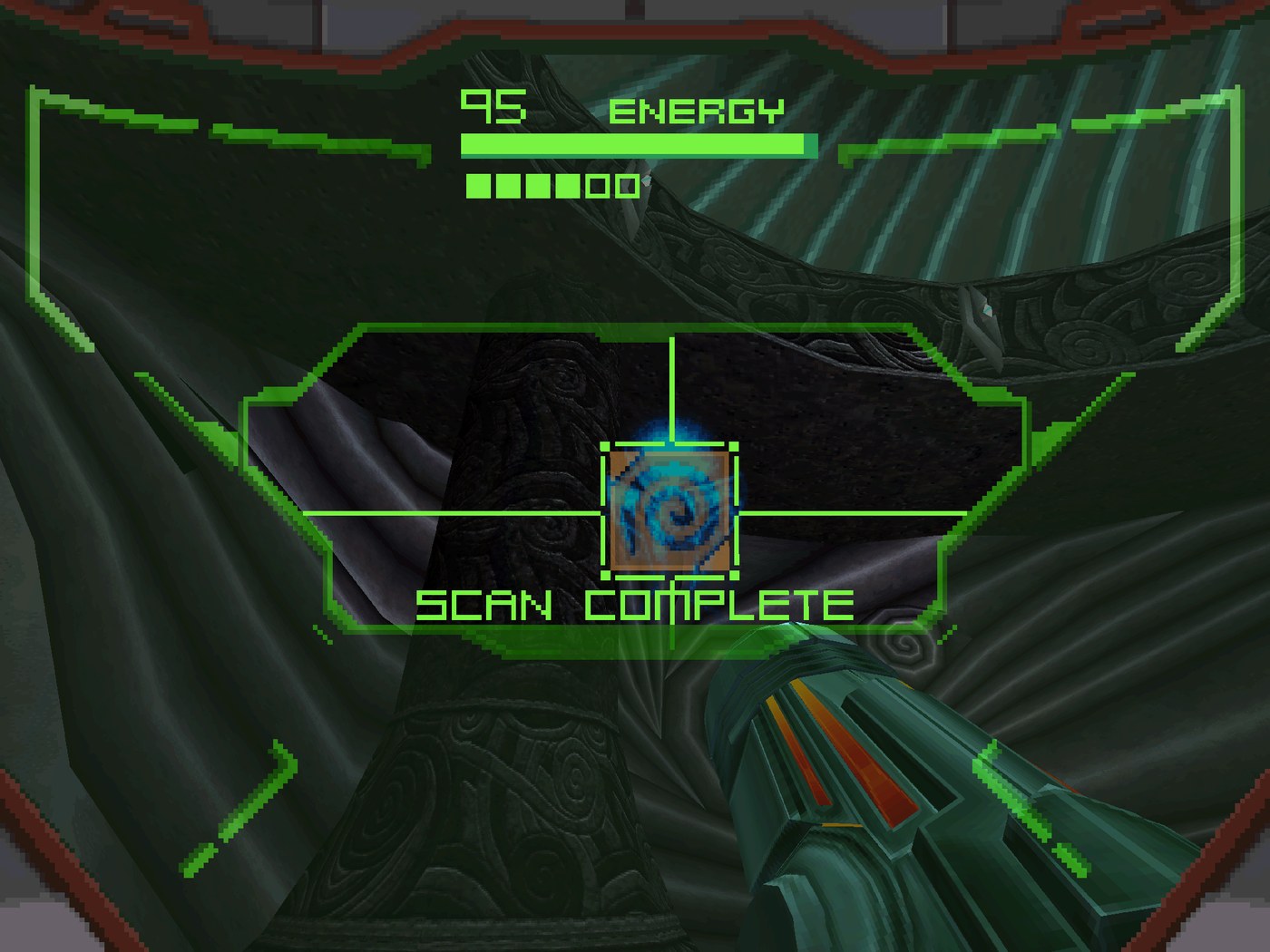
The world design honours the series’ structure perfectly. Tallon Overworld, Chozo Ruins, Magmoor Caverns, Phendrana Drifts and the Phazon Mines form a single interlocking map of locks and keys — except the locks are abilities, and the keys are understanding. A half-pipe in an early room is scenery until the Boost Ball makes it a doorway. A cracked wall is decoration until you learn what to scan for. Backtracking, the mechanic lesser games use as padding, becomes Prime’s core pleasure: every new visor, beam and suit upgrade rewrites rooms you thought you knew.
Combat through the visor
Prime’s lock-on combat is a deliberate rejection of dual-analogue orthodoxy, and on the GameCube’s single-stick controller it was the right call. You do not win fights with twitch aim; you win them by reading enemies — scanning their weaknesses, strafing around their patterns with the dash, and choosing the correct beam or missile combination. Sheegoths shrug off what kills a War Wasp. Pirates change tactics by variant. The great bosses — Flaahgra’s mirrored sunlight puzzle, Thardus in a Phendrana snowstorm, the Omega Pirate looming out of a Phazon pool — are examinations in everything the game has taught you, fought at a scale the series had never attempted.
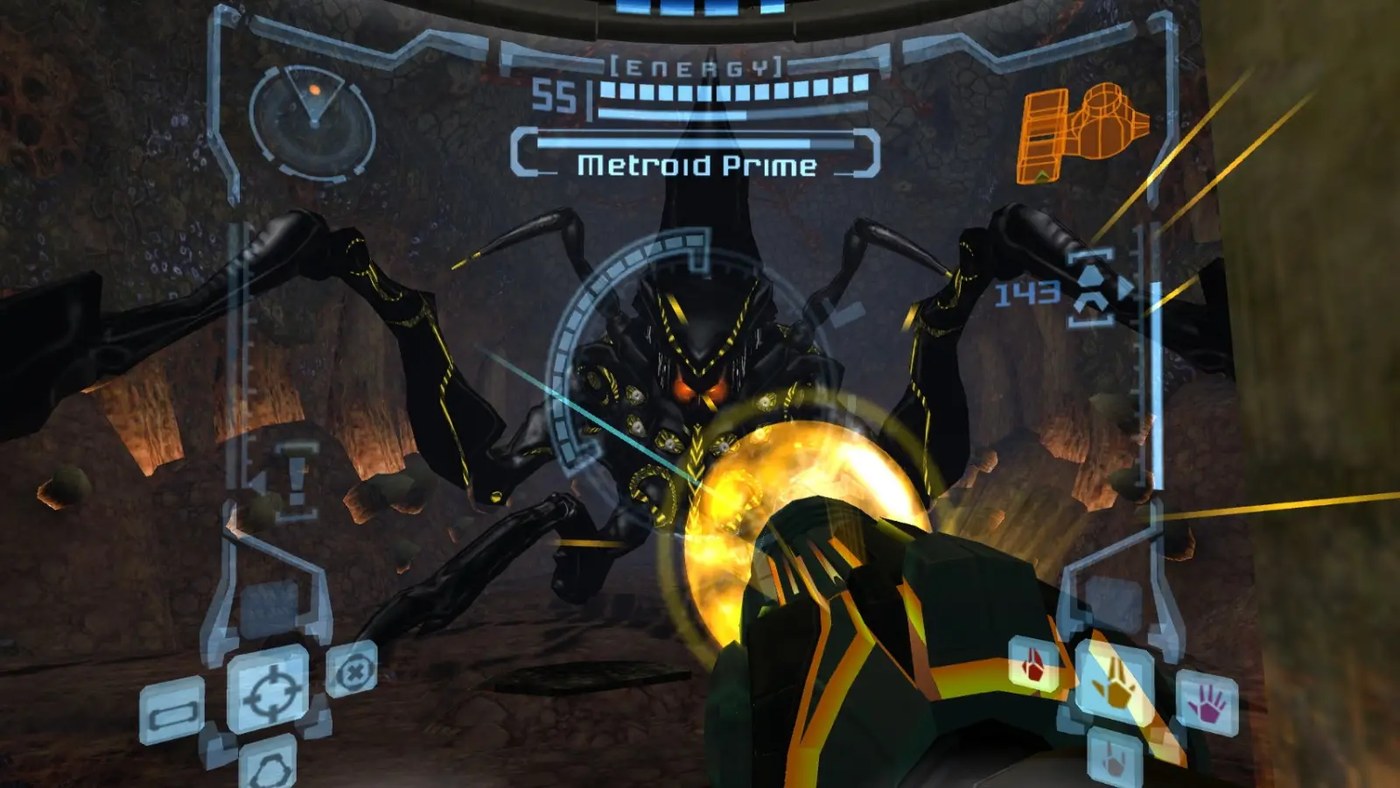
Samus herself is superbly realised. The visor HUD — health, radar, map, threat warnings, all diegetic — was years ahead of its time, and the small touches still startle: rain beading and steaming off the cannon, Samus’s reflected eyes flashing in the visor during bright explosions, the static interference of nearby Phazon. The Morph Ball, the great test of any 3D Metroid, passes completely: rolling through Tallon IV’s tunnels in third person feels precise, physical and fast, and the ball-only puzzle chambers are among the game’s best rooms.
Beauty in the ruins
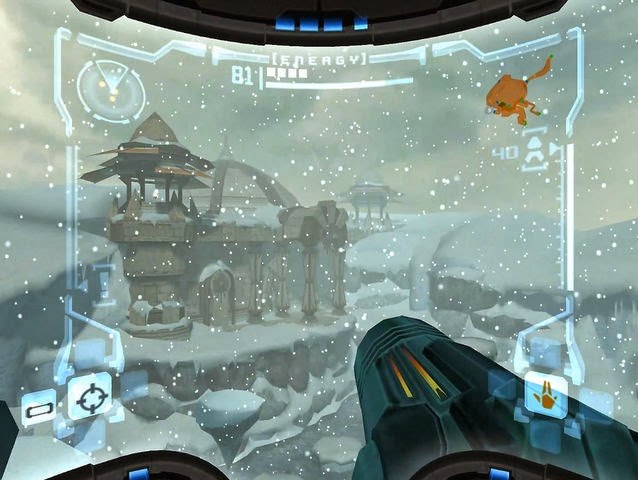
Phendrana Drifts alone justifies the GameCube’s reputation as the most capable hardware of its generation in the right hands. Snow settles on ancient Chozo stone, light refracts through ice, and Retro’s artists sustain that standard everywhere: steam and embers in Magmoor, bioluminescent fungi in the Overworld, the industrial menace of the Mines. The game holds a smooth, steady frame rate while doing it, on a controller whose C-stick you will barely touch for aiming — a technical achievement that still impresses on original hardware. Kenji Yamamoto’s score, built with Kouichi Kyuma, threads Super Metroid’s themes through new ambient arrangements that know exactly when to fall silent. Phendrana’s theme is, without much argument, one of the finest pieces of music on the console.
The sound of being alone
Prime’s audio design deserves more than the passing mention it usually gets. The GameCube’s sound hardware is put to work on layers most players feel rather than hear: the rising electronic whine of the charge beam, the wet percussion of Tallon’s rain, the way Chozo Ruins whispers with sampled choral fragments that make archaeology feel like trespass. Yamamoto and Kyuma’s compositions adapt Super Metroid’s DNA — the title theme is a direct inheritance — while Phendrana Drifts’ piano-led theme has become the series’ most covered piece of music. Crucially, Prime knows the value of near-silence: long corridors where the only sounds are Samus’s footsteps, her suit’s servos and your own scanning, building the isolation that explodes into the game’s superbly scored boss encounters. Few games of any era use quiet this confidently.
The suit progression is equally considered. Rather than doling out raw power, each upgrade changes how you read space: the Thermal and X-Ray visors turn information itself into a weapon, the Gravity Suit converts underwater sections from punishment into freedom, and the Phazon Suit’s late arrival reframes the endgame’s most dangerous substance as armour. It is a masterclass in gating a world by understanding rather than by keys, and it is why Prime’s map — which the game presents in a genuinely usable 3D form, another quiet innovation — feels like a place you learn rather than a maze you solve.
Honest reservations
Two criticisms have followed Prime since 2002, and both are fair. The late-game artefact hunt — collecting twelve Chozo Artefacts scattered across the whole map — sends you backtracking with a shopping list at exactly the moment the story wants momentum, and players who have not been scanning lore entries for hints will feel the drag most. And the control scheme, while intelligently designed around the GameCube pad, is single-stick in an era that was standardising on two; newcomers arriving from modern shooters should expect an adjustment period. The later Wii and Switch controls solve this for some players, but judged as the 2002 GameCube original it is, the scheme is a considered trade-off rather than a flaw — lock-on is the game’s language, and it speaks it fluently.
The verdict
Metroid Prime did the hardest thing in games: it changed a series’ perspective without changing its soul. Every first-person adventure since lives in its shadow, and the GameCube original — moody, meticulous, unafraid of silence — remains the purest way to experience Tallon IV. The Remastered edition is lovely, but there is a particular pleasure in the original disc: the chunkier visor effects, the GameCube pad in your hands, the sense of a young studio betting everything and winning. An essential review score for an essential GameCube game.
It is worth closing on what Prime proved to its publisher. At a moment when Nintendo’s home console was being written off as a machine for children, a studio in Texas with everything to prove delivered the most critically decorated game of its year on that hardware — adult in tone without a drop of cynicism, complex without a single tutorial pop-up. The GameCube’s library is full of games that justify the console. Prime is the one that justifies believing a series can change everything about how it looks and nothing about what it is.
Score: 9.5/10 — A masterclass in exploration and atmosphere that moved Metroid into first person without losing a single step.