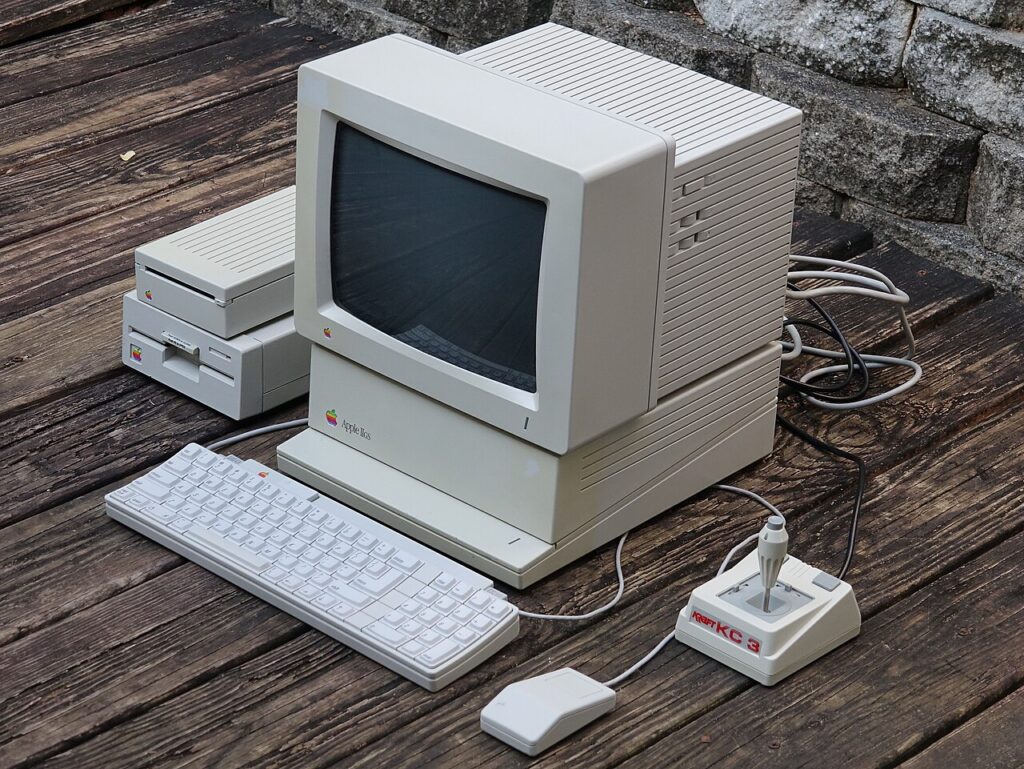
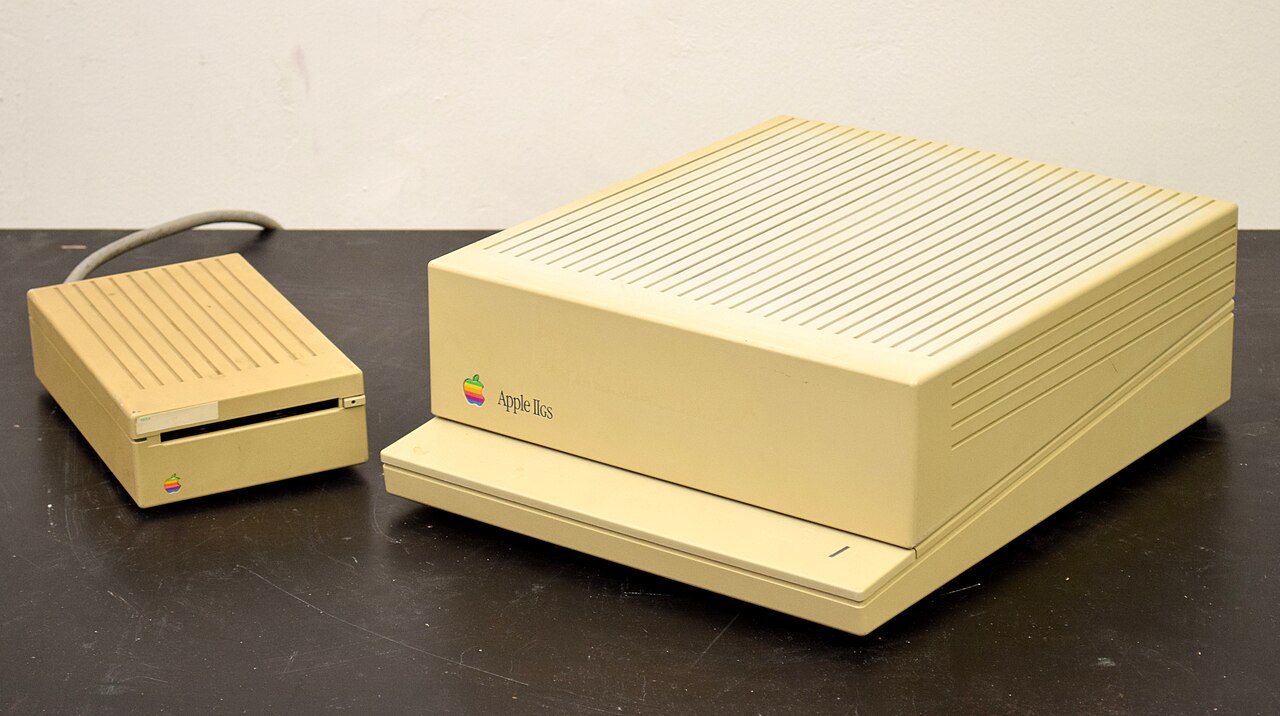
The Apple IIGS is the best machine Apple ever tried not to sell. Launched in September 1986 as the 16-bit crown of the Apple II line – GS stood for Graphics and Sound, and both were revelations – it carried a sound chip from a professional sampler, graphics that embarrassed the early Macintosh, and Steve Wozniak’s signature moulded into the first fifty thousand cases. It also had the misfortune of being an Apple II inside a company that had decided the Apple II was the past, and its six-year life is the story of a superb machine starved in its own home: hobbled speed, vanishing marketing, a software library small enough to love completely. It sold over a million units anyway, mostly to schools and the faithful, and its afterlife is one of the warmest in retro computing. This is the complete story of the Apple II that sang: the schism that built it, the sound chip that defined it, and the long, warm afterlife that vindicated it.
Two Apples: The Schism That Built the GS
By 1985 Apple Computer contained two companies at war. The Macintosh division owned the future, the rhetoric and Steve Jobs’ legacy; the Apple II division owned the revenue – the II line still paid for most of the building, above all in American schools, where the IIe was becoming furniture. The GS was the II division’s answer to the 16-bit age, and its engineering is a peace treaty in silicon. At the centre sat Western Design Center’s 65C816, a 16-bit descendant of the 6502 that could run the entire Apple II software library in emulation mode and stretch to megabytes of memory in native mode. Beside it, the Mega II chip – essentially a complete Apple IIe on a single die – guaranteed that compatibility in hardware. The new modes were the point: the VGC graphics chip delivered Super Hi-Res (320×200 in up to 16 colours per line from a 4,096-colour palette, or 640×200) with tricks (per-scanline palettes) that skilled programmers turned into thousands of on-screen colours; and the sound was a genuine sensation – an Ensoniq ES5503 Digital Oscillator Chip, silicon from the Mirage sampler keyboard, with 32 oscillators that could be paired into 15 stereo voices of wavetable sound. In 1986 the Macintosh beeped in mono; the GS played sampled orchestras. The machine also quietly debuted Apple Desktop Bus, the peripheral standard the Mac would adopt, and built-in AppleTalk networking. The price was $999 before the RGB monitor, disk drives and memory a real system required – roughly double that, all in. And one number was conspicuously low: the CPU ran at 2.8MHz, when the 65C816 could go faster. The GS’s faithful have always believed the clock was chosen in a meeting about the Macintosh, not in a lab. Whether or not the order was ever given, the effect was policy: the GS would never be allowed to outrun the future.
Woz’s Signature: The Limited Edition and the Lineage
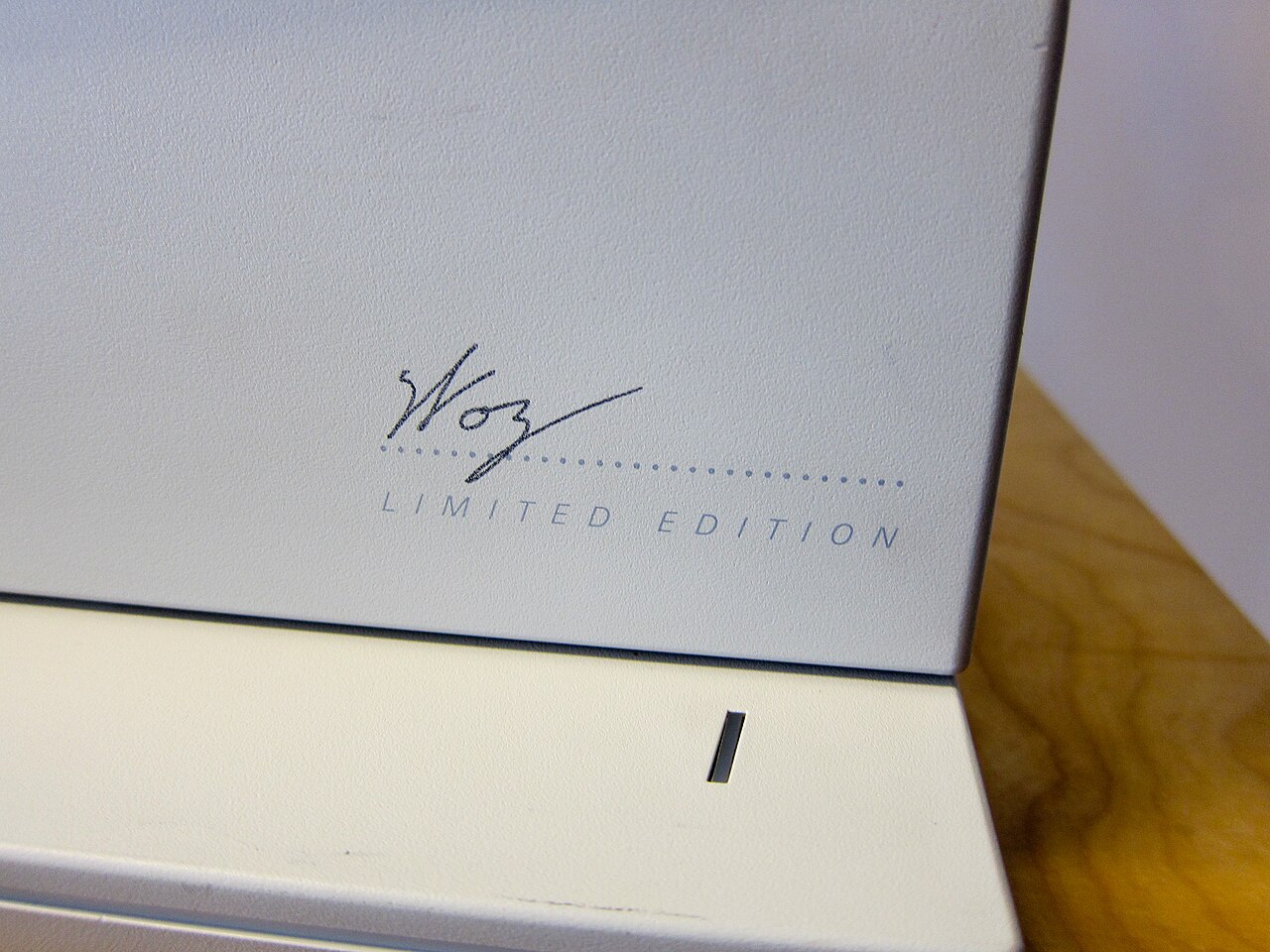
The first production run carried the most romantic detail in Apple’s hardware history: Steve Wozniak’s signature, moulded into the case lid, with a certificate and a letter – the “Woz Limited Edition,” fifty thousand machines marking the Apple II’s tenth anniversary and its designer’s blessing on the line’s last great machine. Wozniak by 1986 was a semi-detached founder (a plane crash, a degree under a pseudonym, a remote-control company), but the GS was his lineage completed: the 6502 architecture he had built the original Apple II around, extended to 16 bits by the same Western Design Center ecosystem that grew from his choices. The signature was also internal politics made visible – a reminder, in plastic, of which half of Apple had invented the company. The machine’s own evolution underlines the ambivalence around it: the ROM 03 revision (1989) remains the connoisseur’s model, with 1.125MB on board, improved ROM and quieter manners, but there was never a faster GS, never a GS laptop, never the aggressive second act the platform’s engineers sketched. What there was, eventually, was software that treated the machine as a small Macintosh done right: GS/OS (1988), and above all System 6.0.1 (1993), a Finder-based graphical operating system of genuine polish – released, in the platform’s defining irony, within the same year as its execution.
The Sound: Ensoniq’s Gift and the SID Connection
The GS’s sound deserves its own chapter because it is the machine’s soul, and because its genealogy is one of computing’s great hidden threads. Ensoniq was founded in 1982 by engineers out of Commodore’s MOS Technology – among them Bob Yannes, designer of the Commodore 64’s SID chip, the most beloved sound silicon of the 8-bit era. The ES5503 “DOC” (Digital Oscillator Chip) that Ensoniq built for its Mirage sampler – the keyboard that put sampling in reach of working musicians in 1984 – is the direct descendant of that lineage, and Apple, shopping for the GS’s audio, bought the SID’s grandchildren. The specifications still startle in context: 32 independent oscillators reading wavetable memory, pairable into 15 stereo voices plus a spare, at a time when the Macintosh offered a single beep channel and the stock IBM PC offered less. The GS’s designers then committed the platform’s characteristic act of self-sabotage-by-committee: the chip’s stereo field was summed into the machine’s single internal speaker, and true stereo required a third-party card in a slot – the orchestra was real, but you had to buy a door to let it out. Owners did, in numbers; the GS music scene (trackers, sample libraries, the FTA demos’ thunderous soundtracks) treated the ES5503 as a studio instrument, and the machine’s games are remembered sonically the way SID games are – The Immortal’s dread, the Sierra ports’ scores, sampled speech in places speech had no business being in 1988. Of all the 16-bit machines, only the Amiga’s Paula argues with the GS’s claim to the era’s best standard-fit audio, and Paula had four channels to the Ensoniq’s thirty-two oscillators. The Apple II line had begun in 1977 with Woz’s beeper. It ended, sonically, with a sampler. No other computer family covers that distance.
The Education Empire: The Computer-Lab Machine
To find the GS in its natural habitat, picture an American school computer lab between 1987 and 1993: a row of platinum cases, RGB monitors glowing, a dot-matrix printer arguing in the corner. Apple’s grip on US education in those years was close to total – the Apple II family was the default school computer of a generation – and the GS was the line’s flagship in the lab, the machine districts bought when they could afford the best version of the ecosystem their teachers already knew. The software of record was educational in the broad, eighties sense: MECC’s catalogue (the Minnesota Educational Computing Consortium, publisher of The Oregon Trail, running the largest educational software operation in the world from the Apple II’s home state), Broderbund’s Carmen Sandiego interrogating geography in Super Hi-Res colour, typing tutors, Logo, and HyperCard GS stacks built by teachers themselves. The significance is generational and easy to miss from the games side of the fence: for a large cohort of American children, “computer” meant this machine – its startup chime of clattering drives, its Finder, its beep-and-sample voice – and the GS’s afterlife warmth is substantially the warmth of the computer lab remembered. Apple’s education empire would migrate to the Mac LC and then dissolve into the PC era’s Dell-and-Chromebook future, but the GS years were its golden age: the last time one quirky, sound-obsessed, signature-bearing machine was the standard instrument of a nation’s schooling.
The Library: Small, Luminous and Mostly Ports
The GS’s native software catalogue was always the platform’s wound – a few hundred titles against the thousands it could run in Apple II mode – but its top shelf gleams with a particular light, because developers treated the sound and colour as an event. The Immortal (Electronic Arts, 1990), Will Harvey’s isometric descent into gore and wizardry, was born on the GS and showed its audiovisual muscle first; Zany Golf, Harvey’s other GS original, turned miniature golf into a surrealist toy; Tass Times in Tonetown, born on the GS, sold the machine’s eighties neon in its purest form. The ports outshone their originals often enough to matter: Defender of the Crown reached its prettiest form here, Sierra’s adventures (King’s Quest, Space Quest, Police Quest) arrived in full colour and voice-rich sound, Bard’s Tale and Ultima lines carried the RPG flag, and Interplay’s Neuromancer adaptation is still argued as the definitive version. France supplied the platform’s underground glory: the Free Tools Association’s demos (Modulae, the Delta demo) extracted effects the hardware supposedly couldn’t do and made the GS a demo-scene machine in Europe even as its games shelf thinned. The serious software was the quiet triumph: HyperCard GS (1991) brought Apple’s hypermedia revolution to the line in colour; AppleWorks GS gave schools an integrated suite; Deluxe Paint II and a shelf of Ensoniq-flaunting music tools (Instant Music, Music Construction Set) made the GS a creative instrument. Because the buyers were so often schools, the education catalogue (MECC and friends) is vast and mostly forgotten – the GS spent its weekdays teaching America and its evenings, in the faithful’s bedrooms, singing.
Programming the Crown: The Toolbox Conversion
The GS asked its programmers to change religion. Classic Apple II development was bare-metal – peek, poke, and the monitor – but the GS carried a Macintosh-style Toolbox in ROM: window, menu, event and sound managers that demanded event-driven programming of a kind the 6502 world had never practised. The culture split accordingly and productively. Byte Works’ ORCA languages (ORCA/C above all, from Mike Westerfield’s one-man operation) became the platform’s development standard and its textbooks the priesthood’s scripture; the shareware and freeware scene in the back of inCider and on the A2 online services ran on converted hackers who discovered that the Toolbox, for all its ceremony, let two people build software that looked like it came from a company. The French FTA’s demos were the other pole – assembly to the metal, contemptuous of the Toolbox, extracting the impossible from the VGC and Ensoniq chips directly – and between the two poles the GS’s small software world achieved a density of craft that its sales figures never promised. It is a familiar story now (every constrained platform grows it), but the GS grew it under unique pressure: the programmers knew the maker had left, and coded like people keeping a house the owner had abandoned – because the house, whatever Apple thought, was the best one on the street.
The Third-Party Lifeline: Applied Engineering’s Shadow Platform
Apple’s neglect created an industry. Because the GS was deliberately sold slow, expandable and under-equipped, its owners bought their performance from the platform’s remarkable third-party sector – above all Applied Engineering of Texas, which functioned as the machine’s shadow manufacturer: the TransWarp GS accelerator (a faster 65C816 card that answered the 2.8MHz question with a screwdriver), RamWorks memory expansions that took the machine to megabytes Apple never offered, the Sonic Blaster to free the Ensoniq’s stereo, and the PC Transporter, an entire IBM XT on a card that let a GS run MS-DOS in a window of its own hardware – the eighties’ most gloriously pragmatic peripheral. Zip Technology’s GSX accelerators, Sequential Systems’ storage and a dozen smaller firms completed an ecosystem whose catalogues (the inCider and A+ magazines carried their advertising like scripture) read as the platform roadmap Apple refused to publish. The arrangement is an early, pure example of a pattern the industry now knows well – the community and its cottage industry sustaining a platform past its maker’s interest, cf. the Amiga’s nineties – and it complicates the starvation narrative: the GS was never as frozen as Apple’s spec sheet suggested, because its owners kept upgrading it themselves. The faithful didn’t just keep the GS. In meaningful part, they finished building it.
The Slow Starvation: How Apple Killed Its Crown
The GS was not beaten by a rival; it was managed to death by its own company’s org chart. Apple’s eighties leadership – Sculley, then Gassée’s flamboyant product regime – bet the company on the Macintosh, and the Apple II line survived as a cash cow to be milked, not fed. The symptoms were consistent: no speed upgrades while the 65C816’s faster grades sat available (third parties sold accelerators – the TransWarp GS – to owners Apple wouldn’t serve); advertising that dwindled to education catalogues; and, in 1990, the chosen migration path made hardware: the Macintosh LC with its IIe Card, a Mac that could emulate the past, positioned explicitly as the GS’s replacement in schools. Developers read the signals and left in order – by 1991-92 the native release schedule was a trickle of ports and devotion. The end was administratively tidy: the IIGS was discontinued in December 1992, and the Apple IIe – the GS’s eight-bit parent – outlived it in production into 1993, the cash cow burying the crown prince. Total IIGS sales are usually put a little above one and a quarter million, a figure achieved essentially without marketing in its final years, on the strength of schools and the most loyal user base in the industry. The counterfactual hangs over Apple’s history: a GS allowed to run at speed, priced to fight, might have held the education market that paid for the Mac’s survival. Apple chose the future it wanted, and the GS became the monument to the one it discarded.
Afterlife: KansasFest and the Faithful
The GS’s second life is the Apple II community’s beating heart, and it has an address: KansasFest, the annual gathering of the Apple II faithful held since 1989, where the GS is the prestige platform of the world’s most cheerful retro scene. The hardware culture is fully industrialised by hobbyist standards – modern storage (the CFFA3000’s compact-flash and USB sorcery), HDMI video cards, network adapters, accelerator reproductions – and the software community maintains System 6 as a living system (fan updates have carried it to 6.0.4 and beyond, decades after Apple’s final release), alongside the FTA demos’ legend and an emulation scene (KEGS, GSplus) that preserves the catalogue whole. Woz Edition machines anchor collections; the Ensoniq chip’s sampled warmth is a chiptune genre of its own. The verdict of history is written in the machine’s continued use: the GS was the Apple II line perfected – graphics, sound and software all arriving at their peak in the same box – and its tragedy is only that its maker had stopped believing in the line at the moment the line produced its masterpiece. The signature on the lid turned out to be the honest review: Woz’s computer, signed; Apple’s, unsigned.