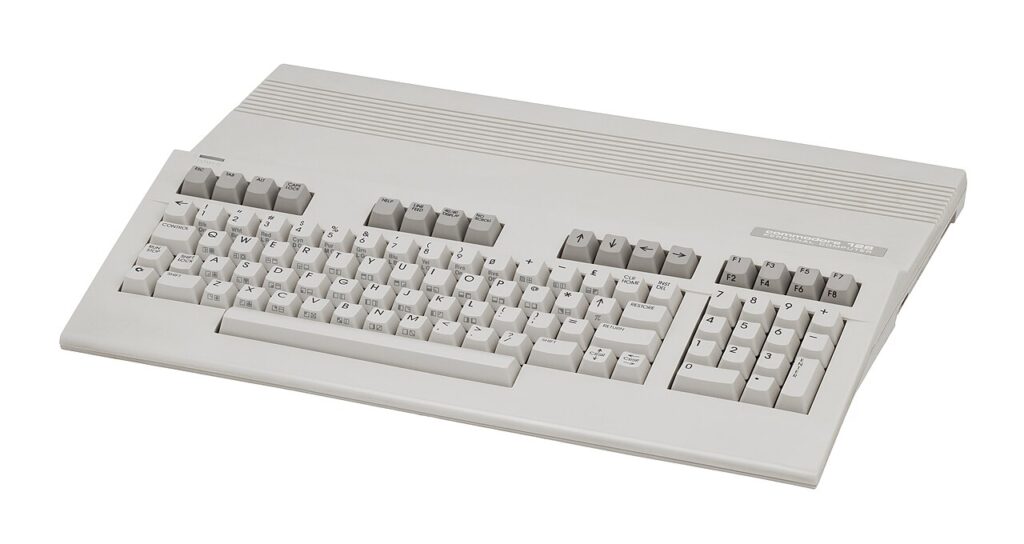
The Commodore 128 is three computers wearing one beige coat, and each of them is excellent. Boot it one way and it is a Commodore 64 so perfectly compatible that almost nothing can tell the difference. Boot it another and it is a 128K native machine with 80-column text, a structured BASIC and the best productivity software Commodore ever shipped. Boot it a third way – on its secret Z80 second processor – and it is a CP/M business computer with access to the largest professional software library of the eighties. It sold in the millions, anchored Commodore’s late eight-bit years, and is remembered, unfairly, as the machine everyone used as a C64. That memory is its story in miniature: the most capable 8-bit Commodore ever made, whose greatest feature was also its curse. This is its complete story – the five-month sprint that built it, the three personalities that shared it, and the long and devoted afterlife in which its owners quietly finished the platform Commodore started. Few home computers have ever offered more, and none has ever been so thoroughly mistaken for its own predecessor by the very people who bought it and loved it most dearly.
Bil Herd’s Machine: The Team Tramiel Left Behind
The C128 was designed in the strange year after Jack Tramiel’s departure, by the engineers he left behind – principally Bil Herd, whose team had built the Plus/4 and TED machines and who approached the 128 as an act of institutional redemption: the machine that would give C64 owners everything the C64 lacked, without taking anything away. Unveiled at CES in January 1985, the specification reads like a complaint list answered line by line. Memory: 128KB, bank-switched by a dedicated MMU, expandable further. Display: two video chips – the familiar VIC-II for 40-column C64 graphics, and a new VDC chip delivering a crisp 80-column RGB picture (640×200, and interlaced modes beyond) for serious work. Sound: the beloved SID, untouched. BASIC: version 7.0, with the structured programming, graphics and sound commands whose absence had been the C64 BASIC’s running joke. And the masterstroke, added late and cheaply because Commodore had CP/M ambitions and a warehouse lesson learned from the C64’s failed Z80 cartridge: a Zilog Z80 processor whose whole job was to start the machine and then run CP/M. The matching 1571 disk drive doubled the 1541’s manners – double-sided, faster burst transfers, fluency in CP/M disk formats. At $299 the package was the most computer Commodore had ever offered for the money, which was exactly the Tramiel tradition, executed by the people he had trained and abandoned. The 128 is best understood as the C64’s design team, unsupervised, building the flagship they’d always wanted to.
The Three Modes and Their Unequal Lives
The machine’s triple personality had triple fates, and the numbers were never close. C64 mode – summoned by typing GO64 or holding the Commodore key at power-on – was an act of total compatibility: because the 128 carried the 64’s hardware in full, its emulation was effectively the thing itself, with compatibility usually quoted at 99-plus percent. Owners voted with their habits and spent most of their hours there, which meant the C128 spent its life propping up its predecessor’s ecosystem. C128 mode, the native personality, built a smaller, prouder library weighted toward the serious: SuperScript and Superbase in their definitive Commodore editions, PaperClip III, Vizawrite, the Jane integrated suite, GEOS in its expanded 128 form, and a demoscene-and-BBS culture that prized the extra memory and the 80-column screen (a great many bulletin boards of the late eighties were hosted on 128s, the machine awake all night in a spare room). CP/M mode is the connoisseur’s revelation: with the Z80 running Digital Research’s CP/M Plus, the 128 opened the door to WordStar, dBase II, Multiplan and the entire business canon of the pre-PC era – and by unit volume, the C128 may quietly have been the best-selling CP/M computer ever made, a punchline with a real claim. The modes’ imbalance wrote the platform’s commercial epitaph in advance: when your flagship’s best trick is being the previous model, the market buys the previous model – cheaper – or buys the flagship and never discovers the rest.
BASIC 7.0: The Programmer’s Commodore
If the C128 has a soul beyond compatibility, it is in ROM, and it is BASIC 7.0. The C64’s BASIC 2.0 – a 1977 dialect with no sound, graphics or sprite commands, which forced a generation to program in POKEs – was the great machine’s one indefensible component. BASIC 7.0 is its apology, and it is comprehensive: structured programming (DO/LOOP, WHILE, BEGIN/BEND blocks), dedicated commands for sprites (SPRITE, MOVSPR, SPRDEF, a built-in sprite editor summoned from the prompt), sound and music (SOUND, PLAY, ENVELOPE, TEMPO – the SID given sentences instead of numbers), graphics (DRAW, CIRCLE, BOX, PAINT across both video chips), disk fluency (DLOAD, DSAVE, DIRECTORY as verbs rather than incantations), and – the professional’s delight, inherited from the TED machines – a full machine-language monitor built into ROM, summonable with MONITOR, for assembly work without a cartridge. The supporting literature treated the machine accordingly: Commodore’s own 128 Programmer’s Reference Guide became the line’s bible, and the magazines (RUN, Compute!’s Gazette) ran 128-specific type-in features alongside the 64’s. For the hobbyist programmer – the person the home-computer era was supposedly for – the C128 was simply the best tool Commodore ever sold: the C64’s universe, the Amiga’s seriousness of purpose, and a language that finally met the hardware halfway. That this audience was outnumbered a hundred to one by people who typed GO64 and loaded a game is the platform’s biography, not its refutation.
The Games Question: A Library of One Mode
Ask after native C128 games and you will be shown a short shelf – which is itself the most instructive artefact in the platform’s history. A handful of publishers exploited the machine: Infocom, characteristically, was the most serious, shipping its late interactive fiction (Trinity, Bureaucracy, Beyond Zork, Sherlock) in 128-native editions that used the 80-column screen and the extra memory as the texts deserved; a few enhanced editions appeared elsewhere (The Last V8’s 128 version is the usual citation), and the productivity-adjacent GEOS world supplied its own amusements. And that, give or take the PD and magazine type-ins, is nearly all – for a reason that is not laziness but arithmetic. A C128-native game addressed an installed base a fraction of the C64’s, could not be sold to the other millions, and competed against the same machine running the entire C64 catalogue flawlessly, including every new C64 release. No publisher green-lights that spreadsheet. The C128’s games library is therefore best described as the C64’s library, complete and perfect, plus a margin of native excellence in text adventures and serious software – the mirror image of the IIGS problem on this site’s Apple shelf, where compatibility also smothered a native catalogue. The two machines make the same historical point from opposite ends of the market: perfect backward compatibility is a feature that eats its host, and both the GS and the 128 are beloved today partly because their owners eventually stopped waiting for native software and simply enjoyed the best of both worlds in one box.
The VDC and the Expansion Habit
The 128’s second video chip deserves its footnote in the history of stubborn engineering. The 8563 Video Display Controller carried its own private memory (16KB standard, 64KB in the DCR revision), generated the 80-column picture entirely apart from the VIC-II’s world, and could be coaxed – through a programming interface so indirect that developers complained about it in print for years, registers hiding behind registers – into interlaced displays up to 640×480 and colour tricks Commodore never documented. The demo scene eventually made it sing in the machine’s afterlife, and BBS and productivity users swore by its razor text from the first day: the 128 was the only home computer of its class that could run a word processor like an office machine and a game like an arcade machine on two different screens from two different chips. Expansion was the same philosophy made physical: Commodore’s own RAM Expansion Units (the 1700 and the 512KB 1750, with DMA fast enough to serve as a RAM disk) were notoriously supply-constrained – legend says the 1750’s chips kept being diverted to other products – and the aftermarket answered for decades afterward, from CMD’s RAMLink and hard drives to the SuperCPU accelerators that took the 8-bit line to 20MHz in the late nineties. Read the 128’s whole peripheral story and a pattern emerges that this site’s IIGS history states outright: when a maker under-supports an expandable machine, the owners and their cottage industry finish the design. The 128’s expansion port may be the most productive slot Commodore ever cut.
Signatures in the Case: The Sprint and the Details
The 128’s makers signed their work the way the IIGS’s designer signed his – literally. Open an original C128 and the inside of the top case carries the design team’s signatures moulded into the plastic, a Bil Herd-era flourish that tells you how the project felt from inside: a young team, abandoned by its famous founder, building its flagship in a five-month sprint and putting its names in the shell. The sprint shows in the details owners still praise. The screen editor – the code between you and the machine – was the finest of the 8-bit Commodores, with ESC-key sequences to define text windows, control the cursor and tame the dual screens, the kind of polish that only happens when a team uses its own machine daily. C64 compatibility was pursued with an almost vindictive thoroughness – the goal, as Herd’s team have told it since, was that no customer could ever find the title that broke it, and the test programme ran to the catalogue’s weird corners, timing-critical loaders and undocumented tricks included. Even the famous FAST command (doubling the 8502’s clock in the borders and 80-column mode) is a Herd-team signature: performance hidden in the spec for people who read the manual. The 128’s reputation among engineers has always outrun its reputation among gamers, and the case signatures are the reason compressed into one image: this was a machine built by people who expected to be judged by other engineers, forever, every time a lid came off.
The European Seriousness
The C128’s geography mirrors its personality: it did best where home computers were treated as instruments. Germany – the C64’s second homeland and Europe’s most serious micro market – adopted the 128 as the professional’s Commodore: Data Becker and the German software houses supported it with localised productivity lines, the magazines (the mighty 64’er above all) covered the 128 as a first-class platform rather than a footnote, and the D model’s desktop form was practically designed for the German home office. Britain took the machine as the thinking owner’s upgrade – the 128 sold in monitor-and-drive bundles to C64 families ready for “the serious one,” its 80-column mode and word processors doing the persuading that its games shelf never could. America, where the C64’s price kept collapsing beneath it and the PCjr/Apple IIc owned the “serious home” shelf space, was cooler – one more case of the 128’s virtues (text, memory, compatibility, CP/M) being exactly the ones its home market’s advertisements couldn’t dramatise. The pattern rhymes with the IIGS’s school-anchored American life and the ST’s German one in this series: the eighties’ serious home computers all found their truest homes where buyers did sums before they did screenshots, and the C128 – three machines, one box, all sums done for you – was the most serious of them all.
The Desktop, the Amiga Shadow and the Squeeze
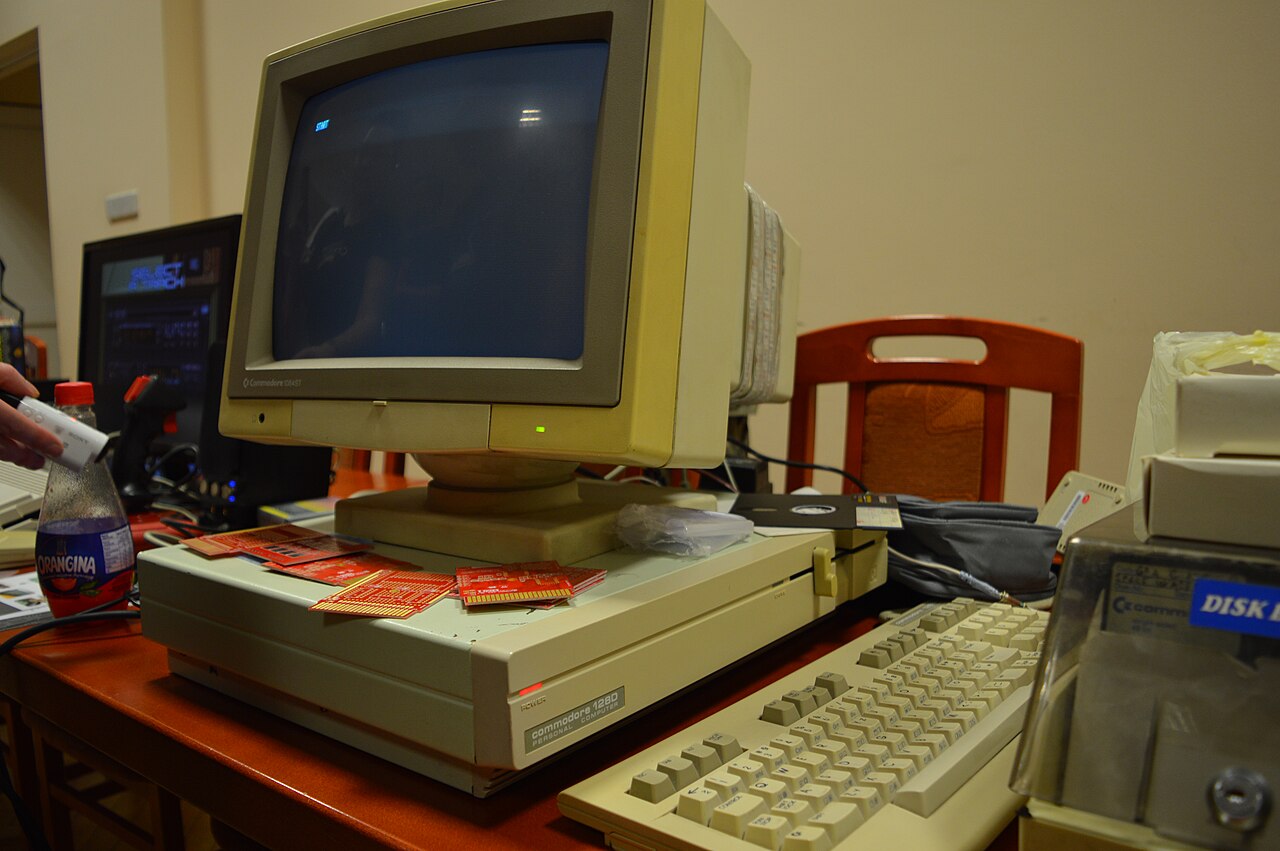
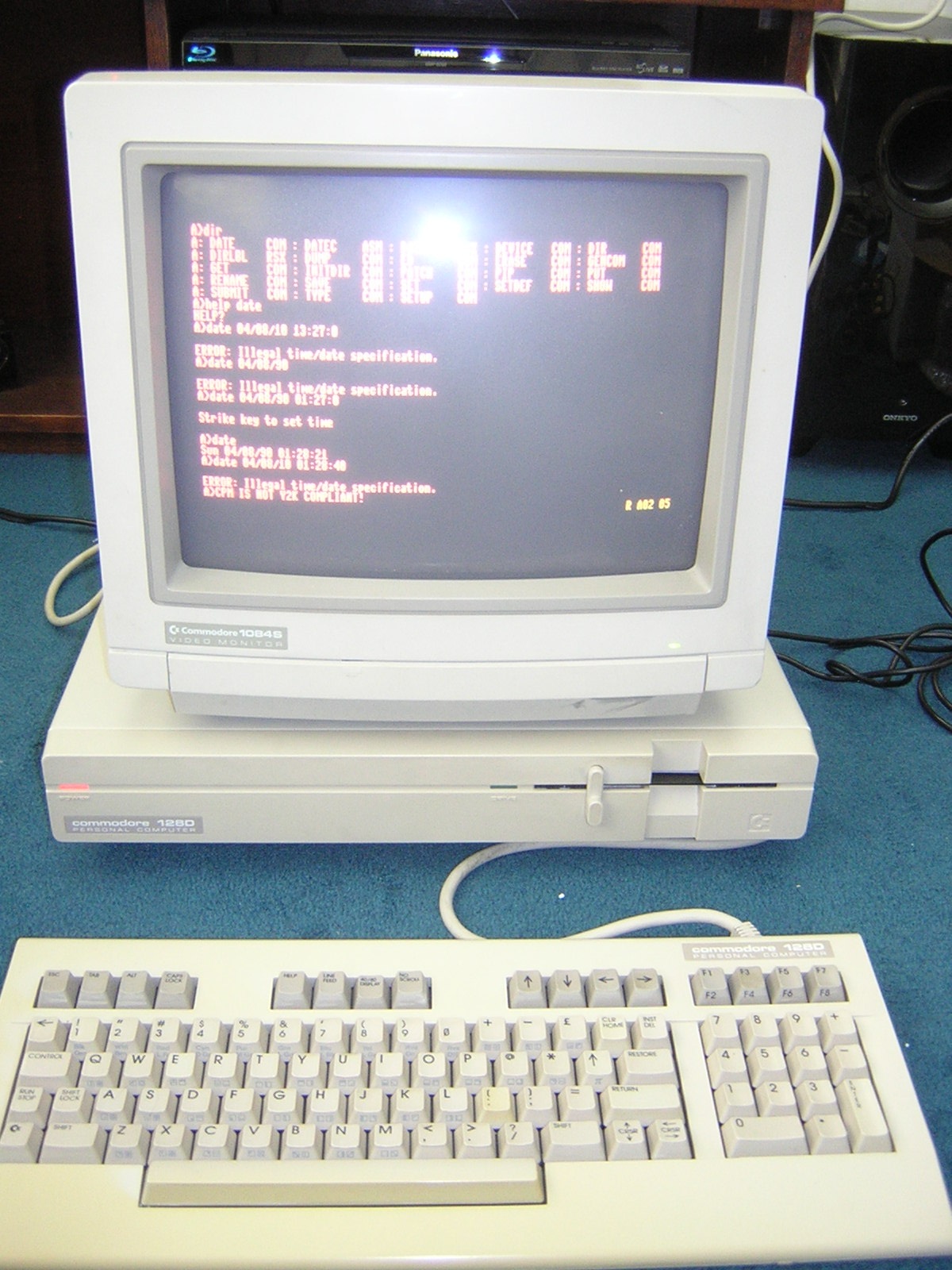
Commodore iterated the 128 the way it iterated everything in the Gould years – sideways. The C128D (1986) repackaged the machine as a desktop system unit with the 1571 built in and a detachable keyboard, aimed at the serious buyer; its cost-reduced successor, the 128DCR, trimmed the metal to plastic and the design to a price, and survives in owner folklore for details like its deleted cooling fan. The deeper problem was positional. In the same summer the C128 launched, Commodore acquired and launched the Amiga – a machine from a different universe of capability at four times the price – and the company’s late-eighties strategy never resolved which future it believed in: Gould-era Commodore sold the C64 (still the volume king), the C128 (the premium 8-bit), and the Amiga line simultaneously, competing for its own dealers’ shelves and its own customers’ wallets. The C128’s price, components and positioning were squeezed between a cheaper legend below and a revolution above. Production ran to about 1989, with lifetime sales usually estimated in the region of five million – a large number for any home computer, and a fraction of the C64’s, which is precisely the comparison its maker kept inviting. The unbuilt sequels mark the line’s end: Commodore’s engineers prototyped toward a successor generation (the stillborn C65 of 1990-91, with its near-Amiga 8-bit ambitions, belongs to the next chapter of the tragedy), while the 128’s actual users carried the platform themselves – CMD’s hard drives, RAM expansions and GEOS successors (Wheels) keeping 8-bit Commodore commercially alive from the aftermarket well into the 1990s and beyond.
Afterlife: All Three Machines, Kept
The C128’s preservation is unusually complete, because its emulator is unusually complete: VICE, the reference Commodore emulator, reproduces all three personalities (the VDC’s quirks and the Z80’s CP/M included) with an accuracy that makes the triple machine a single download. The hardware market has sorted the family – the desktop D models, above all the metal-cased original 128D, are the collectors’ prizes – and the platform’s long commercial aftermarket (CMD’s products became collectible infrastructure) means a working 128 setup can still be expanded with hardware designed across four decades. The strangest afterlife belongs to its cancelled heir: the C65, Commodore’s 1991 attempt at a next-generation 8-bit, cancelled at the prototype stage, became retro computing’s most mythologised unreleased machine – and in 2022 the MEGA65, a faithful modern recreation built with community blessing, finally shipped the C65 to the public, closing a loop the C128’s story opened: the 8-bit line Commodore couldn’t finish, finished by its fans. The verdict on the 128 itself has mellowed into respect. It was never the revolution the Amiga was, nor the phenomenon the C64 remains. It was something rarer in Commodore’s chaotic catalogue: a well-engineered machine that did exactly what it promised, three times over, in a single box. The last great 8-bit Commodore is also, on the merits, the best one – the machine its makers signed from the inside, in every sense of the phrase.