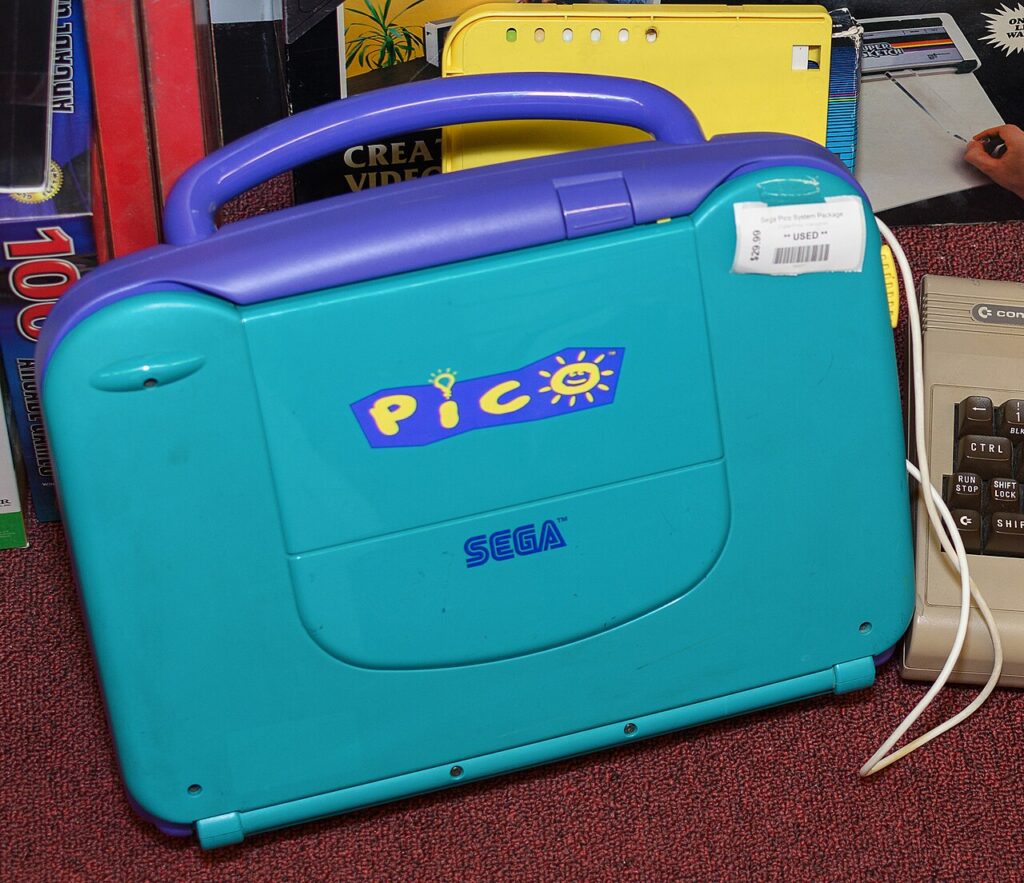
The Sega Pico is the most successful games machine most gamers have never seen. A chunky, brightly-coloured “kids’ computer” that opened like a laptop, took book-shaped cartridges called Storyware, and was operated with a chunky stylus called the Magic Pen, it sold around three and a half million units worldwide – the bulk of them in Japan – and quietly ran for twelve years while Sega’s headline consoles rose and fell around it in plain sight of everyone. The Pico matters out of proportion to its preschool audience: it was the first mainstream games hardware built around a stylus and a touch surface, years before the DS; it pioneered the interactive-book format the LeapPad would later make famous; and it is the purest evidence that Sega in the nineties was not a games company with a toy line, but a toy company with a games division. This is the complete story of the console for three-year-olds. It is also a story about where interactive media actually came from – not only the arcade and the bedroom computer, but the toy aisle, the picture book and the kitchen table – and about the decade in which the industry’s most aggressive games company ran its most durable platform for an audience that couldn’t yet read the logo on the box.
Sega the Toy Company, and the Kids’ Computer Idea
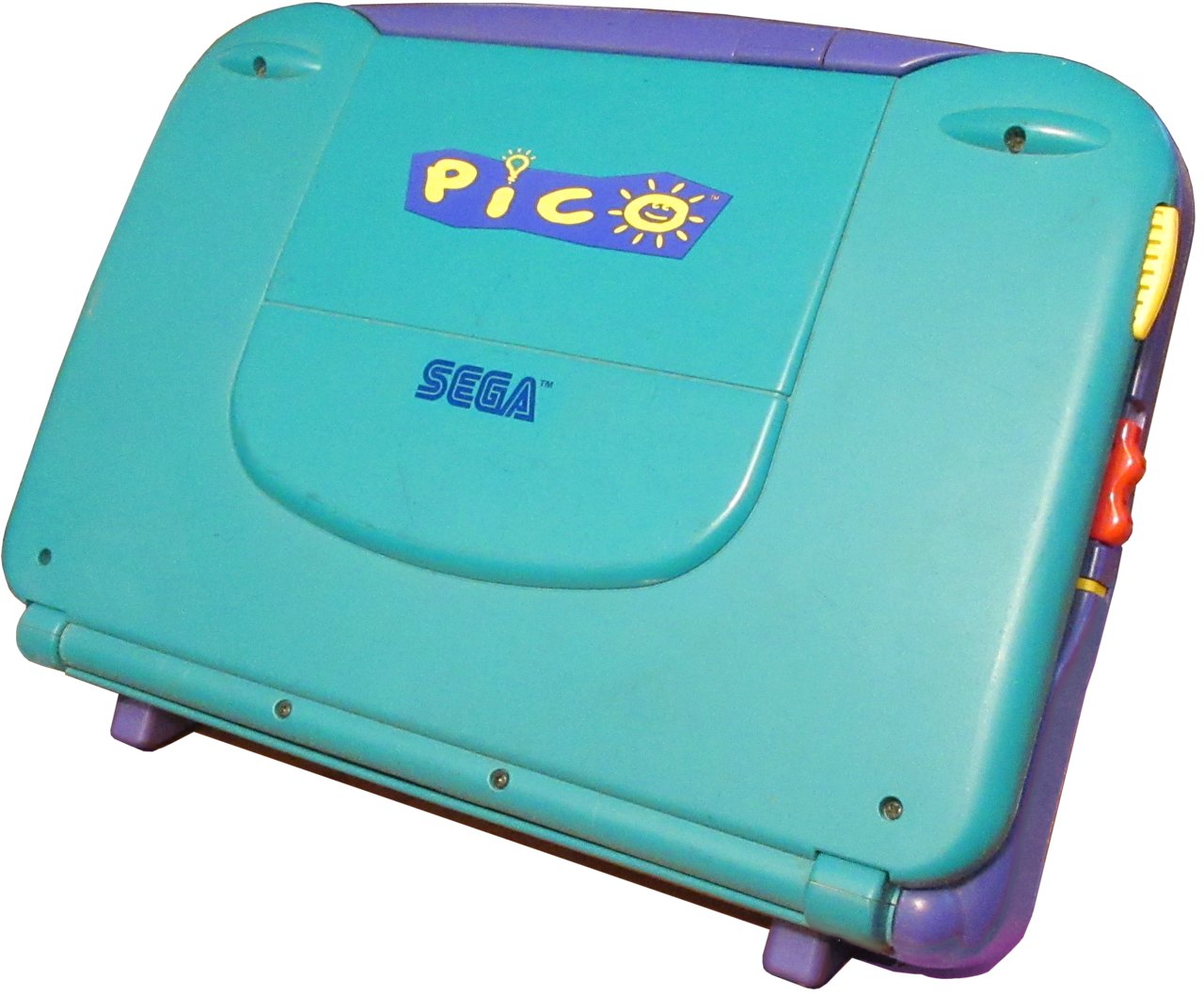
The Pico came from Sega Toys, and to understand it you have to remember that Sega’s roots are as much in amusements and toys as in consoles. By the early nineties the electronic-edutainment category was a proven retail force – Texas Instruments’ Speak & Spell had defined it, VTech’s plastic laptops were filling toy-shop shelves, and every major toy brand wanted an “educational computer” – but none of them was a real games machine. Sega’s insight was to make one: to take actual Genesis-generation technology (the Pico runs on a Motorola 68000 with a derivative of the Mega Drive’s graphics hardware), put it in a rugged clamshell body a toddler could carry, remove the screen entirely – the Pico plugs into the family television – and invent a control scheme a pre-reader could use. In place of a controller there was the Magic Pen, a wired stylus, and a pressure-sensitive drawing pad built into the console’s base. In place of ordinary cartridges there was Storyware: chunky book-cartridges, each with a set of illustrated pages bound into its top. Open a page and sensors told the console which page you were on; touch the picture on the television with the pen (via the pad) and the scene answered. It was, in 1993, a touchscreen book connected to a television, built from console parts – and parents, the actual customers, understood it instantly, which is more than could be said for most of Sega’s other hardware that decade.
Storyware: Sonic Teaches Counting
The library is where the Pico’s double identity – toy and Sega platform – gets charming. Sega’s mascots were conscripted as teachers: Sonic the Hedgehog’s Gameworld (1994) set the hedgehog to mini-games and gentle challenges; Tails and the Music Maker turned the pad into an instrument; Ecco Jr. and the Great Ocean Treasure Hunt! sent the dolphin on an educational dive. The licence shelf was the commercial engine – Richard Scarry’s Busytown was the American flagship (Scarry’s book-world translated uncannily well to a machine that was itself a book), joined by Disney properties (Mickey, Pocahontas, The Lion King) and, in Japan, the licensing machine ran at full industrial strength: Anpanman, Crayon Shin-chan, Hello Kitty and dozens of anime and picture-book properties, with the Japanese catalogue running to several hundred Storyware titles against the West’s few dozen. Software followed the format’s grammar – turn the page, the world changes; touch, draw, sing along, count – with drawing and music modes that used the pad as a blank canvas between pages. Critics, then as now, barely reviewed any of it, which was rather the point: the Pico was sold in toy aisles, judged by parents at kitchen tables, and measured in reading-readiness claims on the box. As a games library it is indefensible and adorable in roughly equal measure – and as a format invention, the page-sensing book peripheral anticipated by six years the LeapPad that would conquer the category the Pico created.
The Hardware on the Bench: A Genesis in a Picture Book
Take a Pico apart and the Sega-ness is structural. The base unit is essentially a Mega Drive’s worth of silicon – the same Motorola 68000 at the family’s heart, a video display processor derived from the Genesis line, sound hardware of the same lineage – re-housed in primary-coloured, drop-resistant plastic engineered like a toy, because it was one. There is no battery and no screen: the Pico is AC-powered and television-bound, a design that looks like a limitation and reads, in context, as supervision – play happened in the living room, on the family TV, in sight of adults, which was precisely what the customer (the parent) was buying. The interface hardware is the invention. The Magic Pen is a tethered stylus with a button, tracked across a pressure pad whose surface maps to the television picture, so a child touching the pad’s image of an object is, from the software’s view, touching the object. The Storyware book sits in a slot above the pad, its ROM in the spine and its pages turning over a sensor arrangement that reports which page is open – the software branches on the physical act of reading, a trick no cartridge before it had attempted. Everything is oversized, rounded and wipe-clean; the pen is too big for small mouths’ worst ideas; the whole object is a lesson in designing down to an audience without designing down the technology inside. Strip the colours away and the Pico is a touchscreen tablet interface from 1993, missing only the screen it deliberately declined to include.
The Mascot Curriculum: Sonic for Three-Year-Olds
The Pico’s strangest cultural artefact is what it did to Sega’s characters. In the US the machine was sold under Sega Club, the company’s children’s label, and its catalogue represents the great unexamined chapter of nineties mascot management: the years when every platform holder tried to rent its icons to education. Nintendo licensed Mario to typing tutors and preschool software on other people’s hardware; Sega, characteristically, built its own machine and put Sonic to work directly – Sonic’s Gameworld has the fastest thing alive patiently hosting ring-collecting exercises and playground mini-games for children who could not yet read his name, while Tails and the Music Maker makes the two-tailed inventor the patron saint of toddler composition. Ecco Jr. slowed the dolphin to a wade; the Disney and Scarry books did the licensing arithmetic. Judged as games these are trifles; judged as franchise strategy they are a window into a Sega that segmented its audience by age with a completeness Nintendo never attempted – arcade Sega, Genesis Sega, and down in the toy aisle, Pico Sega, all running simultaneously, each unaware of the others’ customers. The experiment’s modern echo is the app store’s kids’ category, where the mascots now teach counting on tablets; the Pico did it first, with a stylus, a book, and a television, and kept doing it profitably for twelve years.
Three Markets, Three Fates
The Pico launched in Japan in June 1993 and became one of Sega’s steadiest Japanese earners of the decade – not a phenomenon, but a fixture: the default “first computer” in the toy departments, supported by Sega Toys’ licensing treadmill long after the Saturn and Dreamcast had consumed the parent company’s attention. America got the Pico in November 1994 at $139, and the story there was milder: respectable toy-aisle sales (a few hundred thousand machines), indifference from the games press, and a second life that says everything about the product’s real market – in 1999 Majesco, the budget-reissue specialist, re-released the Pico in the US at $49.99 with reprinted Storyware, and sold it for years more into the discount channel. Tec Toy carried the machine in Brazil, as Tec Toy carried everything Sega; Europe, where Sega’s toy infrastructure was thinnest, barely saw it. The commercial shape of the platform – huge catalogue in Japan, licensed core in America, near-absence in Europe – is a map of Sega Toys’ distribution rather than of demand, and it makes the Pico the inverse of its sibling consoles: a Sega machine that succeeded precisely where Sega was a toy company, and stalled where it was only a games company. Production of the original Pico ended in Japan around 2005, by which point Sega Toys had its successor ready – the Advanced Pico Beena (2005), which moved the concept to standalone colour LCD hardware and ran the line, in Japan, into the next decade. Counted across its life, the Pico’s roughly three and a half million units make it, by some distance, the best-selling educational console of the cartridge era.
The Category It Created, and the Hearing It Shielded
The Pico’s commercial timing had a political dimension that looks, in retrospect, like genius. It launched in America in November 1994, eleven months after the Lieberman hearings had put Sega’s name next to Night Trap and Mortal Kombat in every newspaper in the country. Sega’s defence of its mature catalogue leaned heavily on segmentation – the company rated its games, pioneered the industry ratings system the hearings produced, and could point, literally, to a separate children’s platform with Sonic teaching counting on it. The Pico was Sega Club’s flagship and Sega’s wholesome alibi, and the category it anchored kept growing after it: LeapFrog’s LeapPad (1999) took the Pico’s core invention – the talking book with a pen that reads the page – made it self-contained, and built a billion-dollar category on it; VTech’s V.Smile (2004) revived the TV-console form for the same preschool shelf; Fisher-Price and a dozen followers filled the space between. The pattern is the familiar one from this site’s other histories: the pioneer demonstrates the market, a specialist inherits it. LeapFrog has never been shy about the lineage being generic rather than licensed, and legally the ideas were free for the taking – page-sensing and pen-touch were concepts, not patents Sega enforced. The Pico thus holds the odd honour of inventing a category it is rarely credited with, while the company that invented it watched from the toy aisle as the category became an industry.
Anpanman Economics: The Japanese Catalogue in Depth
To see why the Pico ran for twelve years, look at its Japanese software economics. The razor was nearly free by toy standards; the blades were character books, and Japan’s preschool character industry – led by Anpanman, a property whose licensing machine rivals any in the world – supplied a new must-have title with every television season. Sega Toys could refresh the Pico’s catalogue annually without touching the hardware: a 1993 machine still had new, television-current software in 2002, an unheard-of support tail for Sega hardware (the Dreamcast managed less). The Japanese library ran to several hundred Storyware titles – education, music, drawing, character adventures – and colonised the preschool retail wall the way console games colonised theirs. Institutional and gift purchases (grandparents are the Pico economy’s silent majority, in Japan as everywhere) made the platform recession-proof in a way games hardware never is. When the Advanced Pico Beena arrived in 2005 – colour screen built in, SD-card software alongside books, the concept finally self-contained – it inherited the same licensing engine and ran for years more. The Pico line’s total Japanese story is thus less like a console generation than like a toy franchise’s product cycle, and it outperformed, in years and stability, every games platform its parent shipped in the same decades.
Screen-Free Before It Was a Selling Point
The Pico’s most modern idea was its oldest constraint. A generation of children’s-tech design now markets itself on a promise the Pico embodied by accident in 1993: interactivity without a personal screen. The Toniebox and the Yoto Player – the screen-free audio players that have filled 2020s nurseries, selling tactile, parent-approved media to families wary of tablets – are running the Pico’s play with better industrial design: physical media objects (a figure, a card, a book) that a small child slots in to make something happen, content gated by ownership of the object, play staged in shared family space rather than on a private glowing rectangle. The Pico’s television is the one difference, and even that was a 1993 supervision feature – the shared screen, in the shared room – rather than the solitary feed the modern category defines itself against. Interaction designers have a name for the Pico’s grammar now, tangible user interface, a term the MIT Media Lab coined years after Sega shipped it in a toy. There is a fair case that the Pico is the first mass-market tangible interface ever sold: tens of thousands of children turned a page and changed a digital world before the World Wide Web reached their houses. Preschoolers were the early adopters of a design philosophy their parents now buy back at a premium.
Afterlife: The Book That Played Games
The Pico’s modern existence is the retro scene’s deep water. The hardware is cheap and plentiful; the collecting challenge, uniquely, is bibliographic – Storyware books are ephemera, discarded by the thousand, and complete, working page-sensor books in good condition are the hobby’s quiet grails. Emulation treats the platform with surprising respect (PicoDrive and its successors emulate the Pico, pen input mapped to the mouse, page-turning and all), and preservationists have archived the Japanese catalogue’s long tail of anime licences that exists nowhere else in playable form. The design lineage is the interesting legacy: the Pico’s grammar – stylus, touch surface, book-shaped software, learning dressed as play – runs straight through the LeapPad (1999) to the DS’s edutainment shelf and the tablet apps that finally dissolved the category into the phone. The Pico also reframes its parent: the same Sega that lost the 32-bit war with the Saturn was, in the Pico years, running a profitable, beloved, decade-long platform that its core audience never noticed. There is a whole alternate Sega visible in the Pico – patient, licensed, toy-aisled, successful – and it was sitting in the children’s section all along. That the machine is today the cheapest complete Sega platform a collector can assemble, and the only one whose entire western library fits on a single shelf, is the final irony: the console built for the youngest audience became the hobby’s most finishable collection – a platform you can genuinely complete, whose completion tells the whole Sega story in miniature, from mascot to licence to toy aisle.