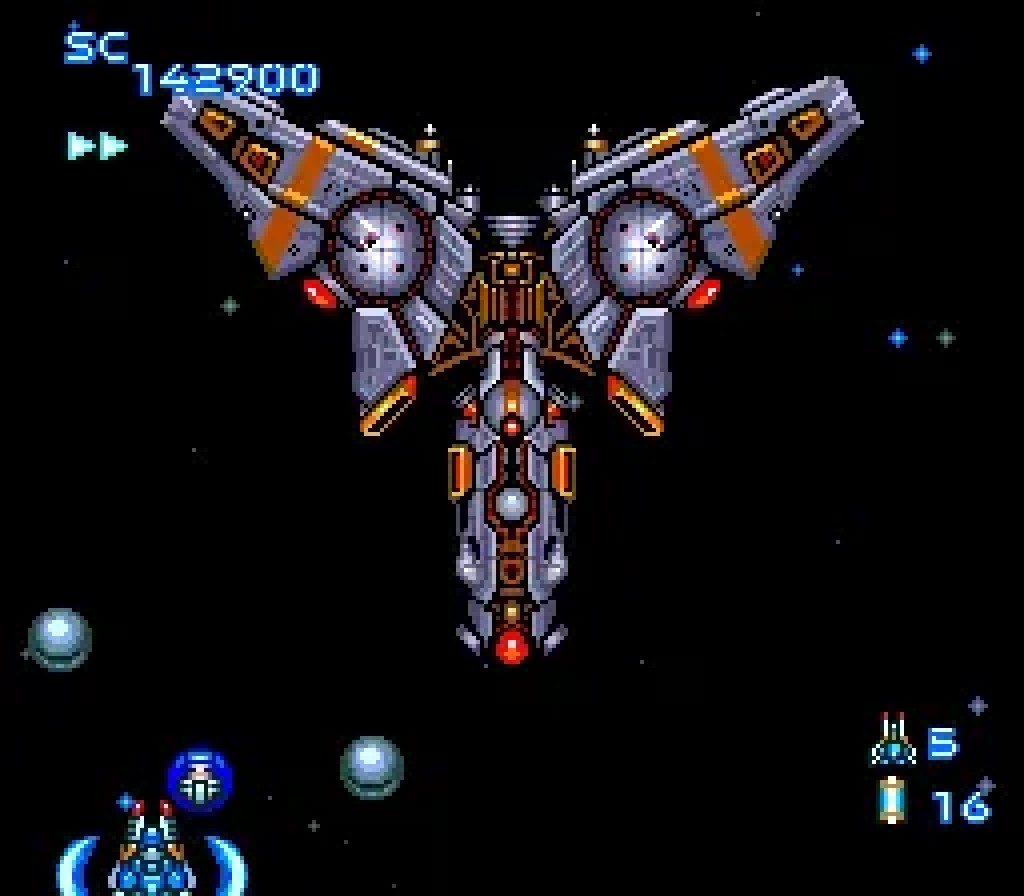
At a glance: Blazing Lazers · TurboGrafx-16 HuCard · Hudson Soft / Compile, 1989 · Vertical scrolling shooter · Score: 9.0/10
Some launch-window games show off a console. Blazing Lazers showed off a philosophy. Released in Japan in 1989 as Gunhed, a tie-in to the Toho film of the same name, and stripped of the licence for its North American release, it paired Hudson Soft with Compile — the studio behind Zanac and the Aleste series — and let them build a vertically scrolling shooter directly for home hardware. No arcade original to compromise for, no quarter-eating difficulty curve to protect. The result was one of the first games released for the TurboGrafx-16 in the West, and more than three decades later it remains the shooter most people should play first on the system.
The premise is pure 1989: a fictional galaxy is under attack by the Dark Squadron, and the Gunhed Advanced Star Fighter — one ship, one pilot, an unreasonable quantity of lasers — must destroy eight Super Weapons across nine areas before taking the fight to the enemy’s heart. You will not remember the plot a week later. You will remember the firepower.
Four weapons, endless escalation
The heart of Blazing Lazers is its weapon system, and it is generous to a degree that still feels transgressive. Four main weapons — a wide photon blaster, piercing wave shots, a multi-directional field thunder and a ring blaster that orbits the ship — can each be powered up through multiple levels by collecting numbered capsules and the purple gel orbs enemies leave behind. Layered on top are four sub-systems: shadow options that mimic your ship, homing missiles, a shield, and a full-fire boost that pushes your main weapon past its normal ceiling. Combinations matter. Some sub-weapons behave differently depending on the main gun they accompany, so experimentation is rewarded rather than merely allowed.
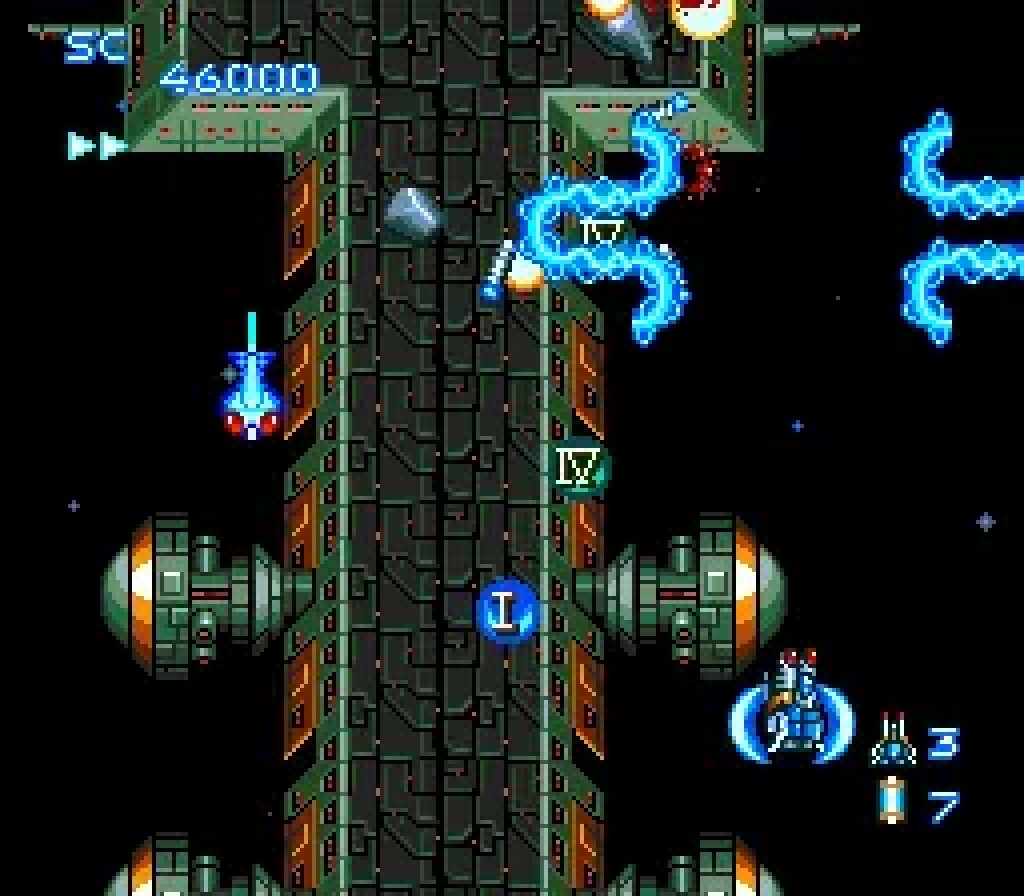
What makes the system sing is Compile’s signature mercy: taking a hit usually downgrades your weapon rather than killing you outright. Death sends you back to a checkpoint, true, and a flashing gold orb can resurrect you on the spot where you fell, but the common punishment is humiliation, not termination. That single decision transforms the game’s emotional arc. Instead of the arcade shooter’s cycle of mastery and sudden exile, Blazing Lazers is a constant, scrambling negotiation — diving through bullet patterns not just to survive but to reclaim the orbs that rebuild your arsenal before the next wave arrives.
Nine areas, no slowdown worth mentioning
The nine areas are a tour of everything the hardware could do in 1989: shipyards and space stations, a stage built from giant brains, deserts patrolled by shooting pyramids and Moai heads — an affectionate Gradius nod from a team that knew its lineage. Backgrounds are detailed without becoming visual noise, which matters, because the screen is frequently full. Compile’s great technical achievement here is pace. Enemies arrive in dense, patterned formations, bosses sprout multiple targeted turrets, and through almost all of it the game simply does not slow down or flicker in the way its 8-bit contemporaries did. Contemporary reviewers noticed: the game was praised on release for exactly this intensity, and later retrospectives have kept it near the top of the system’s library ever since.
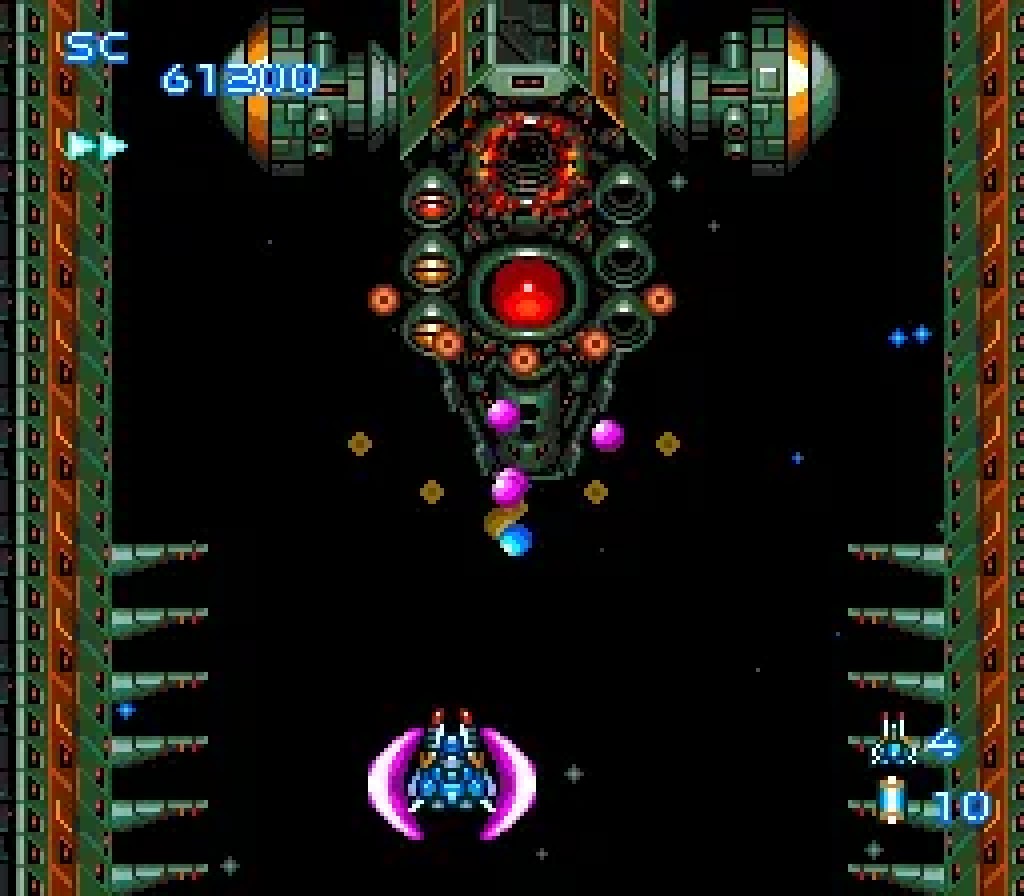
The difficulty curve deserves respect rather than fear. The opening areas teach at a gallop, the middle game tests your orb management, and the final areas — the infamous bubble stage among them — demand that you arrive powered up and stay that way. Ship speed is adjustable in flight across several settings, a small control that becomes essential: slow for the dense weave, fast for the desperate orb grab. Four continues soften the landing, and because the game was designed for a living room rather than a coin slot, finishing it feels like an achievement rather than an accounting exercise.
The sound of a system arriving
Compile and Hudson also understood that a shooter lives in its soundtrack. The music is bright, propulsive chip work that pushes forward at exactly the tempo of the action, and the weapon effects have a chunky, satisfying report that sells the escalation as your gun grows from peashooter to screen-clearing broom. Played through a decent setup today, it is the audio signature of the early TurboGrafx: confident, melodic, unmistakably Hudson.
The areas, taken seriously
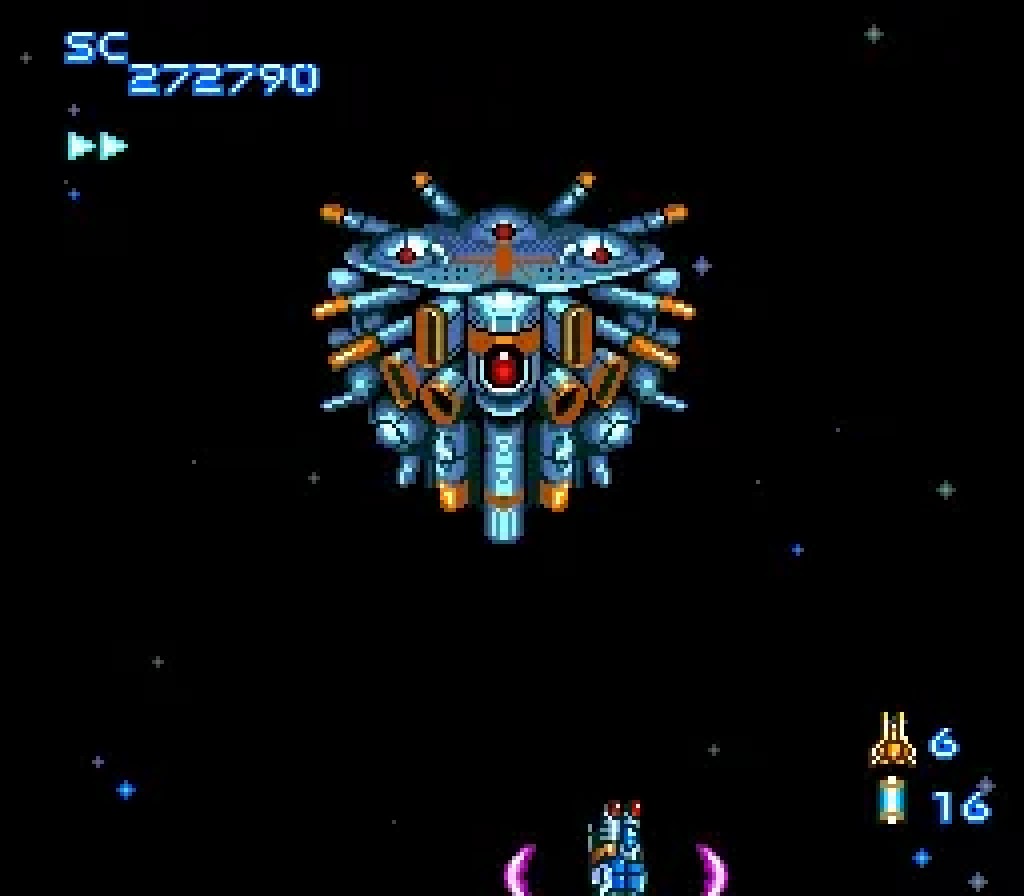
A tour of the nine areas shows how carefully Compile paced the escalation. The opening areas are wide and forgiving, built from shipyard gantries and open space, and they exist to teach the orb economy: kill the carrier, take the capsule, choose your weapon line early because switching late costs levels. The middle game introduces the game’s signature set-pieces — the brain stage, where the background itself is the enemy’s anatomy, and the desert of Area 5, where Moai heads and pyramids borrow Gradius‘s iconography and then outshoot it. The closing stretch is a different discipline: the bubble area, where enemies drift in patterns designed to intersect with your orb-grabs, and a final approach that assumes you have learned the game’s central lesson, which is that firepower is a resource you manage with your positioning, not a state you achieve once and keep.
Boss design follows the same philosophy of readable escalation. The Super Weapons are large, multi-part machines whose turrets can be stripped in an order you choose, and most fights are really examinations in prioritisation: which gun is actually threatening your route, and which is decoration with a health bar? Because your weapon downgrades rather than vanishes when you are hit, boss fights become wars of attrition you can feel yourself winning or losing gradually — a far more dramatic shape than the genre’s usual cliff-edge between fully armed and dead.
Playing it today, and the Compile lineage
Context deepens the appreciation. Compile in 1989 was the shooter specialist’s shooter specialist: Zanac had pioneered adaptive difficulty on the NES, the Aleste games were defining the console shooter on Sega hardware, and Blazing Lazers brought that house style to NEC’s new machine with Hudson’s production muscle behind it. The shared DNA is visible everywhere once you look — the orb carriers, the numbered weapon logic, the ground targets hiding bonuses, the sheer density of things to shoot that are not, strictly, trying to kill you yet. Players arriving from Musha or Robo Aleste will feel at home within a stage; players arriving fresh get the most forgiving on-ramp the studio ever built, because the downgrade-instead-of-death rule survives here in its friendliest form.
On original hardware the game remains a model citizen: no load times, instant restarts, and a continue structure that respects a evening’s play. The difficulty is honest all the way to Area 9, and the score system — built around orb collection and destruction chains rather than survival alone — gives the one-credit player a second game inside the first. It is also worth saying plainly that the audiovisual package, played loud on a CRT, delivers the specific 1989 thrill this site exists to document: a new console, showing off, in the hands of a studio that knew exactly what it was doing.
If you only play one Compile shooter
New players sometimes ask where this sits among Compile’s own catalogue, and the honest answer is: at the door. Zanac is fiercer, the Aleste games are more elaborate, and Musha is more famous in the West. Blazing Lazers is the most welcoming and, stage for stage, arguably the most purely enjoyable — the one where the studio’s generosity and the host hardware’s strengths meet without either showing off at the other’s expense. It is also the TurboGrafx-16’s own origin story as a shooter machine: the first great shot of a library that would spend five years firing them. Play it first, play it loud, and let the orbs fall where they may.
Verdict
Later TurboGrafx shooters would out-spectacle it — bigger bosses, CD soundtracks, caravan scoring scenes — but few would match its balance of generosity and intensity. Blazing Lazers is the rare launch-era shooter that respects a newcomer and still tests a veteran, and its weapon system remains one of the most satisfying on any 16-bit console. If the TurboGrafx-16 has a front door, this is it.
Score: 9.0/10