
At a glance — Game: Bomber Raid · Developer: Sanritsu Denki · Publisher: Sega (Japan/Europe) / Activision (North America) · Original release: February 1989 (Japan) · Original platforms: Master System · Genre: Vertical-scrolling shoot-’em-up
Bomber Raid has a claim to fame that no game would choose for itself: it was the last Master System game released in Japan. Sega’s home market had moved on to the Mega Drive, and in February 1989 (sources differ on the exact day; Sega Does gives 4 February, Giant Bomb 28 February) this modest vertical shooter by Sanritsu Denki closed the book on the console in its own country. The strange part is what happened next. While Japan was done with the Master System, the machine’s best years overseas were still to come, with Sonic the Hedgehog and Castle of Illusion ahead of it in Europe and Brazil. Bomber Raid is a full stop in one country and a footnote in the middle of the story everywhere else.
A 1942-style shooter, competently made
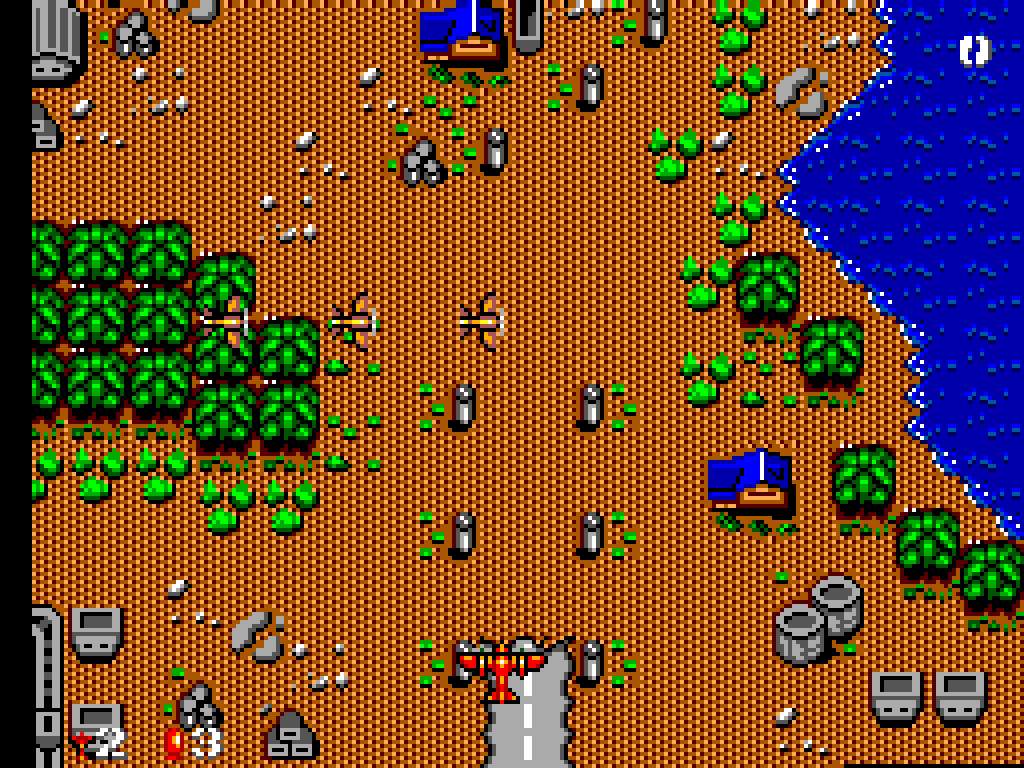
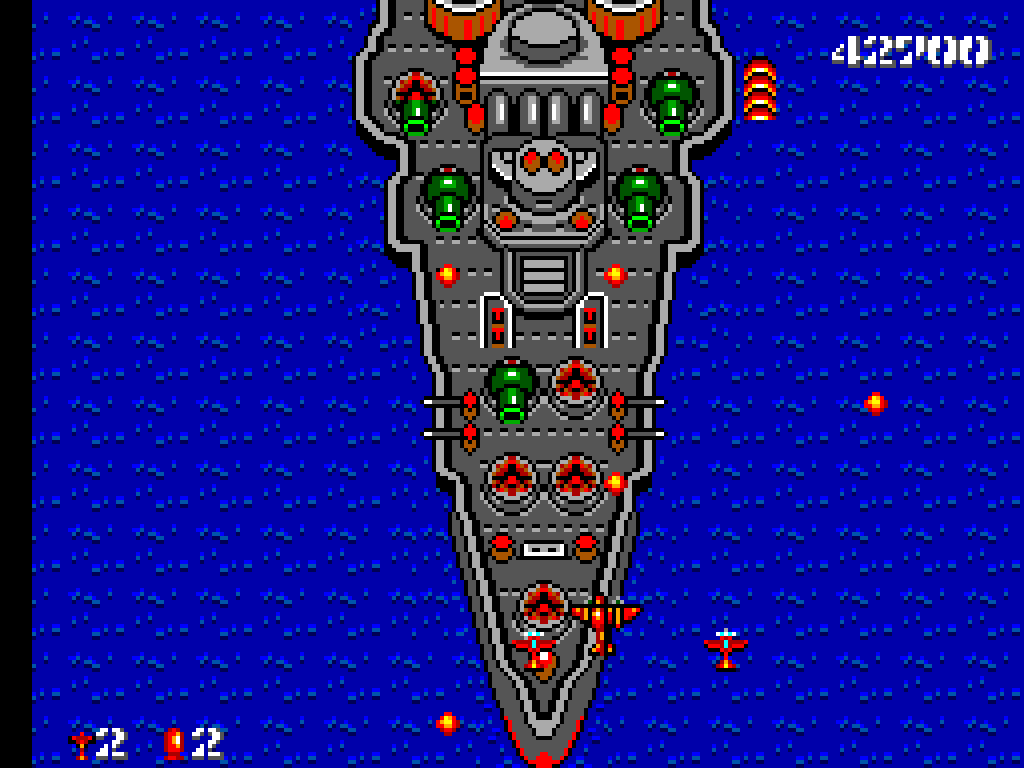
The game itself is a vertical-scrolling shooter in the 1942 mould. You pilot a bomber, modelled on a B-47, over five missions of enemy territory, shooting down aircraft and bombing ground targets: tanks, gun emplacements, trains, bases. Stay alive long enough and your Battle Wing support planes arrive, little escorts that fly in formation with you, add firepower and take the occasional bullet meant for you. Power-ups upgrade your shot, speed is adjustable, and at the end of each mission something big waits, including a battleship that fills a good chunk of the screen.
It is all perfectly competent. The scrolling is smooth, the sprites are clear, and on Japanese hardware the game even uses the FM sound unit for a richer soundtrack than the export version’s PSG bleeps. Sanritsu knew the Master System well by 1989 and it shows in the polish. What it does not show is ambition. Every idea here had been done before, and done with more flair, by shooters years older.
The Battle Wings, and other small mercies
The Battle Wing system is the one mechanic worth describing properly, because it is the game’s only real idea and it is a decent one. Destroy enough ground targets and support planes join you, flying in formation at your wingtips. They add their guns to yours, which turns a pea-shooter into a spread, and they absorb hits that would otherwise end your run. Lose them and you feel it immediately: the screen gets quieter, your firepower thins out, and the remaining enemies take longer to die, which in a vertical shooter means more bullets on screen for longer. Managing your escorts, protecting the formation through the busy sections, gives the five missions a texture that the basic shooting lacks.
The export versions deserve a footnote. Activision handled the North American release and Sega published in Europe, and both versions lost the FM soundtrack that Japanese players heard through the Master System’s FM unit, settling for the thinner standard sound chip tunes. It is a small loss in a game of small things, but it sums Bomber Raid up: even its best feature was region-locked. A prototype of the game also survives and circulates among collectors, which is more afterlife than most fifth-place shooters get.
Average then, average now
There is no shame in a solid B-tier shooter, and Bomber Raid is exactly that. The difficulty is fair, the five missions are varied enough in scenery if not in structure, and the Battle Wing mechanic gives it one idea to call its own. But play it next to the Master System’s better shooters and the gap is obvious. It lacks the speed of one rival, the weapon systems of another, the personality of a third. Contemporary players noticed; the game came and went without making waves anywhere, including in the US, where Activision published it.
Its afterlife is entirely about the trivia. Last of its kind in Japan is a pub-quiz fact that has kept Bomber Raid’s name alive decades after better-remembered games faded, and there is something fitting about that: the Master System’s Japanese story did not end with a masterpiece, it ended with a decent little shooter doing its job while everyone looked at the new 16-bit machine. If you collect for the system, you need it, for the history as much as the game. If you just want a Master System shooter, start elsewhere and arrive here when the shelf is nearly full.
One console, two different endings
The “last game in Japan” label needs one clarification, because the Master System’s story splits in two after 1989. In Japan, Bomber Raid really was the end: no new releases followed, and the machine was done before its second birthday in some counts. In Europe and Brazil, the console was barely getting started. The Master System’s biggest games, its Sonic the Hedgehog conversion, Castle of Illusion, Land of Illusion and a long tail of strong titles, all arrived after Japan had closed the book, and in Brazil the hardware stayed on sale, in evolved forms, for decades. So Bomber Raid is not the Master System’s last game. It is the last page of the Japanese chapter of a book the rest of the world kept writing for years.
That split is also why the game is easy to find and cheap in the West. Activision’s American edition and Sega’s European one sold into markets that still cared, and neither is a rarity. If the trivia appeals, and it should, this is one piece of genuine console history that will not hurt your wallet: the final Japanese release for a Sega system, playable, complete in box, for less than most modern DLC. The game inside is ordinary. The cartridge’s place in the timeline is not.
Set it against its moment one final time and the game makes sense. By February 1989 Sanritsu was building for a Japanese market that had already left: the Mega Drive was four months old, the PC Engine was booming, and a Master System shooter was a product without a country. The wonder is not that Bomber Raid is ordinary. The wonder is that it is finished, polished and quietly professional, a game made properly for an audience that had mostly gone home. Plenty of last games for plenty of systems are shovelware. This one showed up and did its job, and then the lights went out on the Master System in Japan.
Review score: 5.0 / 10 — A competent, unremarkable 1942-style shooter whose real significance is historical: the last Master System game Japan ever got. Collectors need it; shooter fans can queue it behind better games.
— June