
At a glance: Bomberman ’93 · TurboGrafx-16 HuCard · Hudson Soft, 1992 (Japan) / 1993 (North America) · Action / party · Score: 9.0/10
There are multiplayer games, and there is Bomberman — the series that turned bomb placement into a social science. Bomberman ’93, released in Japan in December 1992 and North America in 1993, is widely considered the point where the formula crystallised on consoles: a full single-player adventure, the kick and throw mechanics that deepened the series’ strategy, and a battle mode for up to five players via the TurboTap that remains, controller for controller, one of the finest party games ever shipped on a cartridge-sized card.
The single-player mode first, because it is better than its reputation as the battle mode’s appendix. Bomberman chases the villain Bomber Cop — Bagura in the Japanese telling — across seven themed worlds of grid-based stages, rescuing the captured Mother Computers’ chips world by world. The classic loop is intact: trap enemies in cross-shaped blasts, excavate power-ups from soft blocks — extra bombs, bigger flames, speed, remote detonation — and find the exit before the clock shames you. New stage furniture keeps it fresh: teleporters, conveyor belts and ice rearrange the geometry of every trap, and the boss encounters close each world with genuine spectacle for the format.
The kick that changed everything
Two additions define ’93 mechanically. The bomb kick lets you punt a placed bomb sliding down a corridor until it meets a wall, an enemy or another bomb — converting defence into offence and making every corridor a negotiation. Line bombs and the power glove’s throw, in the wider ’93-era moveset, give experts a language of setups that beginners can read at a glance and spend months mastering. This is the design sweet spot the series has chased since: a game a first-time player understands in thirty seconds and a veteran is still learning after a year of Fridays.

Then, the battle mode. Up to five players — the TurboTap turning the TurboGrafx’s single port into a couchful — in arenas with their own gimmicks, revenge options that let the eliminated haunt the edges, and the kind of emergent treachery no designer can script: the temporary alliance, the corridor ambush, the suicide pact honoured in the breach. On systems where multiplayer meant two controllers, five-player Bomberman was a genuine competitive advantage for the TurboGrafx-16, and the mode’s balance here — item frequency, arena size, blast behaviour — is the template the Saturn’s ten-player legend would later scale up.
Presentation: bright, fast, exact
Hudson’s house style is all over it: saturated colour, chunky readable sprites, animation with squash and charm, and a soundtrack that bounces without ever distracting from the audio cues that competitive play depends on — the fuse hiss, the kick’s slide, the particular silence before a chain reaction. Controls are beyond reproach, which in a game of grid movement and fatal timing is the whole ballgame. Slowdown is a stranger even at five-player maximum chaos.
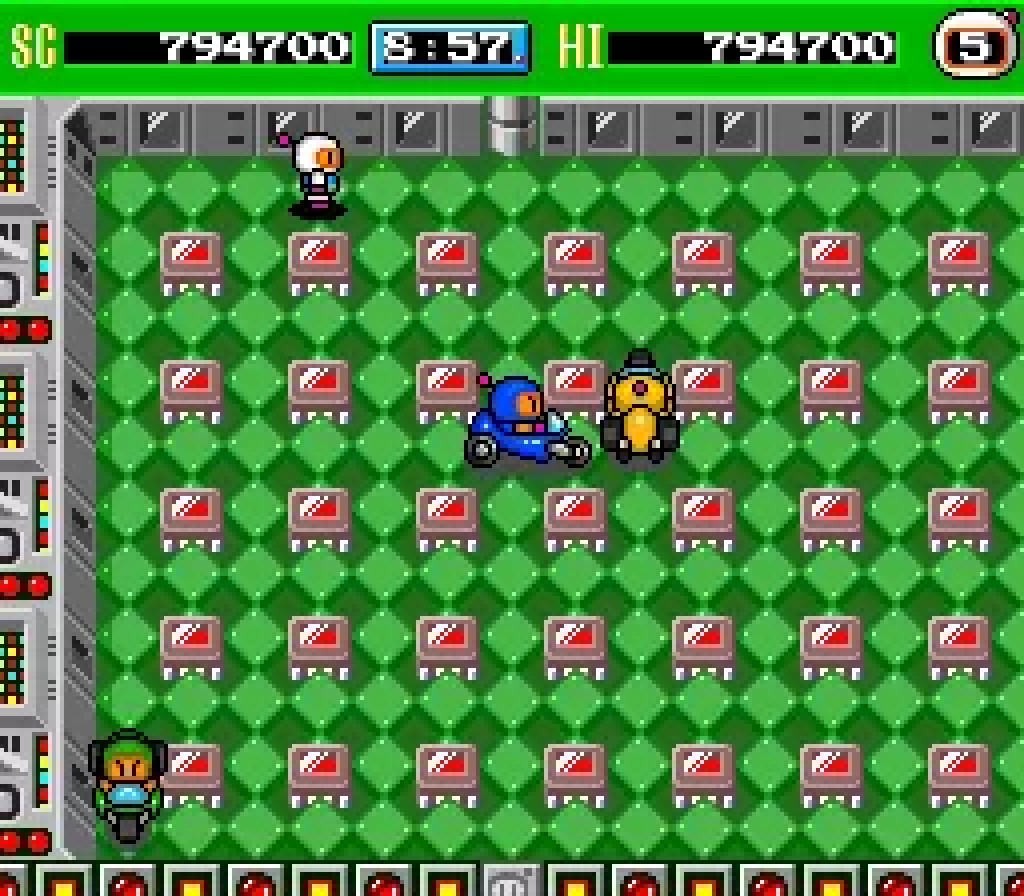
The honest caveats are small. Single-player, played alone and soberly, is a very good version of a loop you may already know well; its worlds are pleasant rather than revelatory, and the difficulty is gentle until the late stages. The battle mode needs the hardware — a TurboTap and a pile of TurboPads — to reach its full five-player glory, and with two players it is excellent rather than transcendent. Neither point survives contact with an actual couch of friends.
Why ’93 specifically
The series sprawls across dozens of releases, and connoisseurs argue for the Super Nintendo’s entries and the Saturn’s monument. The case for ’93 is purity and context: the mechanics complete, the presentation at HuCard peak, the multiplayer a system-selling event, and none of the bloat later entries would experiment with. It is also, not incidentally, one of the last great North American TurboGrafx-16 releases, arriving as the system faded — a party at the end of the world, and a great one.

The single-player worlds, properly toured
The adventure deserves its own map. Seven worlds, each a small thesis on the grid: the quarry mines of the opening world teach excavation and the exit’s discipline; later worlds layer in the teleporters that turn placement into geometry, conveyor floors that move your bombs — and you — mid-plan, and ice that makes every corridor a commitment. Enemy design escalates from wandering fodder to hunters that read your routes, and the power-up economy is tuned with a miser’s care: flame length and bomb count arrive just slowly enough that each one feels earned, and losing them to a careless death genuinely stings, which is exactly the feeling the loop needs. The bosses are the format’s best argument on a HuCard — large, patterned, arena-filling encounters that test the moveset whole, including the kick, rather than merely your stock of lives.
Bagura’s — Bomber Cop’s — scheme gives the tour a shape, and the between-world presentation, all planet-hopping charm, keeps a single player’s evening feeling like a campaign rather than a practice mode. It will not detain an expert for long, and it is not meant to; it is the finest tutorial ever built for the game it shares a card with, because everything it teaches is a battle-mode skill wearing a story costume.
Battle mode, as a social technology
Which returns us, as everything in this series does, to the arena. Five players changes what Bomberman is: with two, it is a duel; with three, a negotiation; with five, it is a society, complete with alliances, vendettas carried across rounds, and the particular silence of four people watching the fifth realise the corridor has no exit. The arenas’ gimmicks — warps, conveyors, differing block densities — are seasoning on a structure whose real content is the other players, and ’93‘s tuning of that structure (item rates, blast behaviour, round length) is the one the series’ competitive memory treats as canonical. The revenge mechanic, letting the eliminated pester the living from the arena’s edge, is the era’s most civilised answer to the party game’s oldest problem, which is what the first person out does for the next four minutes. They stay in. They plot. They matter.
Hardware honesty: you need the TurboTap and enough TurboPads to reach the full five, and sourcing them is part of the hobby in 2026. With two pads the game is excellent; with five it is an heirloom. Either way, this HuCard is the TurboGrafx-16’s most reliable joy per gram, and the battle mode’s design DNA — readable instantly, deep indefinitely, cruel only in the ways friends forgive — has never been improved upon, only re-released.
The case for the card, in one paragraph for the undecided
If a collection can hold only one multiplayer game — one card to be produced when friends are on the sofa and the evening needs saving — the TurboGrafx-16’s answer has been the same since 1993. Bomberman ’93 asks nothing of a new player but thirty seconds of explanation, gives back an evening of escalating treachery, and scales from two players to five without changing its nature. Games this socially reliable are rare in any generation; on a HuCard, in a system whose multiplayer needed an accessory to exist at all, it is close to miraculous. Buy the TurboTap. Invite the four least trustworthy people you know.
Verdict
An essential multiplayer game on any system and the TurboGrafx-16’s defining party title: Bomberman ’93 is the formula perfected, five controllers deep. Bring friends. Trust none of them.
Score: 9.0/10