At a glance: Burnout 3: Takedown · Xbox · Criterion Games / Electronic Arts, 2004 · Arcade racing game · Score: 9.5/10
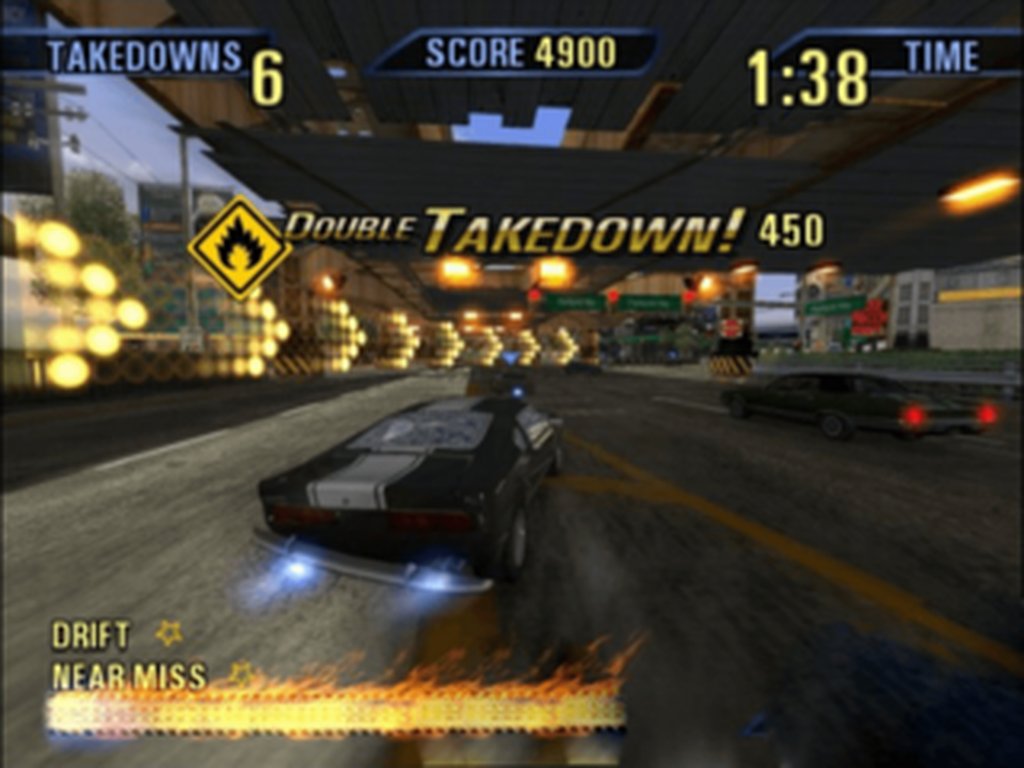
Burnout 3: Takedown is the arcade racer perfected: a game that looked at the polite conventions of driving games — stay on the road, avoid traffic, whatever you do don’t hit anyone — and replaced them with a single ecstatic commandment: violence is speed. Criterion’s third Burnout rebuilt the series around the Takedown, the act of shunting a rival into a wall, a truck or oncoming traffic in glorious slow motion, and made aggression the economy of the whole design: crash rivals to fill your boost, boost to catch more rivals, and thread the whole chain through live traffic at 200 miles per hour. On the Xbox it found its best home of the generation — the sharpest visuals, the smoothest performance and a landmark Xbox Live mode. It remains, two decades on, the most fun you can have with a driving licence you do not possess.
The World Tour structure sprawls across the USA, Europe and the Far East in a web of events — races, eliminators, face-offs against single rivals, road rage events scored purely on Takedowns — that keeps the verbs rotating before any can stale. Crash Mode deserves its own paragraph and its own legend: a hundred junctions, one car, and a physics playground where the goal is to cause the most expensive pile-up in history, with multipliers, crashbreakers that let you steer your wreck after impact, and score targets that turned living rooms into high-score arcades. Crash Mode alone justified the disc’s price in 2004; whole friendships were reorganised around its leaderboards. Aftertouch — nudging your wreck mid-slide into a rival’s path — is the single most imitated mechanic in arcade racing history, and it started here, perfect.
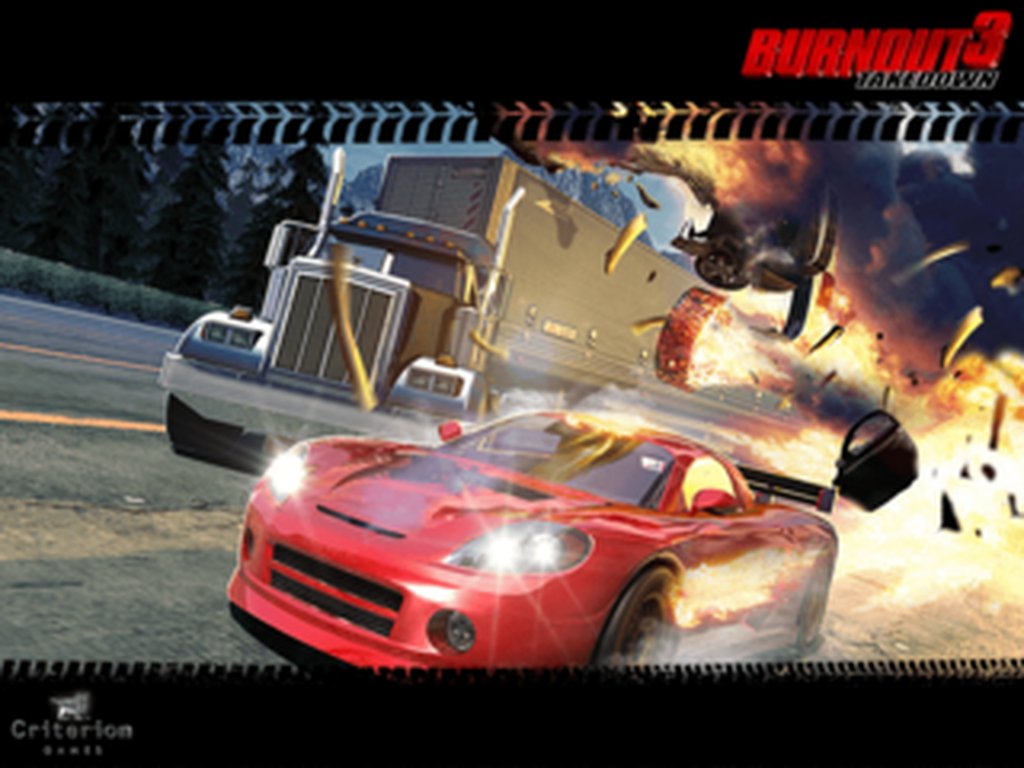
The driving itself is a masterclass in feel. Cars are grippy, drifts are summoned with a dab of brake and held with the throttle, and the boost — earned only through risk, through near-misses, oncoming lanes and Takedowns — creates a risk economy that keeps every second of every race at a decision point. Traffic is not scenery; it is the weapon system. The AI rivals fight back with genuine spite, trading paint and grudges across a championship, and DJ Stryker’s radio patter plus a licensed soundtrack of mid-2000s punk and indie gives the whole thing the tone of a party you are slightly too old for and completely unwilling to leave.
The Xbox version, specifically
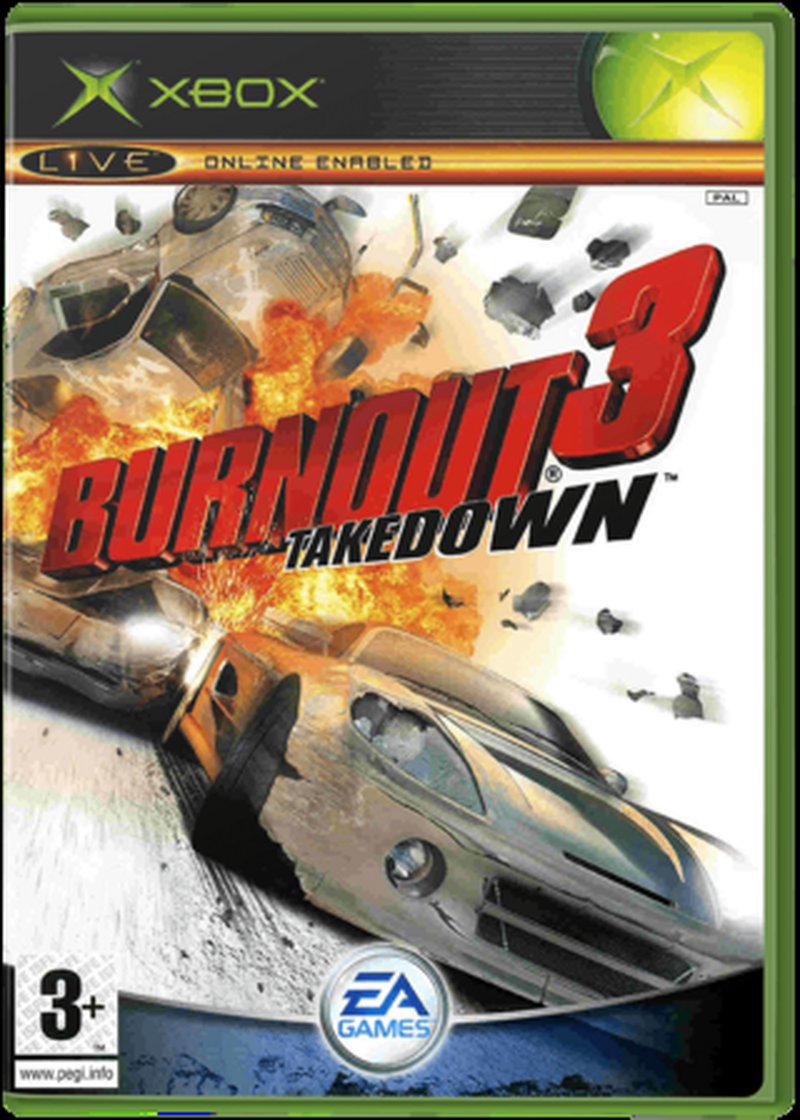
Platform choice matters for Burnout 3, and the Xbox edition wins the generation’s comparison. It runs at the fullest, most consistent speed with the cleanest image — the sense of velocity, which lives or dies on frame stability, is undiluted — and it carries the superior online implementation of its era: eight-player races over Xbox Live with the full Takedown ruleset, voice chat, and optimatch playlists that kept lobbies full for years. The original Live servers are closed, but split-screen remains gloriously intact, system link serves the LAN faithful, and Crash Mode’s score-chasing needs no network at all. The hard drive also powers the era’s beloved custom-soundtrack feature — Burnout 3 with your own ripped CDs at full volume is the period-correct way to play, and the Xbox is the only console of its generation that makes it effortless.
Every racing game asks how fast you dare go. Burnout 3 asks a better question: how much are you willing to break to go faster?
Honest debits, briefly: the World Tour’s back half leans on repeated tracks in reverse and mirror configurations, the rubber-band AI can feel openly theatrical when a rival teleports back into contention, and the crash camera occasionally celebrates a Takedown while your own car meets a truck unobserved. The licensed soundtrack will charm or date-stamp itself depending on your mileage with mid-2000s rock radio. These are the complaints you file about a game you have played for a hundred hours, which is the point: Burnout 3 sustains a hundred hours of arcade racing without ever finding the bottom of its bag of tricks.
Technically the disc is a showpiece: car models that deform, spark showers with real physics, motion blur used with restraint, cities and coast roads that stream past in saturated colour. Criterion’s RenderWare mastery peaked here before the studio went on to redefine open-world racing; you can see the ambition arriving in real time. Even the menus have velocity. Very few games on any system have ever been this single-minded about joy — Burnout 3 knows exactly what it is, the way a great pop song does, and it wastes not one second pretending otherwise.
A note on structure and staying power
What keeps Burnout 3 in consoles decades later is how intelligently its pleasures are rationed. The World Tour’s map unlocks in branches rather than a line, so a wall in one discipline never ends your evening — there is always a Crash junction unexplored, a Road Rage target unmet, a signature Takedown (the game tracks named special moves — into a bus, off a bridge, the famous “gone fishing”) still to hunt. Gold medals feed a completion economy that unlocks ever more absurd vehicles, from the series’ beloved custom coupes to a Formula car and a fire truck that handle like natural disasters. The difficulty curve is generous early and quietly serious late, and the whole tour can be played in split-screen company, which converts its length from a commitment into a standing social arrangement.
It also remains a reference point for feel. Modern arcade racers chase Burnout 3’s specific gravity — the sense that speed is a substance the car is swimming in, that boost bends the world slightly, that a crash is a celebration the game stages for you in slow motion and sparks. Criterion themselves chased it for the rest of the series’ life, and the open-world successors, for all their freedom, never quite recaptured the purity of these closed circuits and their hundred perfect junctions. Takedown is the series at its most distilled: no fat, no apology, no brakes. The Xbox disc is where that purity runs fastest and cleanest. That is the whole recommendation, and it is enough.
Ownership, finally, is easy: the disc is common on both sides of the Atlantic, the Platinum and Classics reissues are content-identical, and the game asks nothing of modern infrastructure to give you everything it has. What it asks is an evening and, ideally, a rival. The rivalry is the point — Burnout 3 was designed as an argument between friends conducted at two hundred miles per hour, and arguments that good do not expire.
Verdict
Burnout 3: Takedown is the greatest arcade racer of its generation and the Xbox edition is the version to own: fastest, sharpest, and built around the most satisfying feedback loop in driving games — crash them, boost, crash more of them. Its influence runs through every arcade racer since, and none has matched its balance of speed, violence and glee. If your original Xbox library has one racing game that is not a simulation, it is this one, and it is not close.