
Here is the first thing to understand about Castle of Illusion on the Master System: it is not the Mega Drive game, squeezed down. When Sega brought Mickey Mouse’s rescue of Minnie to the 8-bit machine, it built a different castle — different levels, different structure, different ideas — and in several respects the smaller game is the more interesting design. The Mega Drive version is a masterpiece of animation and mood. This one is a cleverer platformer than it ever gets credit for, and for Master System owners in 1991 it was the system’s licensed crown jewel.
The premise is straight from the box: the witch Mizrabel, jealous of Minnie, has kidnapped her, and Mickey must fight through the Rooms of Illusion, defeat the protectors of each Master of Illusion, and gather seven magical gems to win Minnie’s freedom. Where the 16-bit game is a linear stroll through storybook set-pieces, the Master System version opens the castle up. Doors lead off a hub, stages can be approached with a degree of choice, and a practice mode — three levels, there to prepare you, as the packaging cheerfully puts it — lets new players learn Mickey’s moves before the real castle starts charging rent for mistakes.

Mickey Gets His Hands Dirty
The defining difference is in Mickey’s hands. The Mega Drive Mickey mostly bounces on enemies, bottom-first. Master System Mickey picks things up — blocks, barrels and other loose scenery — and throws them, which turns combat into a small logistics puzzle: carry a block through a section and you are armed; throw it badly and you are scrambling. He can also grab ropes, climb, and duck through the kind of compact, vertical level design that suits the hardware. It gives the game a tactile, almost puzzle-platformer flavour that sits closer to Sega’s own Alex Kidd lineage than to the 16-bit original, and it works beautifully.
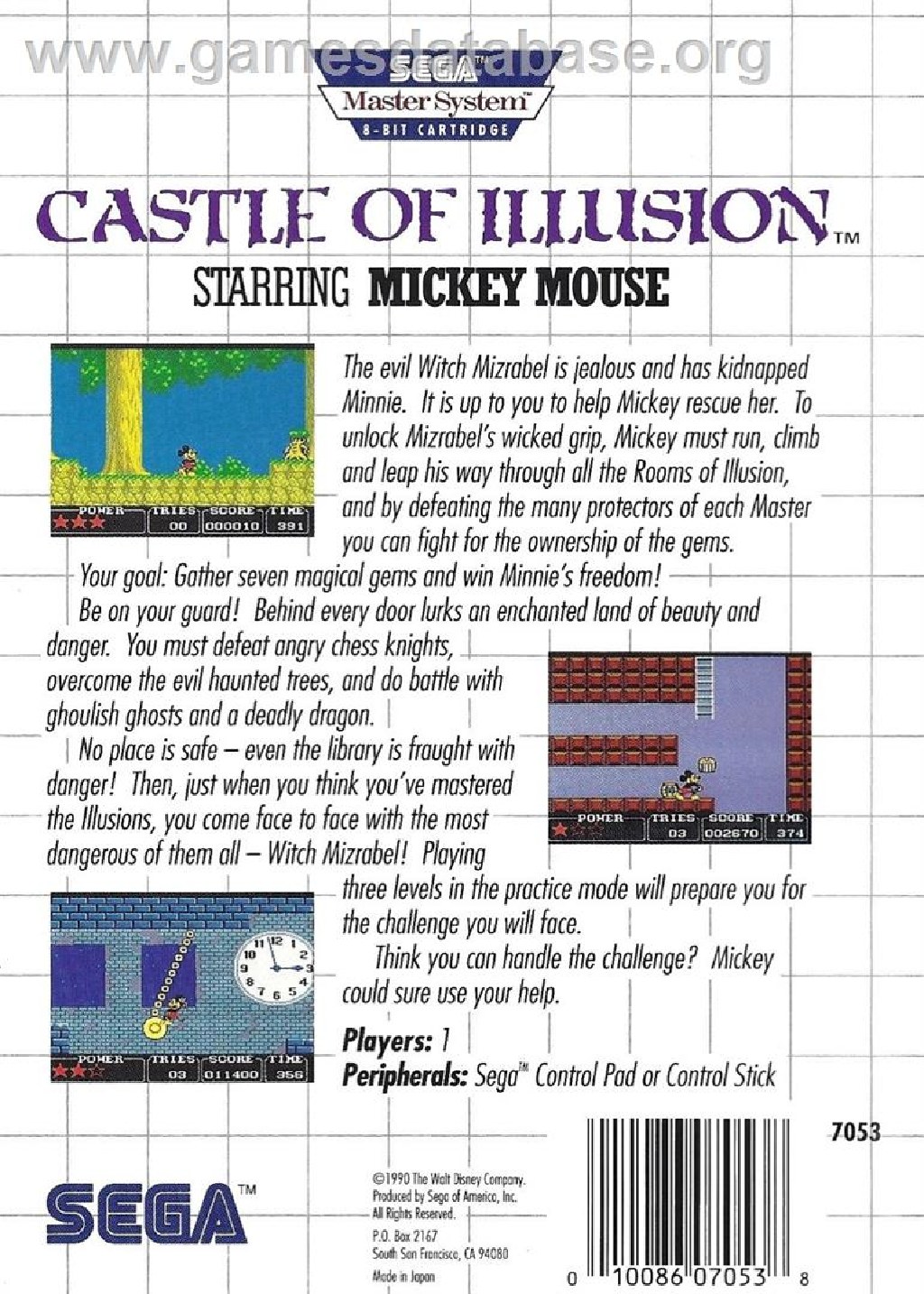
The rooms themselves are a storybook tour with teeth: an enchanted forest of haunted trees, a toy world, a library where the furniture objects to you, a clock tower, and Mizrabel’s castle at the top of it all. The back of the box promised chess knights, ghoulish ghosts and a deadly dragon, and the game delivers all three, each room guarded by a Master of Illusion whose defeat yields one of the gems. Bosses are pattern puzzles in the best Sega tradition — learn the rhythm, use what the room gives you, and do not get greedy.
Eight Bits, Full Charm
What astonishes, revisiting it, is how much of the Mega Drive game’s atmosphere survives the demake. Mickey is small but expressive, the colour work is rich — deep blues and purples in the castle, lush greens in the forest — and the animation sells his worried little run cycle perfectly. The POWER / TRIES / SCORE / TIME display sits in a chunky black bar at the bottom of the screen, a very Master System solution that keeps the playfield clean. Power stars govern Mickey’s health, tries are generous enough to encourage exploration, and the timer keeps a gentle pressure on without ever becoming the point.
The music, inevitably, cannot match the 16-bit arrangements, but the compositions are characterful and the forest theme in particular will move into your head and refuse to pay rent. If there is a criticism, it is the one that applies to so many 8-bit platformers of class: the difficulty arrives in steps rather than a slope, with later rooms — the castle especially — demanding a precision the early game only hints at, and a couple of jumps that rely on knowledge you can only earn by failing them once.

The Other Castle Deserves Its Own Plaque
Castle of Illusion’s 8-bit version spent decades in its sibling’s shadow, partly because the Mega Drive game is so beloved and partly because a near-identical Game Gear version muddied the waters further. That is a shame, because as a piece of design this is no port and no afterthought: it is Sega’s platform team taking a license seriously enough to rethink it, on hardware that rewarded thought over spectacle. Played today, it holds up as one of the finest licensed platformers on any 8-bit system — approachable in its practice mode, deep in its throwing mechanics, and charming in every frame.
Two Castles, One Lesson
Set the two 1990s Castles of Illusion side by side and you get a masterclass in what each Sega machine was for. The Mega Drive game is cinema: vast parallax forests, a Mickey animated like a short film, set-pieces you glide through. The Master System game is a toybox: smaller rooms, denser ideas, a hero defined by what he can carry. Its levels ask more of the player minute-to-minute — which object to bring, which door to try next, when a carried block is a weapon and when it is a step to somewhere higher — and its hub structure, letting you feel your way around Mizrabel’s castle rather than being marched through it, anticipates the exploratory shape platformers would spend the decade growing into.
None of this is to demote the 16-bit game, which remains one of the Mega Drive’s defining titles. It is to point out that “the 8-bit version” was, in Sega’s hands, a parallel development rather than a compromise — the same production culture that produced a distinct, excellent 8-bit Sonic the Hedgehog rather than a broken photocopy of the Mega Drive one. Master System owners of the era knew this instinctively. The cartridges were not the cheap seats; they were a different theatre putting on a different, sometimes equally daring show.
Time has been kind to the toybox. Where many licensed games of the period survive as nostalgia screenshots, Castle of Illusion on Master System survives as a game people still finish, still recommend, and still cite when the subject of great 8-bit platformers comes up — usually in the same breath as the system’s own first-party best. Its difficulty is honest, its length is right, and its central mechanic, that humble act of picking something up and throwing it at a problem, never stops being satisfying. Mizrabel’s castle has two addresses. Make sure you visit this one.
Sound design, briefly, because it sells the illusion as much as the pictures do. Mickey’s footsteps, the springy bounce of a well-timed bottom-bounce on a toy soldier, the chunky clunk of a carried block finding its target — the Master System’s little PSG chip is worked hard here, and the effects give the platforming a physicality that screenshots cannot convey. Throw in a generous sprinkling of hidden stars and secret nooks for players who treat every wall as a question, and you have a game that rewards its audience in the small moments as reliably as in the big ones.
Availability, one last practical note: the Master System cartridge is the same game in every western territory, so there is no wrong door into this castle — only the right console, a quiet evening, and a witch to disappoint.
Verdict
A different game from the famous one, and very nearly as good on its own terms. Castle of Illusion on Master System is colourful, clever and built with real respect for both Mickey and the machine — the rare demake that deserves to be judged as an original.
Score: 8.5 / 10