
At a glance: Chaos Control · Philips CD-i · Infogrames Multimedia / Philips Interactive Media, 1995 · Rail shooter · Score: 6.5/10
Chaos Control is the CD-i’s Starblade moment: a pre-rendered rail shooter of genuine spectacle, built by Infogrames Multimedia in 1995, in which you do not fly the ship — the film flies, and you shoot. It is 2071. The Kesh Rhan, the alien race that destroyed the colonies on Mars and Pluto, has come for Earth, and Lieutenant Jessica Darkhill of the Orbital Defence Forces — flying to avenge her fiancé Morgan, killed in an earlier battle — is the thin line in their way. Across four missions she blasts through a besieged Manhattan, dives into a virtual-reality world to kill an alien computer virus, and takes a prototype fighter out to the Kesh Rhan mothership. The anime-styled cutscenes, the Silicon Graphics-modelled environments and the sheer full-screen confidence of it made Chaos Control the CD-i’s showcase shooter: GamePro named it the platform’s best game of 1995. It requires the Digital Video Cartridge, and it is very nearly the cartridge’s best justification.
The genre bargain needs stating plainly, because everything in this review follows from it. A rail shooter sells freedom and delivers choreography: your ship follows a fixed, pre-rendered path through environments that are, literally, a film unspooling from the disc, and your entire agency is a gunsight — move the cursor, shoot the targets before they drain your shields. Enemies appear in the same places at the same times on every run; there are no power-ups and no shield recharges; die and the mission restarts. Chaos Control is unusually honest about the bargain. Its films are good enough — Manhattan in flames, the dive through the fleet, the mothership run — that the choreography feels like cinema you are defending rather than a corridor you are trapped in, at least the first few times through.
The cursor is the game
Which makes the quality of the cursor the whole ballgame, and here the CD-i tax falls due as it always does. Chaos Control offers two cursor speeds, and contemporary critics identified the problem instantly: one is too slow, the other too fast. On the platform’s pointer controllers the gunsight can feel like it is being towed rather than aimed, and in the denser waves — Kesh Rhan fighters crossing at angles, mechs on the Manhattan streets, the VR segment’s abstract swarms — shield damage arrives through imprecision as often as through slowness. The Saturn and PlayStation conversions, and the Saturn’s later Remix with light-gun support, would show what the game feels like with a proper aiming device. On CD-i you are always aware of the instrument between you and the film.

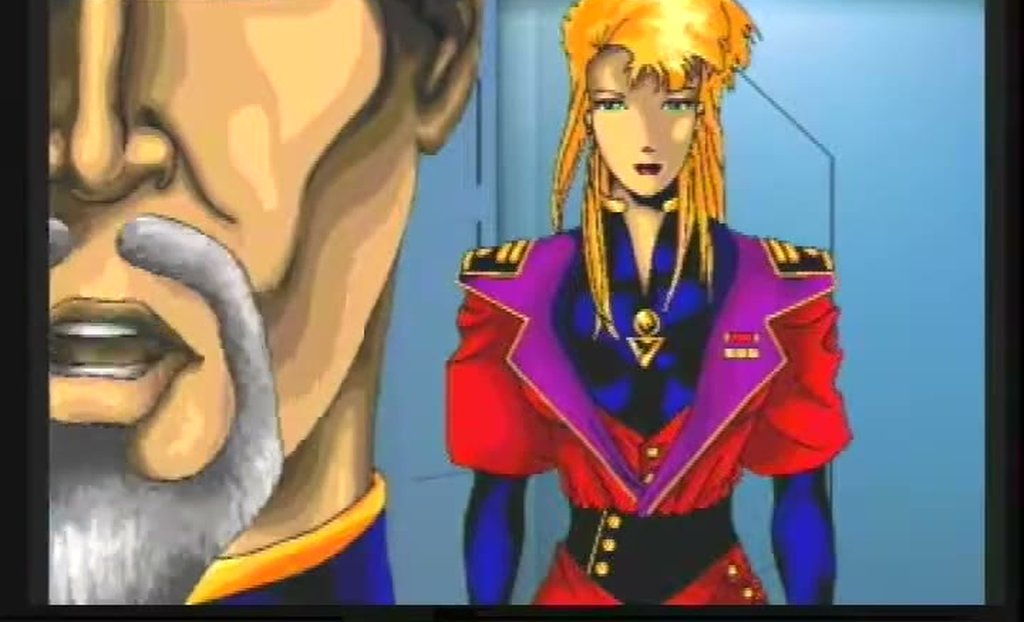
Set against that, the presentation remains the disc’s triumph. Thierry Caron’s score drives the missions hard, the pre-rendered environments were modelled in Softimage on Silicon Graphics workstations and still read as expensive, and the anime cutscenes — Jessica’s story told in bold, cel-styled sequences — give the shooting a narrative spine that most rail shooters never bother with. Jessica herself matters to the game’s identity: a woman lead in a 1995 shooter, played straight as an ace with a grief to settle, was rare enough for Power Unlimited to single it out in its 85% review. The CD-i version, DVC-decoded, runs the film full-screen and full-colour, which is precisely what the cartridge was sold to do.
Four missions, no surprises
The structural deduction is replay value. Four missions, identically choreographed forever, is an evening’s entertainment and a memorisation exercise thereafter; the genre’s best examples pad the film with scoring depth and branching, and Chaos Control largely declines to. Once the patterns are learned, the challenge collapses into execution, and execution is the part the cursor makes least reliable — the worst possible combination. The difficulty, meanwhile, is front-loaded: shield management with no recovery means early mistakes echo to the end of a mission, and the restart-at-mission-start rule turns the final stretch of each film into the only stretch that matters. It is a game you master and then own, rather than a game that keeps offering you new problems.
Chaos Control is the DVC’s demo reel and its best shooter in one disc: a beautiful film that lets you hold a gun inside it. The film holds up. The holding is where the CD-i takes its cut.
Its legacy has a pleasing coda: the sequel, Solar Crusade, was built for Windows in 1996 and its CD-i version shelved — finally released in 1999 as the last official game the platform ever received, which makes Chaos Control the first chapter of the CD-i’s longest story. The conversions to Saturn and PlayStation spread the game wider, but the CD-i original is where its identity lives: Infogrames and Philips building the flagship for their own movie cartridge, anime heroine and all.
The conversions tell the story
Chaos Control’s afterlife is a small history of the rail shooter’s redemption. The Saturn and PlayStation versions spread the game to audiences who had never seen a CD-i; the Japanese Saturn received it twice, the second time as Chaos Control Remix — with two-player support and, crucially, light-gun compatibility — because Virgin, its Japanese publisher, understood what the original’s cursor had been apologising for. The European Saturn release quietly inherited the improvements. None of this diminishes the CD-i original, which remains the version the game was designed around and the one with the full Philips presentation; but the conversions are an admission, in product form, of this review’s central criticism. Given a gun, Chaos Control is a better game. The CD-i gave it a cursor and asked the film to compensate, and the film — to its credit — very nearly does.
As a collector’s piece, the CD-i disc has one more virtue: it is the version that demonstrates the hardware. If you own a DVC, this is the disc you reach for when someone asks why the cartridge exists — four missions of full-screen, full-colour, pre-rendered flight that the base machine could not have attempted. A format is remembered by its demonstrations, and this was one of the two or three best the CD-i ever had.
What tips the score upward, finally, is intent. Chaos Control was not a conversion farmed out to fill a catalogue; it was Infogrames and Philips building the flagship for their own cartridge, with a named heroine, a composed score, modelled environments and anime direction, at a moment when the format’s software was mostly being apologised for. Ambition is not a substitute for depth, and this review has not scored it as one. But on a platform where so little software aimed at anything, a game that aimed at the cinema and hit it has to be marked as the achievement it is — even when the hitting is, in the end, mostly a matter of watching.
Verdict
Chaos Control earns 6.5/10: elite presentation for the platform, a charismatic lead, four well-built missions — and a control scheme caught between two wrong speeds, zero replay architecture, and a DVC requirement that shrinks its audience to the committed. As a reason to fit the cartridge, it makes its case. As a shooter you’d return to for years, the film runs out. Beautiful, brief, and exactly as deep as its disc: one layer.
