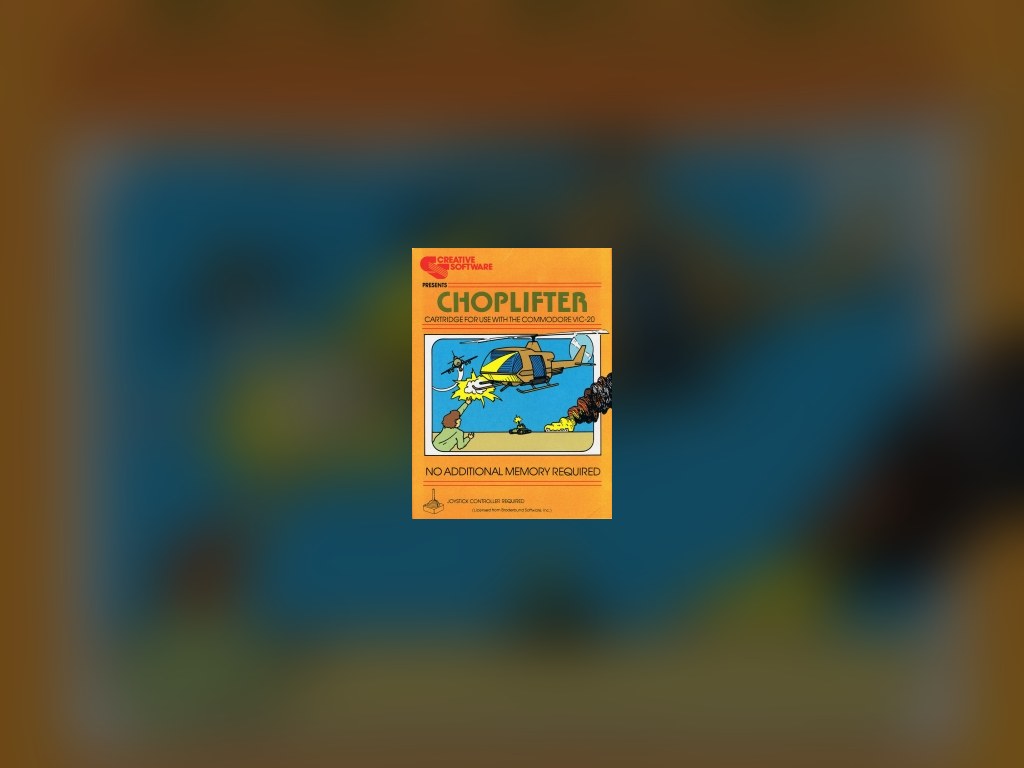
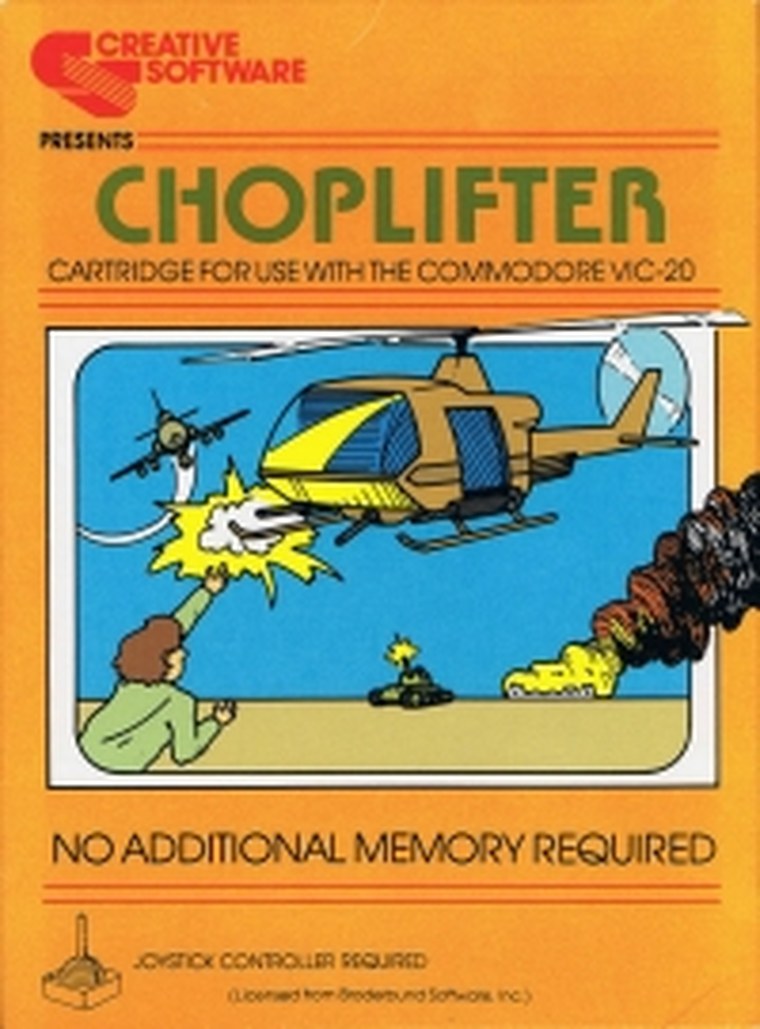
At a glance: Choplifter · VIC-20 · Creative Software, 1982 · Rescue shooter · Score: 8.0/10
This review judges the VIC-20 Choplifter on its own terms, because that is where it deserves to be judged. Dan Gorlin’s Apple II original — a helicopter rescue game in which you ferry hostages from enemy compounds while tanks, jets and drilling rigs try to kill you and them — was a phenomenon of 1982, and every home computer wanted it. Creative Software’s VIC-20 version is the one conversion that had to survive on a machine with a fraction of the Apple II’s resolution and memory. It does more than survive. The side-on world is chunkier, the detail coarser, the playfield tighter — and yet the essential Choplifter is all here: the swooping take-offs, the desperate landings under fire, the hostages sprinting for your skids waving their arms, and the awful, unique guilt of a rescue that goes wrong under your own rotor blades.
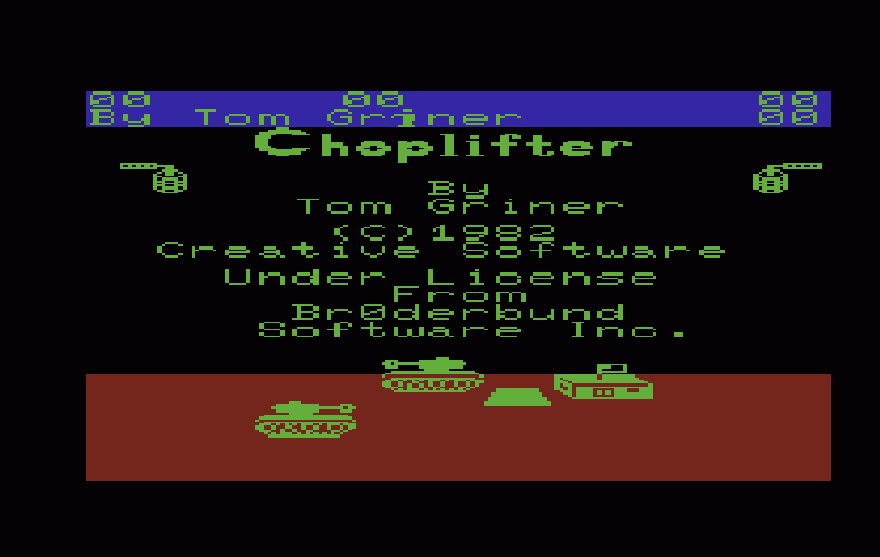
Rescue under fire
The mission structure is untouched. From your base at the right of the scrolling battlefield, you fly left into enemy territory, blast open the hostage compounds, land, and load as many escapees as the cabin holds before running the gauntlet home. Tanks patrol the ground and track you with real malice; jets scream across the sky; the drilling rigs — anti-aircraft platforms in the original’s surreal arsenal — punish low flying. The VIC version keeps the helicopter’s three-facing control scheme, rotating between forward, side-on and reverse with button presses, and that scheme remains the game’s soul: landing side-on to load hostages while a tank bears down is a decision measured in heartbeats. The smaller screen means threats arrive sooner and landings feel tighter, which raises the tension whether or not the programmers intended it.
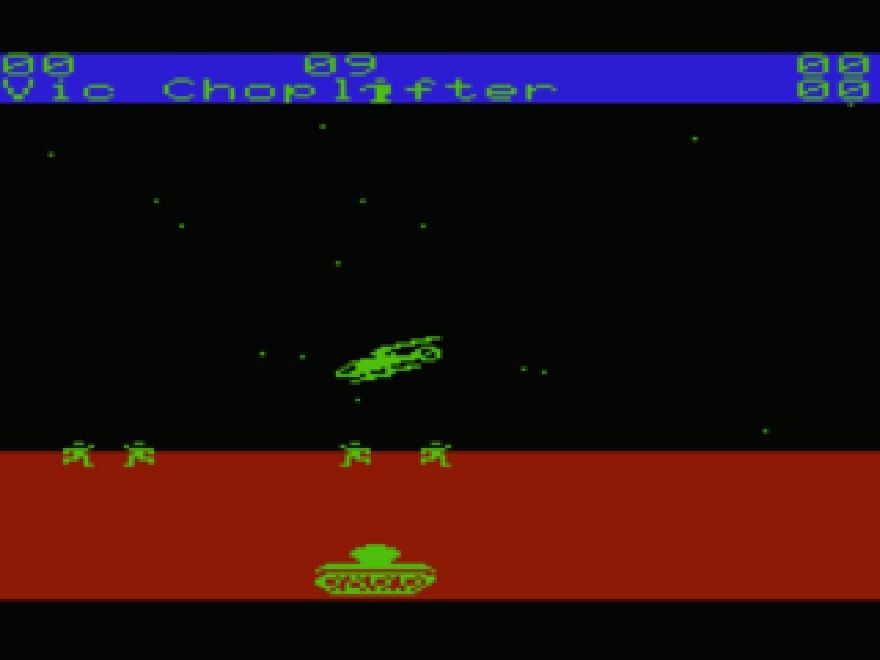
Technically, this is about as well as a 1982 VIC-20 could do this concept. The helicopter animates with genuine character — rotor, tilt and descent all read clearly — the ground scrolls smoothly, and the hostages, tiny as they are, emote: they run, they wave, they scatter. Sound leans on the VIC’s noise voice for rotor and gunfire effects that are crude but effective. What is lost from the Apple original is finesse of detail and the width of the vista; what is kept is the complete emotional arc of a sortie, from swaggering departure to the landing count that tells you how many made it home. Very few VIC conversions of big-name games can say that.
Why the VIC version matters
It is fashionable to rank Choplifter ports by fidelity and put the VIC near the bottom. That ranking misses the point of the machine. The VIC-20 was the $299 computer, the one in ordinary homes, and its Choplifter meant the year’s defining game was playable by the year’s widest audience — in a version that, while visibly humble, plays the same moral arithmetic: how many can I carry, how long dare I stay, was that one extra hostage worth the tank shell? The cartridge format also suits it. Choplifter sessions are self-contained dramas of ten minutes, and instant loading makes the ‘one more rescue’ loop effortless.
New players should know the VIC version is demanding: the tighter screen and chunky sprites leave less margin than the Apple or C64 editions, and jets in particular arrive like jump scares. Persist, and you will find a port with real heart — the little computer’s version of a big game, made by people who clearly loved the original. In a library full of arcade clones, Choplifter on the VIC-20 stands out as something rarer: a conversion with a conscience, where the cargo matters more than the score.
The port that punched up
A little context sharpens the achievement. When Creative Software took on Choplifter, they were converting the defining game of a more powerful machine — a title whose fame rested partly on its animation and scale — onto hardware with a coarser display, a squarer screen and a fraction of the memory, for an audience paying console money. The easy outcomes were ridicule or a hollowed-out imitation. The VIC version avoids both by knowing what Choplifter is actually about: not the sprite count but the sortie — the outbound swagger, the compound breached, the loading under fire, the homeward count. Everything on the VIC cartridge serves the sortie. That editorial intelligence is why the port has defenders decades later while technically smoother conversions of other games are forgotten: it kept the meaning and sacrificed the decoration, which is the correct order of priorities and a rarer discipline than it sounds.
It also gave the VIC-20 something its library needed — a big, emotional, contemporary hit that treated its players as heroes rather than marksmen. Most VIC games are about shooting things. Choplifter is about saving people, under time pressure, with your own clumsiness as a live threat, and the VIC’s family audience felt that difference in 1982 exactly as players feel it now. The little chopper’s rotors have never really stopped since.
In the slot today
A word about difficulty settings, or rather their absence: the VIC Choplifter offers the mission as it comes, and its challenge curve is carried entirely by the enemy’s growing attention — more tanks awake, jets arriving with less courtesy, the compounds deeper in hostile country. That purity will frustrate players raised on options menus for exactly one evening. By the second, most report the intended effect: the mission is the mission, its terms are not negotiable, and mastery is measured against a fixed standard shared with every other pilot who ever flew the cartridge. There is a dignity in that standard which the modern smorgasbord of assists has quietly retired, and the VIC’s little helicopter still upholds it.
It helps that failure in Choplifter is so rarely cheap. The game shows you the tank, gives you the altitude, counts your passengers aloud at the landing pad. When a sortie ends in fire, the debrief is written in your own decisions. Games that respect the player enough to let them fail legibly are the ones still being flown four decades later. This is one.
The cargo matters more than the score — the VIC Choplifter keeps the complete emotional arc of a sortie.
Judged as the VIC-20 version specifically, Choplifter is a triumph of priorities: everything that makes the game matter — the landings, the rescues, the guilt — survives the journey to 5K. It is tougher and chunkier than its siblings, and all the more lovable for it. A must-own Creative Software cartridge.
Verdict: fewer pixels, same heart. Fly left, land gently, bring them home.
So judge the VIC Choplifter as its players did: not against the Apple II they did not own, but against the other cartridges in the VIC slot — and by that measure it is one of the machine’s essential third-party releases. Spool up, fly left, and land like the hostages matter. They do.