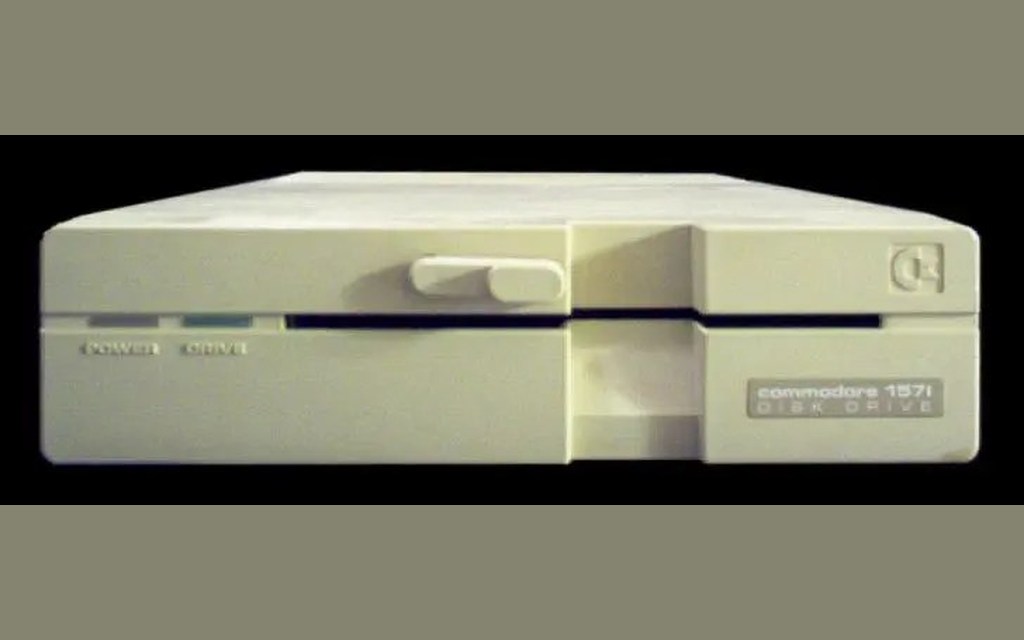
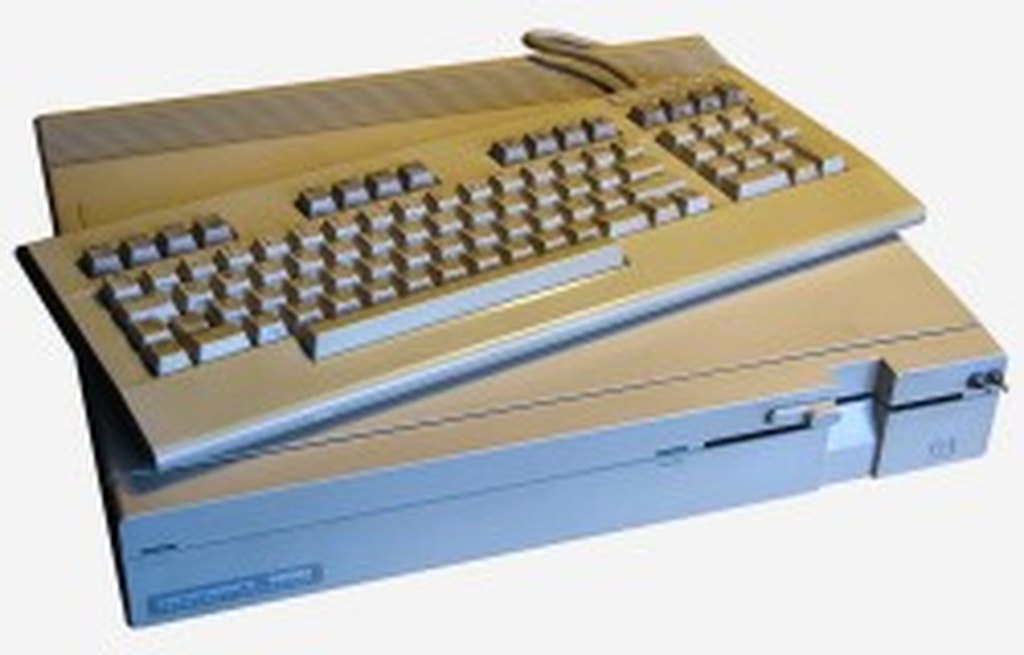
Commodore disk drives were never just disk drives. In an era when rival systems treated the floppy unit as a dumb peripheral, Commodore’s drives were computers in their own right — each with its own processor, RAM, ROM and operating system, chatting with the host over a serial cable. The 1571, launched alongside the C128 in 1985 at $299, is the summit of that philosophy: a double-sided, double-density drive with a proper MFM controller chip, able to read the disk formats of the CP/M and early MS-DOS worlds, communicate at burst speed with the C128, and hold some 340 kilobytes on a single 5.25-inch floppy at a time when the standard Commodore drive managed half that on one side. It remains, four decades on, the smartest drive Commodore ever sold.
The capacity jump alone justified the nameplate. The 1541’s single head meant a disk’s second side was usable only by flipping it over — the notorious “flippy” ritual, complete with notches cut by hand. The 1571 carries two heads and uses both sides in place: 1,328 blocks free, 144 directory entries, roughly double the working storage with no gymnastics. For a C128 running CP/M or GEOS or a database, that difference was the difference between a toy and a tool.
Burst mode: the serial bus grows up
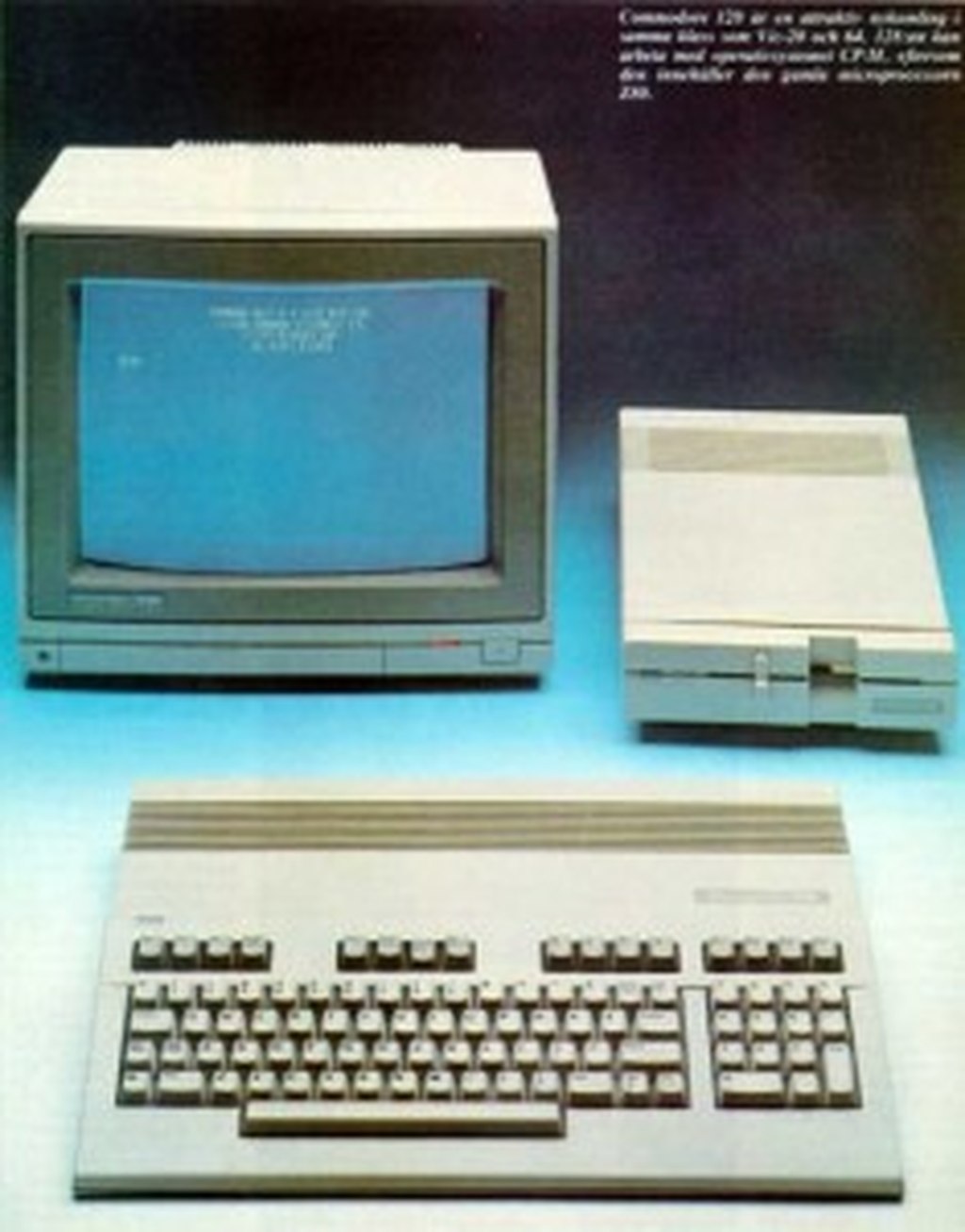
Speed was the deeper story. The 1541’s serial transfers were famously funereal — a few hundred bytes per second in stock form, the reason an entire industry of fast-load cartridges and replacement ROMs existed. The C128 and 1571 introduced burst mode: a faster serial handshake that, drive and computer together, moved data at roughly nine times the 1541’s pace. On a C128 in native mode, the 1571 feels like a different species from its predecessors — directory listings snap in, GEOS boots in human time, CP/M’s disk-heavy habits stop hurting. Compatibility was preserved as a fallback: boot the 128 in 64 mode (Commodore key held down) and the drive politely reverts to single-sided 1541 behaviour; a command could also switch a native-mode drive’s personality per session. Hardware DIP switches on the rear set the device number, an owner’s-touch detail the 1541 had pioneered and the 1571 kept.
The second controller talent made the 1571 a diplomat. Its WD1770 floppy controller — the same family of chips at the heart of many business systems — can read and write MFM formats, which means the 1571 could handle CP/M disks from Kaypro and Osborne machines and even early MS-DOS formats, given the right software on the 128 side. A single drive that speaks Commodore GCR, CP/M MFM and DOS MFM was, in 1985, a genuine interoperability bridge — and a cornerstone of the C128’s three-computers-in-one claim.
The flaws, catalogued honestly
No Commodore product ships without a bug list, and the 1571’s is documented with affection by its keepers. The first release ROM (version 3.0, the one fitted to most standalone drives) contains a known fault in relative (REL) file handling that can silently corrupt that file type — professional users learned to check their ROM version the way drivers check oil (the 128D’s internalised drive shipped with the fixed 3.1). Early drives were also scarce: production lagged the C128’s launch, and many early owners paired their new computer with the old 1541 while waiting. The community’s long-term answer to the drive’s remaining slowness was third-party: JiffyDOS ROMs for both drive and computer became the connoisseur’s upgrade, and a later ROM revision (often called 3.5, or 310121) consolidated the fixes. None of this dented the drive’s reputation among the people who maintained serious 128 systems — the consensus of four decades is that a well-kept 1571 is a precision instrument by the standards of its day.
Two heads, two disk encodings, nine times the speed, and a computer in the box: the 1571 treated the floppy drive as a colleague, not a peripheral.
There is one more piece of keeper’s lore, passed down by the drive’s documentation community: the heads. The 1571’s upper head rides on a sprung assembly that old drives remember — the advice to store the drive with its head-protection card inserted (or a sacrificial old disk) so the spring isn’t bent by decades of pressure against the lower head is the kind of detail that only exists for hardware people love enough to preserve. The 1571 rewards that love. It was the drive the C128 deserved: fast where Commodore drives had been slow, fluent where they had been parochial, and built — like the computer it served — by people who believed a disk drive should have a mind of its own.

A computer serving a computer
Linger a moment on the strangest fact in the 1571’s specification: it is, itself, a computer. Inside the case sits a 6502-family processor with its own RAM and a full disk operating system in ROM — the drive parses commands, manages its buffer, runs its own diagnostics and can even execute code uploaded from the host, a capability Commodore programmers exploited for everything from copy protection to custom fast loaders. This architecture was Commodore orthodoxy since the PET drives, born when disk controllers were expensive and 6502s were house products, but the 1571 is its fullest flowering: a peripheral with a payroll of one processor, two read/write heads and a WD1770 controller fluent in rival encodings. The practical consequences were the ones owners felt — the host computer stays responsive while the drive thinks; the drive can be interrogated, reprogrammed and upgraded in ROM — and the cultural consequence is the devotion: people don’t write lore about dumb hardware. The 1571’s documentation community, its ROM archaeology, its keeper’s tips about head springs and ROM revisions, all flow from the drive being interesting — a small colleague with a service manual, not an appliance.
Set beside its contemporaries the design looks even bolder. Apple’s Disk II was a masterpiece of minimalism, a mechanism under total host control; Atari’s drives spoke a simpler protocol to a simpler bus. Commodore alone insisted the peripheral should have a mind. The 1571 is where that insistence peaked — and, not coincidentally, where the company’s disk drives stopped being a punchline about speed.
Keeping one alive in 2026
Four decades on, the 1571 asks the ordinary stewardship of precision mechanisms and repays it unusually well. The checklist is the community’s standard: belts and lubrication assessed on any unrestored unit, heads cleaned and their sprung upper assembly stored protected, ROM version known (3.0’s relative-file fault is a reason to plan an upgrade, not a panic), and the power arrangement treated with the same respect as the computer’s own. None of it is exotic — the drive’s DOS is well documented, its parts are shared with a large survivor population, and the modern ecosystem supplies everything from JiffyDOS sets to full diagnostic software. Owners report the pattern familiar from the computer itself: a serviced 1571 simply works, decade after decade, its two heads reading disks their writers never expected to outlive the century. In an era of disposable storage, a forty-year-old floppy drive with a service manual and a fan base is a small argument for building things properly.
Standing in the line
Commodore would go on to make the 1581 for 3.5-inch disks and the 1570 stopgap for Europe, but the 1571 is the design the faithful measure the rest against — the moment the company’s smart-drive philosophy met a computer fast enough to use it. Pair a C128 with a 1571 today and the system feels whole in a way a 1541 never quite achieves: this was the intended configuration, the serious Commodore desk of 1985, and it still convinces.