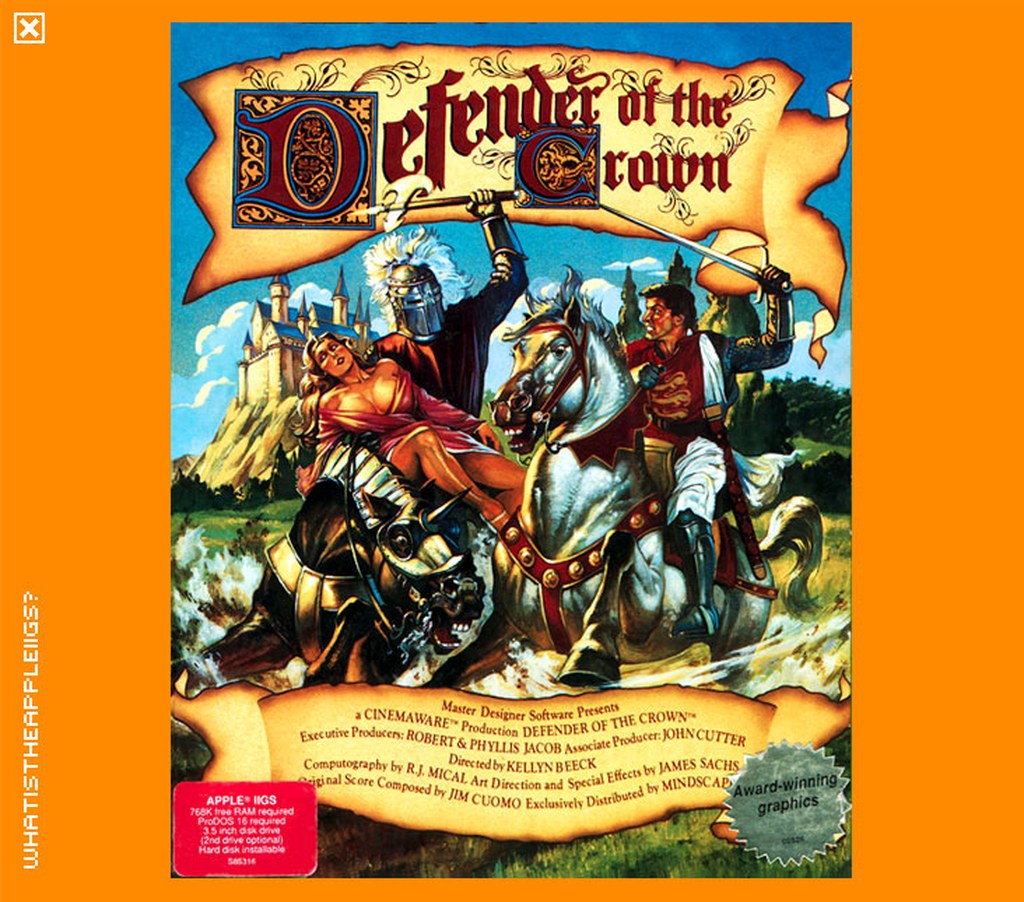
At a glance: Defender of the Crown · Apple IIGS · Cinemaware, 1989 · Medieval strategy action · Score: 8.0/10
Defender of the Crown was the game that invented a genre of presentation. Cinemaware’s 1986 Amiga original — a Robin Hood-era strategy game wrapped in the visual language of a Hollywood epic — had shown the whole industry what “cinematic” could mean on a home computer. The IIGS version, arriving in 1989, was one of the last and most interesting stops on its long tour of platforms: a conversion that had to prove Apple’s quiet machine could stage the same spectacle. It could. On the evidence of this port, the GS was the most Cinemaware-friendly computer Apple ever made.
The game casts you as one of four Saxon lords in a leaderless England, 1149. The king is dead, the Normans hold castles across a map of provinces, and the crown goes to whoever unifies the island — by strategy, by siege, by the joust, and occasionally by rescuing a damsel, because this is a Cinemaware game and romance is a military resource. You build armies, tax your lands, raid enemy castles for gold, forge alliances of convenience, and hurl catapult stones at fortifications in first person. It is a strategy game built from mini-games, years before that structure had a name.

The GS stages the spectacle
Everything in Defender of the Crown is about the image, so the port stands or falls on its art — and the IIGS version is, scene for scene, one of the most beautiful releases in its entire library. The super-hi-res screen carries the game’s painted look with real fidelity: the map glows, the character portraits have genuine painterly weight, the joust charges towards you with the screen shaking, and the damsel-rescue and coronation sequences land their storybook moments. Side by side with the Amiga original there are compromises in animation, but in still splendour — the thing Cinemaware actually sold — the GS version gives up remarkably little. The Ensoniq soundtrack completes the illusion with a score of proper medieval pomp.
The strategy layer underneath deserves its due. Territory is income, income is armies, and armies are the only argument the Normans respect; the map game is a tight little economy of aggression and consolidation. The action sequences are not decoration: a won joust wins land and fame, a successful raid funds a siege, a botched catapult assault wastes an army you needed. Sherwood Forest offers Robin Hood’s help to the deserving — which is to say, to Saxons who visit when their cause is just — and the whole campaign is paced to be winnable in an evening, a design courtesy modern strategy games might re-learn.
Where the crown slips
Honesty about the port’s compromises: some of the Amiga version’s flourishes arrived reduced, loading between sequences was a floppy-era patience test (modern storage largely cures it), and the computer lords’ behaviour, while characterful, is not deep — experienced players will find the difficulty plateaus once the economy is understood. The action sequences also vary in quality, the sword-fighting raids being notably less graceful than the joust and the superb catapult game. None of this is unique to the GS version; it is Defender of the Crown’s own texture, faithfully preserved.
On the IIGS, Defender of the Crown is the full Cinemaware illusion — painted, scored and staged like a film — running on the Apple II that learned to sing.
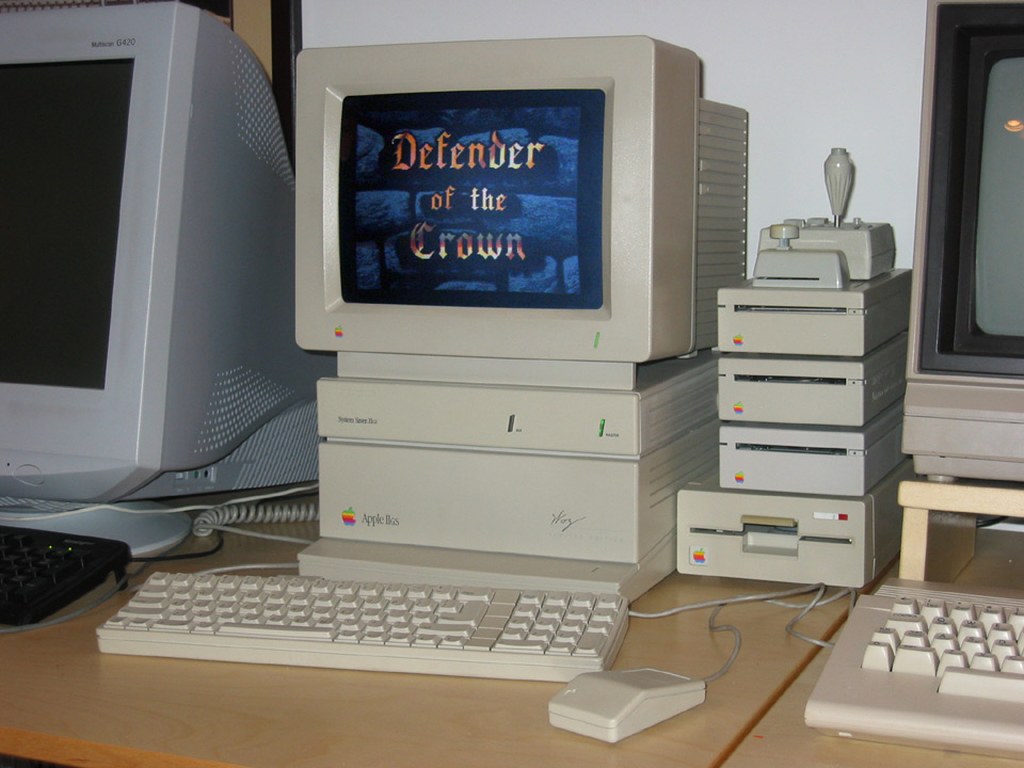
What the GS version adds, uniquely, is a certain appropriateness. This was a machine sold on graphics and sound to people who had been told those things were frivolous; Cinemaware’s entire catalogue was the argument that they were the point. Defender of the Crown on the IIGS feels like the meeting of two manifestos, and the result is the version many in the GS community reach for when they want to show a visitor what the fuss was about — ideally on a real machine, with the monitor glowing, as in the photograph above.

An evening’s empire
Replay value comes from the four lords, whose starting positions and strengths genuinely change the campaign’s shape, and from the game’s gift for anecdote: every player has a story about the joust that won them England or the raid that emptied the treasury at the worst possible moment. As a strategy game it is light; as an experience — the word Cinemaware built a company on — it is close to perfectly formed, and the IIGS stages it beautifully.
Reading the campaign like a veteran
New players underestimate how much of Defender of the Crown is decided before the first battle. The four Saxon lords are not cosmetic choices: geography is destiny, and a lord whose lands cluster can build an economic engine while a scattered lord spends the early game merely surviving. The wise campaign opens with consolidation, treats the joust as an income stream rather than a sport — land and fame both compound — and saves the first siege for a castle whose loss the Norman owner cannot afford. Robin Hood’s aid, granted to the just, is the game’s great leveller, and timing your appeal to Sherwood for the campaign’s crisis is the closest the design comes to a trump card. None of this depth is advertised on the box; all of it is there, which is why the game survives its own simplicity.
A word, too, for the version’s place in the Cinemaware story. The studio’s catalogue was the IIGS’s secret weapon in the late eighties: games designed around presentation landed on the one Apple built for presentation, and Defender of the Crown — with The King of Chicago beside it — gave GS owners the interactive-movie experience in something very close to its original glory while other platforms made do with approximations. Played today on real hardware with the sound up, it still produces the reaction Cinemaware banked on in 1986: visitors stop and watch.
For new lords: three opening lessons
If you are taking up the sword for the first time, the campaign will teach you its economy quickly, but three lessons are worth arriving with. Fame is a currency: joust early and often, because the land it wins compounds. Gold is a weapon: a raid that empties a Norman treasury in spring is worth an army in autumn. And patience is a strategy: the crown is won by the lord whose kingdom is whole when the others have spent themselves, so let the Normans exhaust each other against your walls before you march. Master those, and the coronation screen — one of the great reward images of eighties gaming, staged here in full GS splendour — is a matter of time and one good siege.
The verdict
Defender of the Crown is one of the IIGS library’s great presentations and a genuinely enjoyable light strategy campaign beneath the pageantry. The GS port honours the Cinemaware promise in full colour and full voice, and remains the machine’s most handsome history lesson.
Final practicalities for the modern lord: the game is well behaved on contemporary setups, benefits enormously from fast storage — the sequence-to-sequence flow that floppy owners waited through becomes the brisk picture-book rhythm Cinemaware intended — and remains one of the finest ways to show a visitor the IIGS doing the thing it was sold to do. Choose your lord, mind your gold, and may your lances strike true.
Score: 8.0/10 — Joust, raid, besiege and woo your way to the crown: Cinemaware’s medieval epic in a rich, musical IIGS presentation.