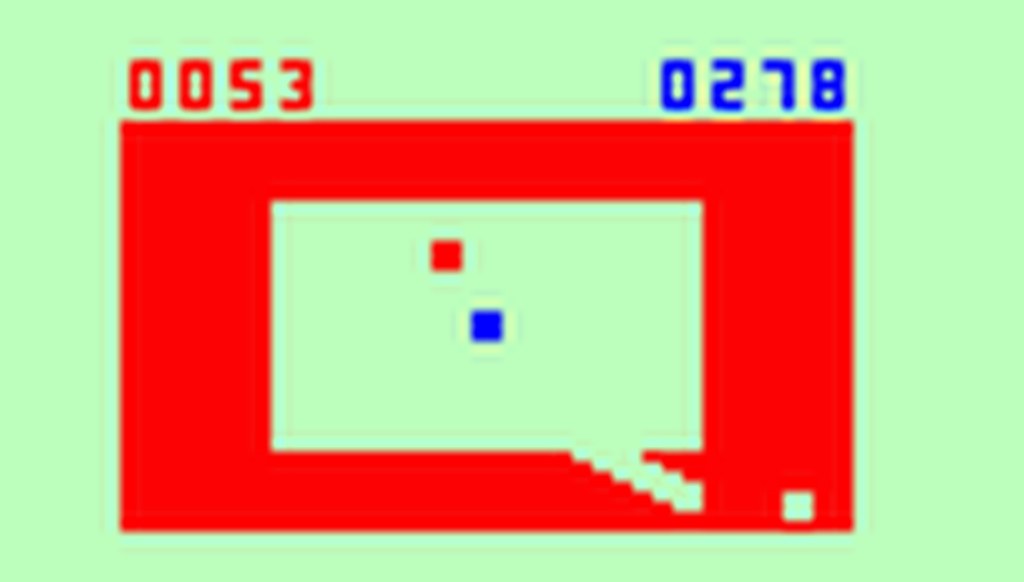
At a glance: Dodge It (Videocart-16) · Channel F · Fairchild, 1978 · Action / dodgeball · Score: 8.0/10
Strip a video game down to one verb and see if it survives. Dodge It, released in May 1978, is built on the verb “avoid”: you are a small square in a rectangular room, the computer throws balls into the room, and the balls do not stop coming. That is the entire design, and Video Games magazine, looking back in 1983, reached for the words “…nightmarish and marvelous” — the ellipsis theirs, the helplessness shared by everyone who has watched the seventh, eighth and ninth balls enter the room and understood that the geometry has turned against them. Dodge It is the Channel F’s purest arcade game: no score attack on enemies, no shooting back, just survival measured in seconds and spite.
The escalation is the game. One ball is a warm-up, a gentle diagonal threat you can sidestep while learning the stick. Two balls impose angles. By four or five, the room is a billiard problem being solved against you in real time — balls rebounding off walls into intersections you were standing in a moment ago — and the maximum of nine balls is less a difficulty level than a weather event. Your square is quick and the controls are honest, which matters enormously: in a game whose only failure state is contact, any death you blame on the stick ends the spell. Dodge It almost never lets you blame the stick. It makes you blame your positioning, three seconds ago, which is exactly where a survival game should put the blame.
A game you can rebuild before you play it
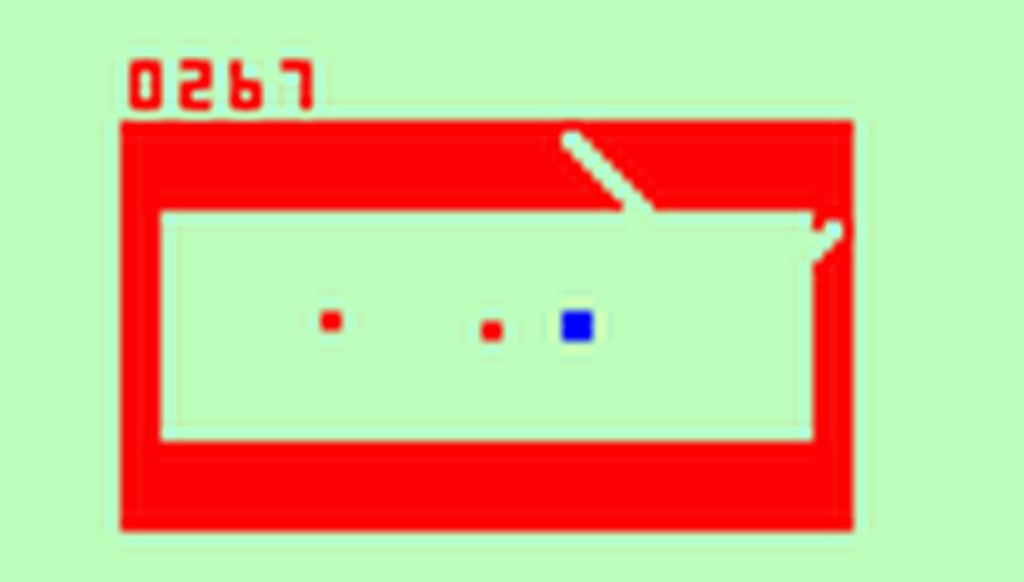
What elevates Videocart-16 above a one-joke cartridge is its options. Before the room fills, the console’s keypad lets you set the variables: the size and speed of your square, the size and speed of the balls, and the size of the room itself. Shrink the room and slow your square and the game becomes claustrophobia practice; open the room out, speed everything up, and it turns into something closer to a bullet-hell played at walking pace. This is 1978 — difficulty menus were not yet a courtesy the industry extended to anyone — and Dodge It effectively ships with its own modding tools. Brett Weiss described it as “sort of the opposite of Pong”: where Pong is about meeting the ball, this is about the moral inverse, and the variables let every household find its own favourite flavour of the nightmare.
And then there is the death. When a ball finally finds you, Dodge It does not blink you politely away — it detonates into a screen of multicoloured rectangles radiating outward and absorbing your square, a small firework of pure framebuffer indulgence. On a machine whose games are mostly exercises in restraint, the death screen is a flex: look what the display can do when it stops pretending to be a playing field. Players in 1978 must have died on purpose to see it again. It would be understandable.

Solo, together
Two players can share the room, each steering a square, which transforms the game again: the balls do not care which square they remove, cooperation keeps both of you alive longer, and yet the room keeps filling, so every partnership is a countdown with better company. The Channel F library is rich in duels and poor in shared ordeals; Dodge It is the exception, a game where the opponent is the room itself and the other human is simply someone to be trapped alongside. It is also, not coincidentally, one of the finest demonstrations of the console’s much-mocked hand controller — eight-way movement with none of the twist-and-plunge complications, the stick reduced to the one job it does flawlessly.
One room, one square, up to nine balls and nowhere at all to hide: Dodge It is the opposite of Pong, and it is nightmarish and marvelous in exactly the proportions its first critics claimed.
The honest limits: there is no progression beyond the rising count, no pattern to learn that will save you at nine balls, and sessions are measured in minutes rather than evenings. But that is the arcade bargain of its era stated cleanly, and Dodge It states it cleaner than most. Everything on the cartridge serves the one verb. The options reshape the nightmare, the death screen celebrates it, and the room — that plain rectangle — becomes, ball by ball, the most frightening place on the Channel F.

Nine balls: a small mathematics of dread
There is a quantitative pleasure in Dodge It that deserves naming before the verdict. Each added ball does not add a ninth of the danger; it multiplies it, because every ball is also a moving wall that herds you toward the others. The game’s difficulty curve is therefore exponential in the way all great survival games’ curves are — the room feels manageable one ball past the point where it has actually become lethal, and the real contest is between your reading of the geometry and your optimism about it. Fairchild’s programmers tuned the introduction of balls so that the lesson arrives exactly once per game: there is always a specific ball — the fifth, say, or the seventh — after which survival stops being a plan and becomes a talent. Finding your personal number, the ball at which your own game changes character, is the cartridge’s replay engine. Two players can compare numbers. Households in 1978 evidently did, the way households compared high scores, except that this score is measured in furniture: balls in the room when the rectangles bloomed.
It is also, incidentally, the cartridge to hand a sceptic who believes old games were slow. Dodge It’s late rooms are fast in the only way that matters — decision-fast, the player’s mind running ahead of their square through a thickening geometry — and the sceptic’s conversion usually takes one death: the bloom of rectangles, the instant restart, the resolve to count better this time. The Channel F library contains smarter games, prettier games and more important games. Very few contain a purer loop, and none makes sixty seconds feel longer, in the best way, than this one does at eight balls.
Bring a friend, set the room small and the balls fast, and the cartridge makes its oldest promise good one more time: the nightmare is marvellous, the rectangles are beautiful, and nobody — nobody — survives the ninth ball for long.
The verdict
Dodge It is the cartridge that proves minimalism was a choice Fairchild’s programmers could make brilliantly, not merely a limit imposed on them. Given a framebuffer, a stick and a beeper, they built a survival game with configurable physics, a legendary death animation and a two-player mode that turns panic into company. If the Channel F’s card games show the machine thinking, Dodge It shows it sweating — and of all its action cartridges, this is the one whose central idea needs no historical allowances at all. Step into the room. Count the balls. Marvel, nightmarishly.
Score: 8.0/10 — Survival in its purest 1978 form: a room, a square, nine balls and the best death screen on the Channel F.