
At a glance: Dropzone · Atari 400/800 · Archer Maclean / U.S. Gold, 1984 · Side-scrolling shooter · Score: 9.0/10
Some games are love letters. Dropzone is a love letter written at 200 miles an hour. Archer Maclean, a teenage British programmer with a famous obsession for Williams’ Defender, built his tribute for the Atari 8-bit in 1984 — and ‘tribute’ undersells it. Dropzone takes Defender’s entire grammar — the jetpack spaceman, the scrolling moonscape, the scientists to rescue, the scanner that shows a whole war in miniature — and rebuilds it faster, brighter and meaner than the arcade original, on a home computer, essentially alone.
The stage is Jupiter’s moon Io, all volcanic oranges and purples, and the job is Defender’s job: alien forces are snatching your scientists from the surface, and you — one man, one jetpack, a laser and a small supply of smart bombs — are the entire air force. Strap in. Dropzone does not believe in a gentle first minute.
Speed is the whole point
The first thing that hits you is the velocity. Maclean’s scrolling is silk — the landscape streams beneath you at a pace that makes the Atari’s contemporaries look sedate, and your spaceman answers the stick with an immediacy that borders on telepathy. Short hops, long burns, instant reversals: Dropzone’s movement model has that rare quality where after ten minutes the character disappears and you are simply there, threading between an android’s fire and a falling scientist, deciding in fractions of a second whether the rescue or the kill matters more.
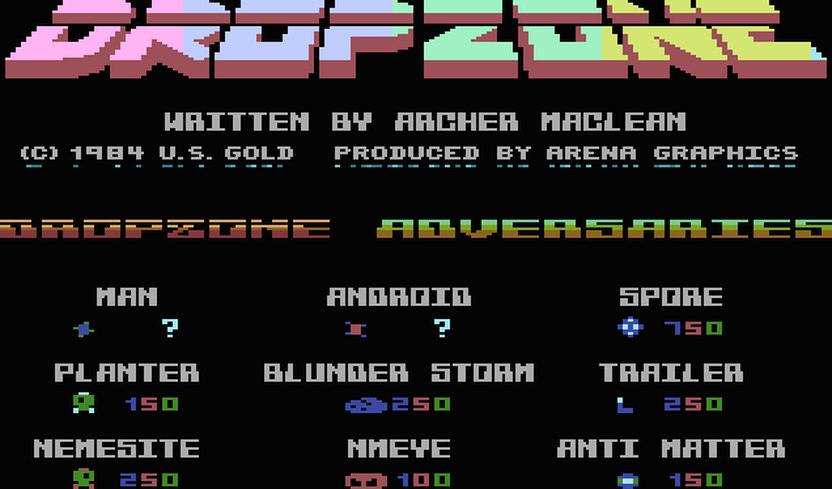
The enemies escalate with real design intelligence. Androids hunt you. Landers crawl towards your scientists and haul the screaming prizes skyward — shoot the lander, catch the man, because a scientist dropped from a great height is a scientist lost. Spores, blossoms, nmeys and the dreaded blunder… the bestiary keeps introducing new movement patterns just as the old ones become reflex, and the waves are tuned so that the game crosses from brisk to berserk on a curve you can feel in your forearms. The cloaking device — a limited invisibility that lets you reposition mid-chaos — and the strata bomb for true emergencies give you exactly two panic buttons, both rationed. Dropzone is hard the way Defender was hard: fairly, legibly, and at you personally.
Built like a watch
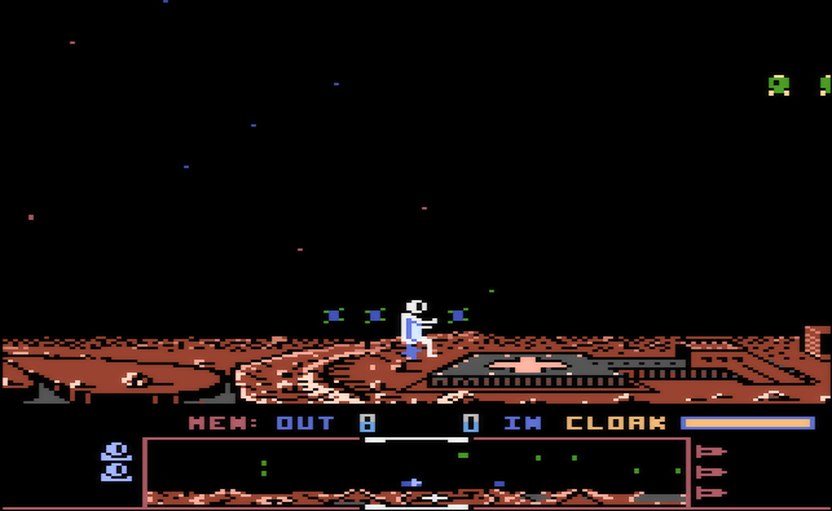
Technically this is one of the great 8-bit programming performances. The playfield is rich — a parallax-touched landscape, a detailed base complex, particle explosions — and the famous scanner occupies the bottom of the screen, compressing the whole moon into a tactical strip you learn to read in glances. Maclean’s later reputation (Jimmy White’s snooker mathematics, IK+’s balletic fighters) starts here: precision, smoothness and an almost arrogant command of the hardware. POKEY is used sparingly but perfectly — jetpack burn, laser crackle, the rising panic of the warning klaxon when a scientist is lifted.

Dropzone is Defender taken personally — one programmer deciding the arcade classic could be outrun on a home computer, and being right.
If there is a criticism, it is the genre’s own: Dropzone is a score-attack game, and its pleasures are the pleasures of mastery rather than discovery. There is nothing to unlock, no ending to reach — only a wave counter, a ranking ladder from Practice to Megastar, and your own previous best glaring at you. Players raised on campaigns may bounce off. Players raised on arcades will recognise a purer drug.
The Maclean standard
Dropzone made Archer Maclean’s name, and the story of its making is part of its legend: a self-taught programmer, still in his teens when he began, who had already converted arcade games for pocket money and decided that the Atari 8-bit — then being written off in Britain in favour of cheaper machines — deserved a flagship written specifically for it. The game was published by U.S. Gold in 1984 and became the rare British Atari title that American owners imported and envied in return. Maclean’s later career — International Karate, IK+, the Jimmy White snooker simulations with their obsessive physics — is all prefigured here: the insistence that feel is a technical discipline, the frame-perfect movement, the sense that a game’s code should be invisible and its motion inevitable.
It is also a game with a long memory built in. The ranking system grades you from Practice through a ladder of titles to Megastar, and the grades are stingy in the way that creates decade-long grudges against oneself. The attract mode’s hall of fame, pre-loaded with the initials ADM — Archer’s own — at a round 10,000, is a standing insult the game issues to every new player: beat that. Most of us, forty years on, are still working on it. That is not a failure of the design. That is the design, working exactly as intended, one three-minute run at a time.
Reading a Dropzone run
Watch a master play and the game’s real structure reveals itself: it is a triage simulator wearing a jetpack. The scanner at the screen’s base is not decoration — it is the game, the whole war compressed into a strip of blips, and experts play it the way air-traffic controllers work a radar, eyes flicking down every few seconds to re-plan the next ten. Who is being lifted, and where? Which android has gone hunter? Is that blossom about to split somewhere expensive? The visible screen is merely where the current emergency happens to be. This is why Dropzone replays so well on real hardware with a real stick: the bottleneck is never the graphics or the code, it is the speed of your own decisions, and decisions do not age. The Atari’s crisp single-button stick is the perfect instrument for it — thrust is the stick, laser is the button, cloak and bomb are the keyboard keys your other hand learns to stab without looking. Four decades of controllers have added nothing the game needs.
And when a run ends — when the last scientist is gone and the rank screen delivers its verdict — the failure is always legible. You were greedy over a falling man. You cloaked a second too early. You trusted the scanner’s calm and missed the lander at the map’s edge. Dropzone’s mercilessness is informational, not random, which is why the next run always starts within seconds of the last one’s end. The jetpack is already fuelled. Io is already turning below you.
The ports, fairly judged
Dropzone travelled — to the Commodore 64 in a strong conversion, and years later to consoles and handhelds — and every version is worth an evening, but the hierarchy is not in doubt. The Atari original’s speed, its colour and its feel are the reference the others were measured against, and the 64 version’s slight softening of the pace changes the game in your hands whether or not it shows in screenshots. If you meet Dropzone first on another system, you have met a very good game. On the Atari 8-bit, in a dark room, with the volume up and a stick that clicks, you meet the one Maclean built the decade around.
Verdict
Dropzone is the finest Defender-style game on any 8-bit machine and one of the essential Atari 8-bit titles, full stop. It honours its inspiration by beating it — on speed, on feel, on the sheer joy of movement. Four decades on, a good Dropzone run still produces the arcade shakes. Megastar rank is waiting. It will take a while.