
At a glance: Fire Power · Apple IIGS · MicroIllusions, 1989 · Tank action / capture the flag · Score: 7.5/10
Before networked multiplayer was a feature you listed on a box, Fire Power was two tank crews shelling each other’s bases across a scrolling battlefield — on the same machine, on a split screen, shouting distance apart. MicroIllusions’ tank game began life on the Amiga, and its IIGS conversion, arriving in 1989, brought the whole glorious argument home to Apple’s machine: capture the flag from the enemy fortress, raze everything in your path, and try not to be razeed first. It remains one of the GS’s finest two-player games.
The concept is beautifully blunt. Each side holds a walled base, a flag, and a stock of tanks, turrets, and infrastructure. You roll out into a large scrolling map of roads, rivers, forests and installations, hunting the enemy flag while your own fortress — repaired, one hopes, by your diligence between sorties — awaits the enemy doing exactly the same to you. Buildings burn. Walls crumble. Helicopters interfere. The map remembers your destruction, so a long match becomes an archaeology of your own shelling: that gap in the wall is where the last duel went wrong.
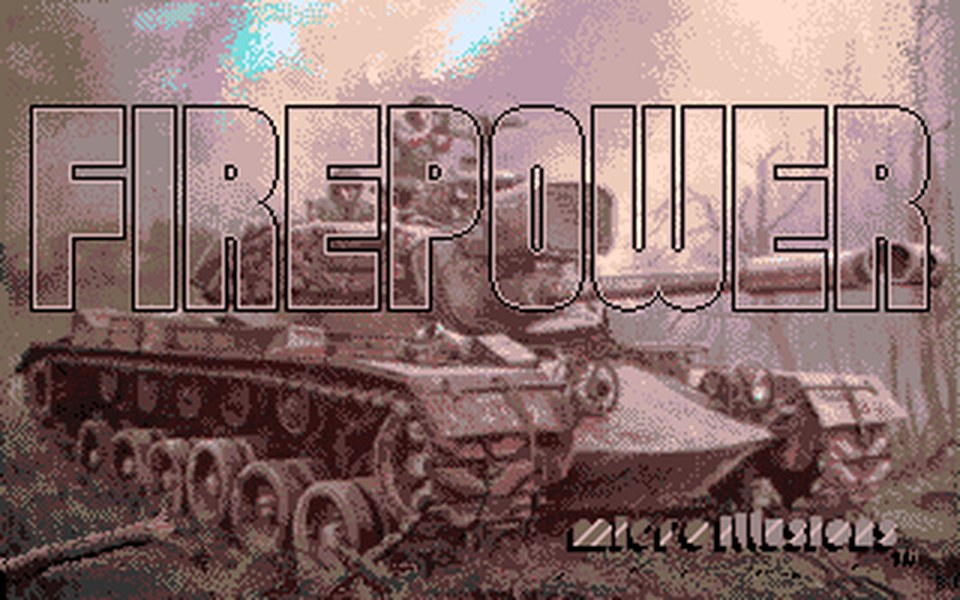
Split-screen warfare, 1989 style
The two-player mode is the headline and the reason to own the game. The screen splits, each commander with their own scrolling view, and Fire Power becomes a game of information as much as aim: you glimpse the enemy’s sector only when your scouting earns it. Attack in force and your base stands open; turtle, and the enemy’s flag convoy rolls home unopposed. Solo players get a capable computer opponent and the same sprawling maps, and the game remains good — but against a human, with the taunting that the format encourages, it is great. Few IIGS titles understood the social physics of the split screen this well.
Technically, the conversion acquits itself honourably. The battlefield scrolls smoothly enough to keep fast tank duels readable, the sprites are chunky and legible, and the destruction — the game’s signature — is properly satisfying, with structures collapsing into burning wreckage that stays wrecked. The Ensoniq chip delivers deep, concussive effects; a Fire Power duel is one of the loudest experiences in the GS library, and all the better for it. Compared with the Amiga original the GS version gives up a little polish, but it keeps the scale, the pace and the violence intact, which is the correct list of priorities.

Depth in the details
What gives Fire Power its staying power is the ecosystem inside the battle. Capturing the flag is the goal, but the map is full of secondary decisions: rescue your own captured soldiers, destroy the radar and power installations that make the enemy base efficient, manage the balance between offence and the perpetual repairs your fortress demands. Tanks handle with a pleasing weight — this is armour, not a sports car — and the terrain matters, with roads offering speed at the price of predictability and forests offering cover at the price of ambush. A good match swings repeatedly, and the flag mechanic guarantees a climax: somebody’s convoy, creeping home under fire, while both screens erupt.
Fire Power turned the IIGS into a battlefield for two: split-screen, base-razing, flag-stealing warfare years before multiplayer was a marketing bullet point.
The flaws are period flaws. The computer opponent, while spirited, learns nothing from you across a long campaign of matches, and the solo game eventually becomes a solved problem in a way the human game never does. The interface asks you to manage a lot with keyboard and joystick conventions of the time, and new players should expect a clumsy first match before the controls settle. None of it dents the core: this is a design so sound that its capture-the-flag-with-destruction formula kept being reinvented for decades afterwards.

Why it matters to the GS
The IIGS library is not short of solo experiences; it is short of great head-to-head ones. Fire Power fills that gap with the confidence of a game that knows exactly what it is. Paired with the machine’s sound hardware and a second human being, it produced the kind of living-room noise that sold computers in 1989 — and it still produces it now, which is why surviving copies change hands briskly among the GS faithful.
Playing it now
Fire Power has aged into one of the GS community’s favourite demonstration games, and it is easy to see why: it needs no historical excuses. Load it on a real machine with two players and the room understands the pitch within a minute — there is your tank, there is their base, the wall between is negotiable. It is System-friendly and quick to load from modern storage, and the split-screen format, which modern gaming largely abandoned for online play, turns out to be the game’s time capsule and its charm: all the intelligence about your opponent is in their face, across the room, trying not to react to your flag run.
Solo players, for completeness, should know the shape of the long game: the computer defends competently and attacks with conviction, and a full campaign of escalating maps will occupy a serious evening. Learning to repair efficiently — to treat your base as a living thing rather than a backdrop — is the solo game’s curriculum, and it transfers directly to the multiplayer duel, where the player who neglects their walls loses to the player who shells with a plan. Fire Power rewards the methodical warmonger, which is to say it rewards exactly the temperament its box art promises.
The formula that kept returning
Fire Power’s influence is written across the decades that followed it, in every top-down arena where two bases and a flag decided an evening. Its particular blend — persistent destruction, territorial infrastructure, the flag as a moving climax — turned out to be one of multiplayer design’s permanent ideas, rediscovered by each generation of networked games as if new. The IIGS version deserves its line in that genealogy: not a diminished port of the Amiga original but a full-strength rendition that carried the design to an audience the Amiga never reached, and played it, split-screen and shouting, exactly as intended.
The verdict
Fire Power is the IIGS’s essential two-player game: a big, destructible, flag-chasing tank war whose split-screen duels remain as tense and funny as they were in 1989. Solo it is good; with a rival on the couch, it is the best argument the GS ever made for a second chair.
For the modern owner, then, the recommendation writes itself: if your IIGS ever hosts two players, Fire Power is the disc they will ask for again. Keep a second chair near the machine. You will need it more than the manual ever suggested, and the shouting, when it comes, is the sound of a 1989 design working exactly as its makers hoped — in your house, on your Apple, with your flag halfway home and your best friend’s tank coming over the ridge to stop it.
Should your household crown a champion, the game supports the ceremony: scores and outcomes are clear, grudges are portable between sessions, and the map you fought over last month is still, in memory, the place where the flag run happened. Great multiplayer games become family geography. Fire Power’s battlefield is exactly that, surveyed in shellfire.
Score: 7.5/10 — Capture the flag, burn the base, mind your own walls: MicroIllusions’ tank war is the IIGS’s finest head-to-head hour.