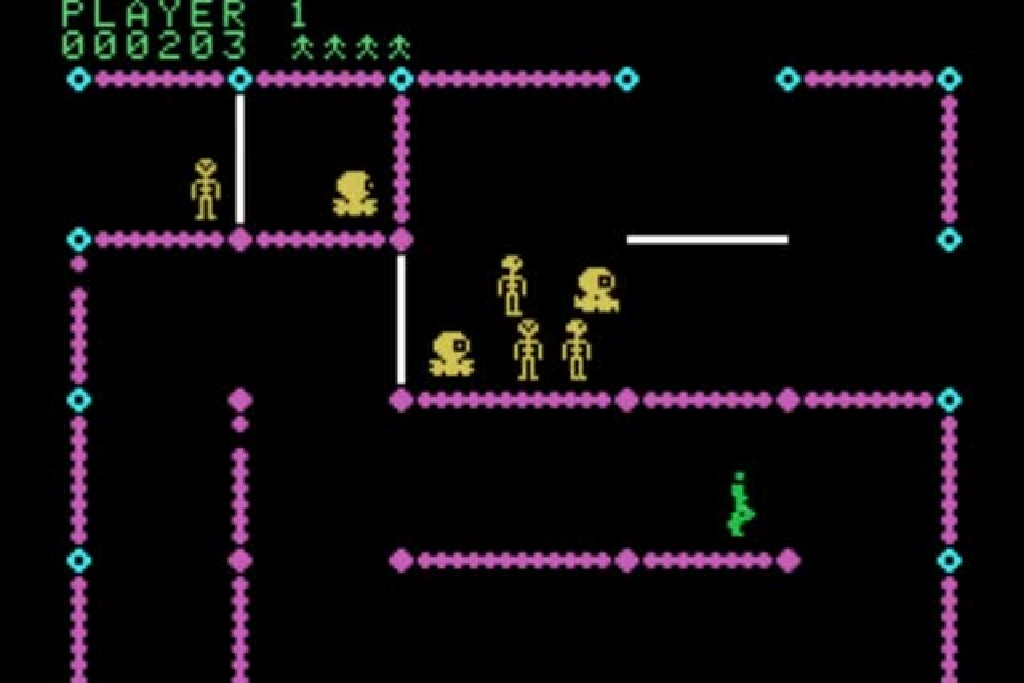
At a glance: Frenzy · ColecoVision · Coleco/Stern, 1983 · Maze shooter · The sequel to Berzerk · Score: 8.5/10
Berzerk put a lone human in a maze of murderous robots, gave the walls a fatal charge, and sent Evil Otto — gaming’s most cheerful face of death — bouncing in whenever the player dawdled. Its sequel, Stern’s Frenzy, asked what would happen if the maze fought back properly: walls you can shoot through, rooms containing machinery that changes the rules, skeletons and tanks alongside the robots, and Otto still smiling through all of it. The ColecoVision conversion is the home version that matters — the sequel skipped most rival machines entirely — and it is one of the system’s most replayable shooters.
The core loop is Berzerk’s, sharpened. You enter a room from one of its exits; robots occupy it; you can fight or run. Touching a wall, a robot or a shot ends you. Clear the room for the bonus, or escape and let the room’s survivors go — but dawdle and Otto arrives, indestructible, herding you towards a decision. Room by room, the score climbs and the robots get faster, smarter and ruder.
Everything Berzerk had, plus a toolbox
Frenzy’s additions transform the tactics. Some wall segments are now destructible — shoot them open to create firing lines or escape routes, or to drop a wall’s protection from a robot that thought it was safe. Other segments are reflective, banking robot fire alarmingly around the room. Special rooms house machinery with live effects: devices that multiply the robots, that freeze or release them, that supercharge the room’s danger — shooting the machine is sometimes the only sane play and sometimes the spark for total chaos. The enemy roster widens beyond robots to skeleton warriors and tank-like hulks in later rooms, each shifting which fights are worth taking.

The ColecoVision version carries the whole design across: destructible and reflective walls, the machinery rooms, the extended bestiary, Otto’s entrances, the escalating room layouts. It moves at a properly unfriendly pace in the later rooms, and the console’s sound chip gives the robots their electronic menace — while Berzerk’s famous synthesised taunts are necessarily absent, the action audio keeps the pressure where it belongs. Control is single-stick move-and-fire in the direction you move, as the arcade decreed, and the pad’s short stick suits the game’s sharp room-to-room direction changes.
Otto always collects
It is worth dwelling on Evil Otto, because Frenzy understands him best. He is not a timer made visible so much as an argument: every room in this game eventually becomes untenable, and mastery is knowing the moment just before he arrives — the last robot worth shooting, the last bonus worth grabbing — and leaving on your own terms. The machinery rooms weaponise that argument beautifully, tempting you to stay and shoot one more device while the smile bounces closer. The best Frenzy scores are built almost entirely out of well-judged exits.

As a piece of the ColecoVision story, Frenzy is the connoisseur’s shooter: less famous than Zaxxon, less licensed-glamorous than the Nintendo and Sega titles, but arguably the purest arcade loop on the system. It is also a game whose home availability was essentially this cartridge — if you wanted Frenzy in your living room in the eighties, this was the way, and the conversion rewarded the faithful with the complete design rather than a cut-down token. Collectors note: it is a common enough cartridge to find, and one of the best value-for-play propositions in the library.

Room economics: which fights are worth taking
Frenzy’s depth hides in a question it asks in every doorway: is this room worth it? The scoring system pays for cleared rooms and surviving robots are simply abandoned when you exit — but the exit you take decides your next room, and a greedy clear on a bad layout can cost more than it pays. The machinery sharpens the question. A device that multiplies robots is a threat until the moment it becomes a bonus farm; a room whose machinery releases everything at once is a room to cross at a sprint; and the destructible walls mean the room you enter is never quite the room you fight in — the first shot of any engagement should often be spent on architecture, opening your escape line before the robots organise. Otto, as ever, is the auditor: he converts every dithering calculation into a deadline, and the game’s best players develop an almost financial sense of when a room’s remaining value drops below its rising risk.
The Berzerk family at home
For the home audience of 1983, this cartridge was also a small event: Berzerk itself had been a famous arcade presence and a well-known cartridge elsewhere, but its superior sequel was effectively a ColecoVision exclusive in the living room. That shapes how the system’s shooter library reads today. Zaxxon supplies the spectacle, Time Pilot the sweep, and Frenzy the claustrophobia — three completely different kinds of shooting on one console, all converted completely. Frenzy is the one that most rewards the long relationship: its rooms are procedurally varied enough that no two runs tax you identically, its difficulty scales by nerve as much as by numbers, and its central relationship — you, the robots, and a smiling sphere that will not be reasoned with — remains one of the purest in games.
For collectors and first-time humans
Frenzy’s cartridge is common, affordable and — this matters for a game built on split-second room entries — thoroughly reliable, with none of the keypad dependencies that make some of the system’s games overlay-sensitive. It is a pure stick-and-button game, which also makes it one of the best cartridges for showing the console to newcomers: the entire design is visible in the first room, and the whole of its depth arrives, as it should, in the form of a bouncing smile. One house recommendation for returning players: keep a running score rivalry. Frenzy’s structure — rooms, risks, exits — produces enormous score variance between a cautious run and a inspired one, and few games on the system generate better arguments about which room was worth it. Otto presides over all such arguments impartially, and collects from both sides.
If a single image argues for this cartridge, it is the late-room scramble: walls shot open mid-fight, a machinery room detonating its contents two screens of logic away, robots arriving in numbers the doorway was never designed for, and Otto — patient, smiling, punctual — crossing the threshold exactly as your escape route closes. That Frenzy can generate that much theatre from dots, lines and a dozen sprites is the whole case for the arcade’s second golden age, filed in one cartridge.
Clear a room, fear the next one, and never — under any circumstances — let the smile catch you admiring your own score.
The verdict
Frenzy takes one of the arcade’s foundational shooters and improves every part of it — then the ColecoVision brings it home whole. Destructible walls, dangerous machinery, escalating rooms and the smiling face of doom itself: absolutely essential, forever.
Score: 8.5/10 — Berzerk, evolved — and Otto is still grinning.