
At a glance: Frogger · ZX81 · Cornsoft, 1981 · Arcade action · Score: 7.5/10
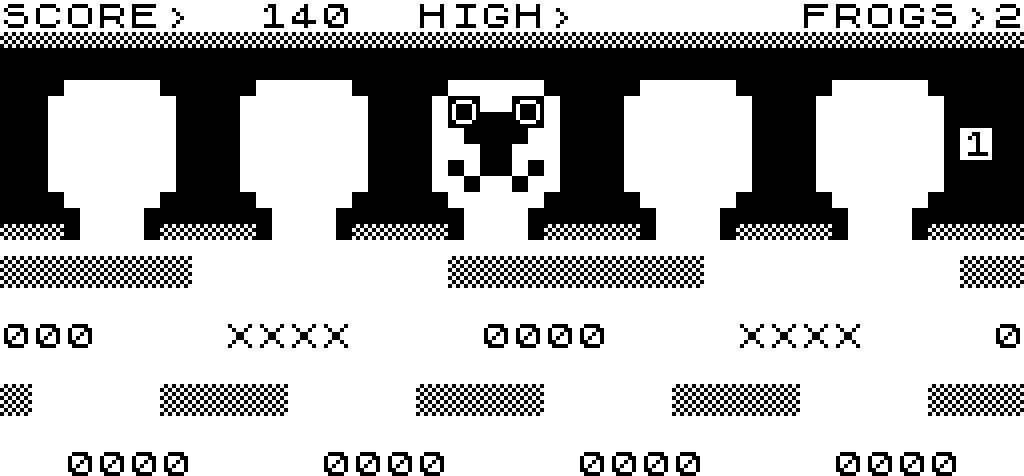
The frog had a busy 1981. Konami’s Frogger hopped into arcades that year and instantly became one of those games every machine must have — and the ZX81, months old and dressed for a different party entirely, got its conversion from Cornsoft, a small label whose frog crossed the road in character blocks inside the machine’s first year. It should not work. Frogger is a game about timing, lanes and a river full of moving furniture, rendered here on a computer with no colour, no sound and no sprites, whose display is a grid of characters. It works anyway, and the screenshot tells you why: the road bands, the river, the logs and traffic and the frog itself are all legible at a glance, big and blocky and unmistakable, a monochrome cartoon drawn with the only crayons Sinclair provided.
That legibility is the review, in a sense. The ZX81’s early arcade conversions live or die on whether the player can read the screen at speed, and Cornsoft’s Frogger reads beautifully. The upper half of the screen is the river, with its rows of logs to ride; the lower half is the road, with its traffic to dodge; the far bank holds the homes the frog is trying to reach, and somewhere along the way a timer — labelled, bluntly, TIME — ticks down your right to dawdle. One frog at a time crosses; the score line at the top keeps the tally of your ambition. Anyone who has played the arcade game in any of its thousand forms will be oriented within seconds, which in 1981 was the entire commercial point: a recognised game, on the new machine, recognisably itself.
Why the frog suits the machine
Frogger’s design is secretly a ZX81 design. The arcade original moves in a grid: the frog hops one space at a time, lanes move in discrete steps, collisions are cell-based. A character-mapped display is not a compromise for this game; it is the game’s natural habitat, which is why the conversion feels honest in a way that, say, a character-block racing game never can. The hops land on cells. The logs carry the frog one cell at a time. Death arrives by arithmetic: you were in the wrong square when the truck was. There is even a case that the monochrome suits the frog’s world — the road is black bands and white dashes, the river is pattern and space, and the whole screen has the graphic confidence of a newspaper cartoon.
The compromises are the era’s usual ones. There is no music, because there is no sound hardware; the arcade’s jaunty soundtrack is replaced by the silence of a machine thinking. The membrane keyboard takes the hops — direction keys doing the work of a four-way stick — and membrane keyboards are nobody’s favourite input device, though for a game of discrete, deliberate hops the pairing is less cruel than it is for anything requiring a diagonal. And the frog himself, rendered in blocks, has a charm that is partly nostalgia and partly genuine draughtsmanship: the Cornsoft sprite is one of the most characterful things on the early machine, a face you can read at two inches tall.
Frogger moves in squares, thinks in squares and dies in squares. On a screen made of squares, Cornsoft’s frog is not a conversion struggling against the hardware — it is a game that found its natural habitat.
The conversion economy
Cornsoft’s Frogger sits in an interesting place in the ZX81 story: the very beginning of the conversion economy, when small labels moved faster than licences and an arcade hit could be re-imagined in Yorkshire or Ohio before any official paperwork existed. DJL Software and others also fielded ZX81 frogs; Timex’s American range later carried an officially Sega-licensed Frogger for the TS1000. The Cornsoft version’s claim is priority and charm: 1981, the year of the arcade original, on the year of the machine. That a computer launched in March could be playing a respectable Frogger by the end of its first year told buyers exactly what Sinclair had promised them — this little wedge is a real games machine, whatever the sceptics with their colour computers said.
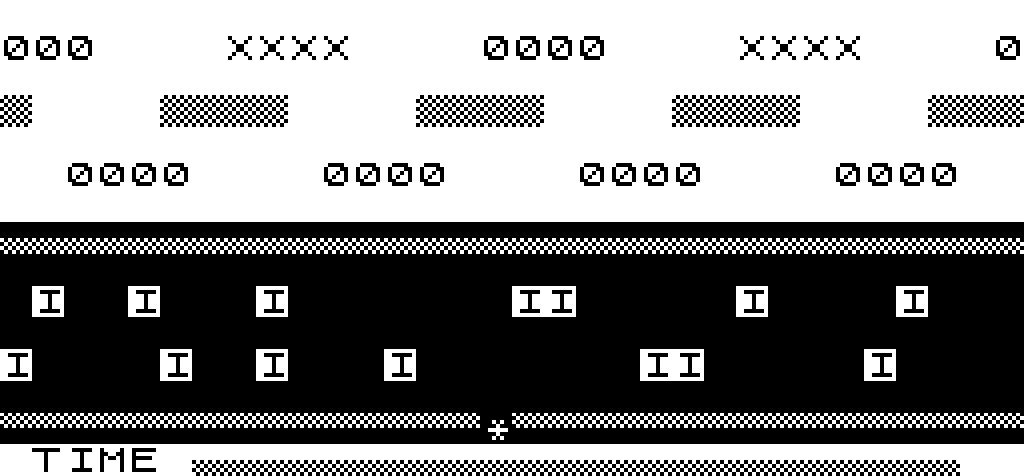
Played now, it remains the most immediately playable of the ZX81’s arcade conversions, because its contract with the player is so clear: cross, ride, home, faster. Sessions are measured in minutes and decided in single hops, and the game has the arcade’s essential cruelty intact — the frog dies at the water’s edge, one cell from the log, as frogs have died on every machine since.
A field of frogs
The Cornsoft frog was not alone in the pond, and the company it kept maps the ZX81’s unlicensed gold-rush in miniature. DJL Software fielded its own Frogger — its inlay survives in the archives alongside Cornsoft’s program — and Mikro-Gen offered Frogs; later, the American range regularised everything, with Timex carrying a Frogger in Sega livery for the TS1000, the arcade licensor’s name finally attached to a ZX81-family frog. That sequence — independent conversions first, official blessing later, the market tidied in retrospect — is the early software business in one amphibian. For the buyer of 1981, none of the paperwork mattered. What mattered was that the new machine, within months of launch, could be shown playing the year’s defining arcade game to a visitor who had queued to play it in an arcade. Cornsoft’s version was the one that made that demonstration first, and its frog — big-eyed, blocky, unmistakable in the screenshot — is as good an emblem as any of the machine’s opening year: a face drawn from the character set, doing a perfect impression of the future.
The game’s democracy deserves the last word before the verdict. Frogger needs no manual, no lore, no patience with parsers or maps: cross the road, ride the river, go home, faster next time. On a machine whose catalogue could be forbidding to the newcomer, Cornsoft’s cassette was a front door — the tape you lent, the tape you loaded for your mother, the tape that explained the wedge to the sceptical in ninety seconds. Every platform needs one. The ZX81’s had webbed feet.
Playing it in 2026
Cornsoft’s frog is preserved in the standard archives, and it asks the least of any game in this package: no map, no parser, no patience — just crossings, at rising tempo, until the timer and the traffic agree on your fate. It is the ideal first ZX81 game to show a sceptic, because its argument is visual and immediate: a complete, charming, properly difficult arcade conversion, drawn in text, on the cheapest computer of its year. The frog has crossed many roads since 1981. This was one of the first, and it still hops.
Verdict
Cornsoft’s Frogger is the right game on the right machine at the right moment: a grid-born arcade classic translated into character blocks with its readability, timing and charm intact, inside the ZX81’s first year. It lacks sound because the machine lacks sound; it lacks colour because the machine lacks colour; it lacks nothing that matters. One of the early catalogue’s most likeable cassettes, and the frog’s first British home.
Score: 7.5/10 — A game that thinks in squares, on a screen made of squares: the ZX81’s friendliest arcade conversion.