We all know the honest cheats: the Konami Code, thirty lives, typed into Contra by a generation of players who needed the help. This is about the other kind — the moments the game itself cheats back. Retro developers, constrained by simple hardware and a terror of games being finished too quickly, built machines that lied to your face: opponents who read your inputs, racers who teleport behind you, cheat codes that punish you for knowing them. The games fought dirty. Here’s how.
The Code That Bites: Parodius and Tomb Raider II
Konami’s code — up, up, down, down, left, right, left, right, B, A — was so famous that Konami itself weaponised the fame. Enter it in Parodius, the company’s self-parodying shooter, and instead of a full power-up the game simply kills you on the spot: the developer trolling its own legend, in a game that was already a parody of Gradius. It’s the perfect joke about cheat culture — the code had become so automatic that players typed it without thinking, and Parodius punished exactly that reflex.
Lara Croft’s second outing played the same trick. Players who tried the first Tomb Raider’s famous cheat sequence in Tomb Raider II discovered that Core Design had booby-trapped it: Lara doesn’t power up; she explodes. In an era before patches, these traps were permanent, printed into every cartridge and disc — developer humour with a body count.
The Opponent Is Reading Your Controller
Fighting games are where retro cheating gets systematic. Street Fighter II’s arcade AI remains the most documented offender: computer-controlled charge characters — Guile, Blanka, E. Honda — cheerfully perform moves that require two seconds of charging the instant you press a button, because the CPU isn’t holding anything at all. It reads your inputs frame by frame and reacts before your character has finished starting the move. Add damage scaling that quietly fattens the CPU’s hits and shrinks yours as the rounds progress, and “the computer is cheap” stops being a loser’s excuse. It’s a specification.
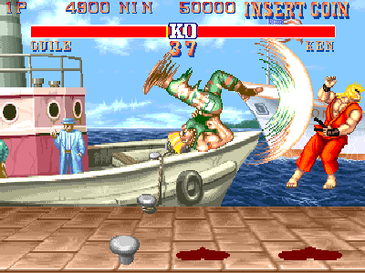
Street Fighter II’s CPU opponents ignore the charge times human players must obey — and hit harder than the manual admits. (Image: Wikimedia)
Mortal Kombat’s arcade AI ran a similar racket, with opponents whose reaction times collapsed to inhuman levels on higher difficulties, while strategy games of the era simply handed the computer resources it never earned — production bonuses and free units on the harder settings of the era’s big strategy titles were standard practice, difficulty by accounting fraud.
The Rubber Band: Mario Kart’s Elastic Grudge
The most universal cheat is the one designed to feel like drama. Mario Kart’s rubber-banding ensures that CPU racers who fall behind receive a quiet speed boost, while leaders find their rivals mysteriously glued to their mirrors. Mario Kart 64 perfected the formula: no lead was ever safe, no deficit ever fatal, because the game was engineered so that the pack stayed together and the last lap stayed interesting. Racers in countless other series run the same elastic under the bonnet; Mario Kart just made it famous, partly because at 150cc the pretence wears so thin you can watch last-place opponents move at speeds the game’s own physics deny you.
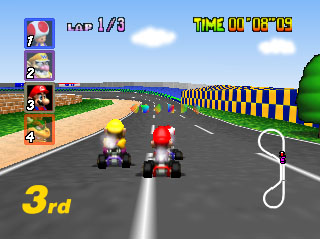
Mario Kart 64: the rubber band in full stretch — the pack is never as far behind as the track says it should be. (Image: Wikimedia)
It Started Honestly: The Space Invaders Accident
The genre’s founding cheat wasn’t even deliberate. In 1978’s Space Invaders, the aliens sped up as you destroyed them for the purest of hardware reasons — fewer sprites on screen meant the processor had spare capacity, so the fleet’s stately crawl became a frantic dive as the wave thinned. Tomohiro Nishikado noticed the effect and kept it, and without meaning to, he had invented difficulty ramping: the game squeezes harder the better you play. Every rubber band, every adaptive director, every quietly adjusted AI since descends from that accident — the difference is that modern games employ the squeeze as a design philosophy and deny it’s happening.
The Cheats That Help You
Fairness demands the other ledger be opened too, because games cheat in the player’s favour at least as often — they just do it discreetly. The original Resident Evil 4 silently adjusts its difficulty behind your performance, trimming enemy aggression when you struggle. Alien: Isolation’s xenomorph is famously tethered by a “director” that points it toward you — and away from you — to keep the tension calibrated. Shooters routinely make the first enemy shot miss. Racing games slow the pack’s tail as readily as they speed it. The retro era’s difference is one of candour: its cheats were crude enough to catch in the act, and catching them became part of the culture — playground intelligence, magazine exposés, the shared grievance that bonded a generation of players. The computer cheated. Everybody knew. Beating it anyway was the whole sport.
Why They Did It — and Why We Forgave Them
It helps to remember the economics. Arcade games cheated because quarters were revenue; a fair machine is a short session. Home games cheated because a £40 cartridge finished in an afternoon felt like theft, and AI that played by human rules on 8-bit and 16-bit hardware was usually too stupid to be fun honestly. Rubber-banding, input-reading and damage fudges were prosthetics for silicon that couldn’t yet think — and they accidentally produced the era’s defining feel: adversarial, suspicious, and personal. The game wasn’t a puzzle to solve so much as a crooked dealer to outsmart.
The Dice Were Always Loaded
There’s a deeper stratum beneath the arcade examples, and it’s older than video games entirely: the suspicion that the machine’s randomness isn’t random. Digital games inherited the argument from pinball and the slots, then encoded it. Early computer role-playing games rolled their dice off-screen, and players have sworn ever since that the rolls cluster against them at the worst moments — sometimes they’re even right, because more than one classic RPG quietly weighted outcomes to manufacture drama. The strategy genre formalised it: on higher difficulties in the era’s defining titles, the AI’s “bonuses” were printed in the manuals like tax tables — extra production, free technology, resources from nowhere — cheating disclosed in the appendix, as if that made it sporting. Perhaps it did. The modern settlement, in which games publish their odds and tune their elastic in the open, was built by players who grew up catching Guile’s instant Flash Kicks and never quite trusted a CPU again.
Modern games still cheat, of course — they just hire better liars. Dynamic difficulty adjusts silently; racing AI hides its elastic in “drama managers”; shooters miss their first shots on purpose to give you a fighting chance. The retro era’s cheats are beloved precisely because they’re so blatant. The Parodius code kills you in the open. Guile’s instant Flash Kick doesn’t pretend. There’s an honesty in that dishonesty — and a generation of players who learned to win anyway wouldn’t have it any other way.
And perhaps that’s the real legacy of the cheating era: it taught players to read games critically — to watch the machine’s hands as carefully as their own. Every modern discussion of adaptive difficulty, dynamic rubber-banding and algorithmic mercy starts from instincts trained in arcades where the dealer really was crooked, and proud of it.