
Most racing games ask one simple question: can you go faster than the other car? Geoff Crammond asked a crueller one. Can you go faster than the other car while balanced on a narrow ribbon of track suspended in empty air, with a jump coming up, a drawbridge beyond it, and nothing underneath you except a very long fall? That is Stunt Car Racer, released in 1989 for the Amiga, Atari ST, Commodore 64, ZX Spectrum and MS-DOS, with an Amstrad CPC version following in 1990. Nearly three decades later, in March 2018, this site reported that Crammond’s high-wire classic was being ported to the Atari Jaguar — a machine that had been commercially dead for more than twenty years. This feature looks at both halves of that story: why the original game still commands such affection, and what the surviving record actually shows about the Jaguar version that was announced with such enthusiasm.
A Track With Nothing Underneath It
The first thing anyone remembers is the height. Crammond’s circuits are not painted onto a landscape; they are built above it, like roller-coaster track that somebody forgot to finish. There are no run-off areas, no forgiving gravel traps, and in places no track at all — just gaps you are expected to clear at speed, and sections of drawbridge that reward commitment and punish hesitation. Fall short or drift wide and your car drops away into the void, after which a crane winches the wreckage back onto the circuit while the clock, and your opponent, keep moving. It is a wonderfully pure piece of design. Every corner is banked, every crest is a decision, and the famous later circuits — the Ski Jump above all — turn a racing line into an act of faith. You are not really steering around a course so much as threading a needle, at speed, hundreds of feet up.
That purity was no accident. Crammond, who held a physics degree and had already built his reputation on the Revs simulation and the strategy landmark The Sentinel, spent around three years developing the game. By his own account it began as an experiment in driving across randomly undulating ground. Modelling the suspension properly made bouncing over ramps the most enjoyable part, so the ramps stayed, multiplied, and were eventually gathered onto a circuit — which he then lifted into the air so that wandering off across the fields stopped being an option. The elevation was, in other words, a solution to a design problem. It also became the game’s identity.
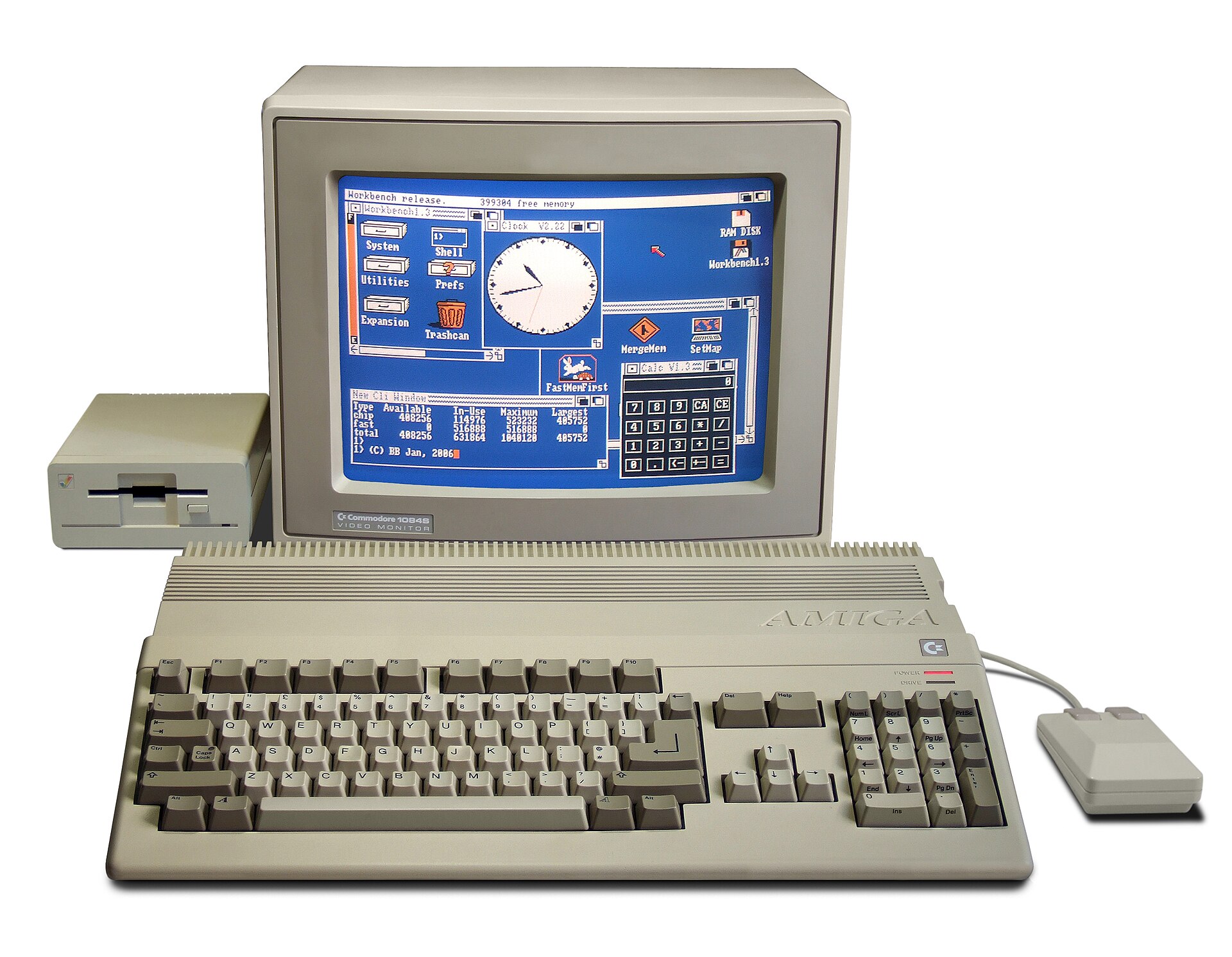
The Commodore Amiga 500, one of the two 16-bit home computers on which Stunt Car Racer made its name. Photo: Bill Bertram, via Wikimedia Commons.
Physics You Could Feel in Your Teeth
Plenty of 1980s racers offered speed. Very few offered consequence. Stunt Car Racer is a one-against-one duel — three laps, a single rival, a limited supply of turbo boost — structured as a league of four divisions, three drivers apiece, with promotion and relegation at the end of each four-race season and two circuits per division. Eight tracks in total sounds modest until you try to survive the upper divisions, where the jumps lengthen, the landings narrow and the margin for a sloppy approach disappears entirely. What elevates the whole thing is the damage model. Land too heavily after taking a crest too fast and the frame rail across the top of your view begins to crack. Clip a wall, drop into a gap or trade paint with your opponent and the crack creeps further. A genuinely heavy impact punches a hole in that rail — structural damage that stays with the car for the rest of the season in the higher divisions and makes every subsequent crack spread faster. When the fracture finally reaches the far side, the car is wrecked and the race ends on the spot.
It is an elegant, legible system, and decades ahead of the soft-body damage modelling later racers would boast about. It changes how you drive. Boost stops being a toy and becomes a budget: spend it on the straights where all four wheels can use it, never waste it while airborne, and lift off before a crest even when lifting feels like surrender, because the landing you save may be your season. Reviewers at the time understood exactly what they were looking at. Scores clustered in the high eighties and nineties — 94 per cent from Zzap!64 for the Commodore 64 edition, 96 per cent from Amstrad Action, 93 per cent from Computer and Video Games — and Your Sinclair‘s readers voted it their game of 1989. The 8-bit versions, programmed for Spectrum and CPC by Pete Cooke and driven by filled 3D on the C64, were marvels of compression; the Amiga and ST editions, which Crammond coded himself last of all, remain the reference versions. Later all-time lists kept the game in circulation long after its hardware faded: Amiga Power placed it tenth among Amiga games, Edge included it in a 2000 ranking of the hundred greatest games, and Polygon still found a slot for it in 2017.
Two Computers, One Cable, No Excuses
If the damage model was ahead of its time, the multiplayer was ahead of almost everyone’s. On the Amiga and Atari ST, two players could race head-to-head by joining two machines together with a null-modem serial cable, each driver watching from their own screen and their own computer. Better still, the link was not fussy about which badge was on the box: an Amiga could be cabled directly to an Atari ST for cross-platform play, a trick almost unheard of in an era when the two camps treated each other as rival tribes. In 1989, networked play meant hauling hardware into the same room, and Crammond made it work across the fiercest divide in British home computing. Anyone who has since enjoyed seamless cross-play between rival consoles is, knowingly or not, enjoying a very old idea. There was talk at MicroProse of pushing further — fields of up to eight cars and a track editor were both considered and both set aside, because either would have cost the game its smoothness. Two cars, rendered perfectly, beat eight cars rendered badly. It is a trade-off more modern studios could stand to relearn.
The Jaguar Announcement of March 2018
Which brings us to the Jaguar, and to the news item this article originally carried on 11 March 2018. The immediate spark was another conversion: Crammond’s Commodore 64 original had just been brought to the Atari 8-bit family by enthusiasts on the AtariAge forums, to considerable applause. Inspired by that effort, Jaguar homebrew coder CyranoJ — already well known for a long-running project bringing Atari ST games across to Atari’s 64-bit console — announced that Stunt Car Racer would follow, this time sourced from the Atari ST edition rather than the C64. Contemporary coverage on Indie Retro News described a project at an early work-in-progress stage: running footage existed and was shared in video form, but there was no audio yet, and the report was careful to frame the port as something still being built, promising the signature material — the Ski Jump, the boosts, the heavy landings — once finished. That framing matters. What was reported in March 2018 was an announcement and an early build, not a finished release, and any honest retelling has to keep it that way.

The Atari Jaguar console with its original controller — the unlikely destination announced for Crammond’s racer in 2018. Photo: Evan-Amos, via Wikimedia Commons.
What Became of the Port: The Record, Checked
So did Jaguar owners ever get to fall off the Ski Jump? The record, checked for this feature, gives a more satisfying answer than the usual homebrew silence — with one important distinction to draw first. There are, confusingly, two Jaguar Stunt Car Racer stories. The older one is commercial: a Jaguar version was rumoured in the console’s 1990s lifetime, surfacing in period press and a retailer catalogue, and reference works list it among the Jaguar’s cancelled games under MicroProse. That version never appeared, and nothing in the 2018 story changes it. The homebrew project is a separate, later thing, and should never be blurred into the old rumour.
For the homebrew port itself, the trail does not go cold after the announcement. CyranoJ’s own long-running AtariAge thread cataloguing his Atari ST ports for the Jaguar — a thread he continues to maintain, and which presents the collection with footage and file downloads — lists Stunt Car Racer among the completed entries, specifically described there as a GPU-accelerated version, with its associated file included in the thread’s downloadable set. In other words, the project progressed well past the silent, audio-free work-in-progress shown in March 2018: the Jaguar’s graphics hardware was put to work on a game originally written for an 8 MHz machine, and the result took its place in the released ST-ports collection rather than joining the long list of announced-and-abandoned Jaguar projects. A forum poster writing in 2020, comparing the Jaguar’s own commercial racers unfavourably with it, already spoke of playing the port as an accomplished fact. What the record does not show is a commercial cartridge release — no boxed edition, no shop listing — and this feature will not invent one. The port’s life is the normal, honourable life of Jaguar homebrew: built by an enthusiast, shared through the AtariAge community in the locked-ROM form used across that ST-ports project, and played by the people who still keep the big cat running.
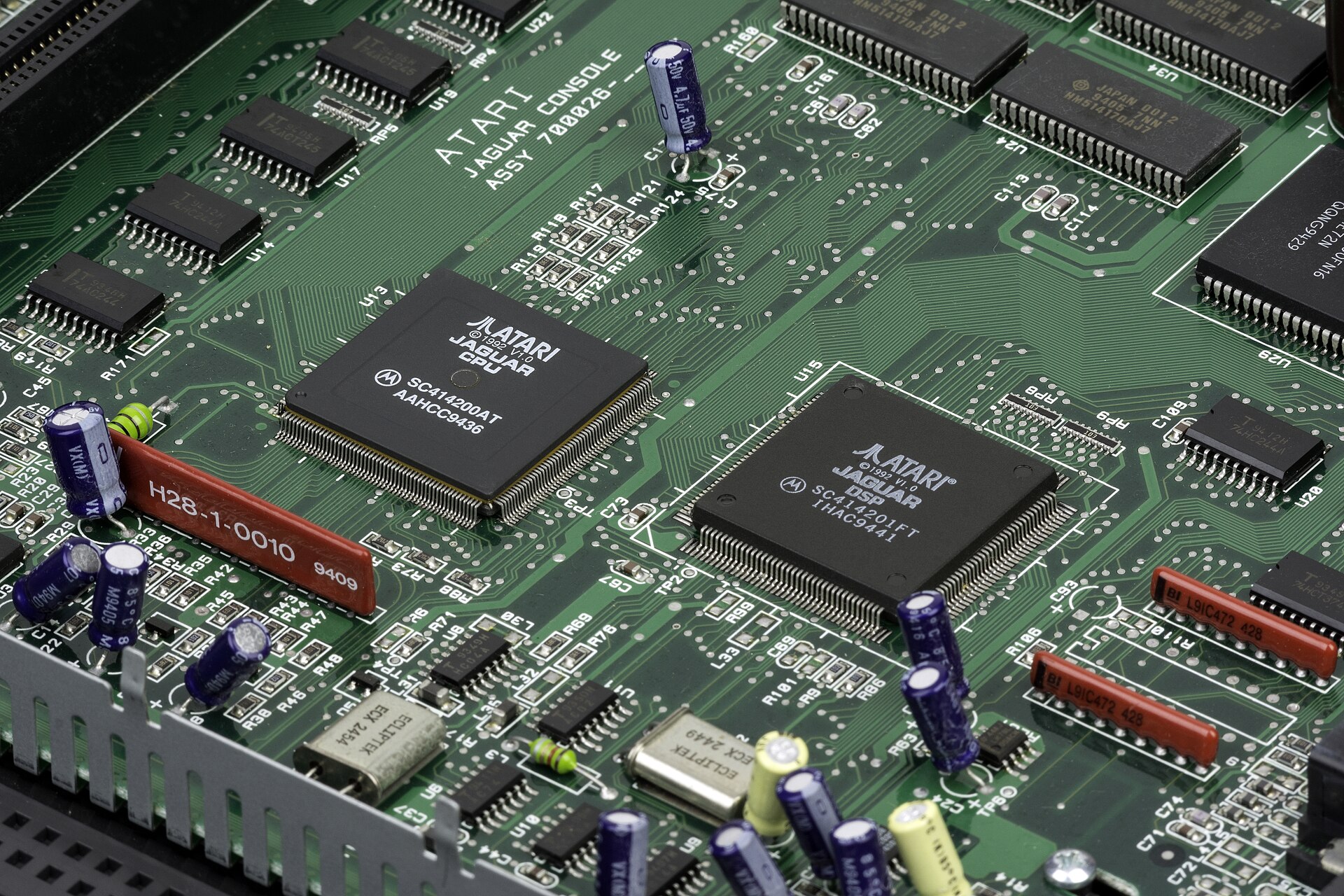
Tom and Jerry, the Jaguar’s custom graphics and sound chips — the hardware a GPU-accelerated port exists to exploit. Photo: Evan-Amos, via Wikimedia Commons.
Why This One Refuses to Stay Retired
Step back, and the Jaguar episode is just one stop on an unusually long afterlife. The game has been converted, in the homebrew era alone, to the Atari 8-bit machines and the BBC Master, reworked for the Commodore Plus/4, given new tracks by fans in the TNT edition, and remade from scratch for modern PCs — while its one official sequel, Stunt Car Racer Pro, announced in 2003, never arrived at all. There is something fitting in that pattern. Crammond’s original was a game about commitment: pick your speed before the jump, because once you are in the air there is nothing left to decide. The people who keep porting it are making the same choice. A 1989 racer with eight tracks, two cars and a crack that spreads across the top of the screen turns out to contain everything a great racing game needs — risk, physics, consequence and one perfect multiplayer trick — and every new machine that can run it becomes a fresh excuse to prove the point all over again, even one as unlikely as the Atari Jaguar.